




Memory Chips Break Wall Street Doubts, Micron Surges 9% in Largest Gain in a Year.
TradingKey - Against the backdrop of marginally easing geopolitical risks and a rebound in risk appetite, the storage sector has seen a recovery in market sentiment, Micron (MU.US) shares surged nearly 8.9% on Wednesday, marking the largest single-day gain since April 9, 2025.
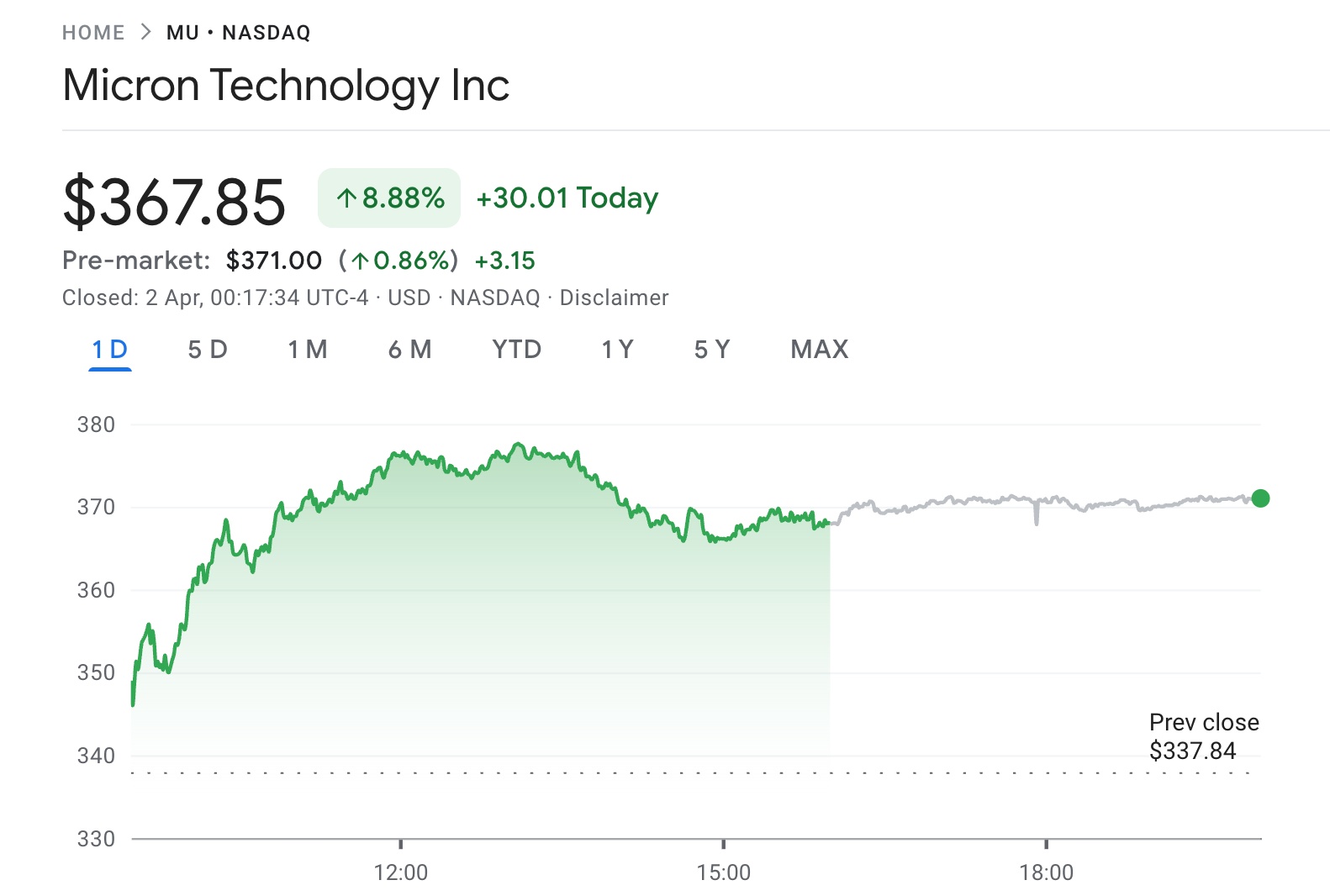
From the perspective of market drivers, this rally primarily stems from a decline in macro risk premiums. As signs of cooling tensions emerge in the Middle East, market pricing for extreme scenarios has quickly corrected, and funds are flowing back into high-beta sectors. Memory, as a quintessential high-beta asset, has become a direct beneficiary of the recovery in risk appetite.
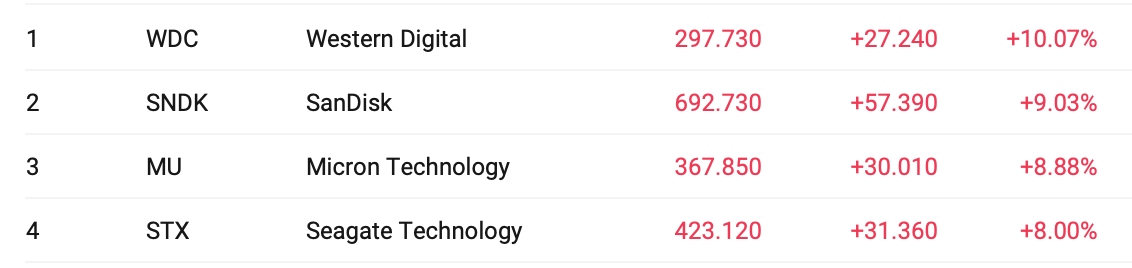
Simultaneously, Western Digital (WDC.US) , Seagate Technology (STX.US) and SanDisk (SNDK.US) recorded gains of approximately 8% to 10% respectively. In Asian markets, Samsung Electronics and SK Hynix also rose significantly, indicating a global consensus among investors to increase exposure to the storage sector.
Previously, Micron's stock price had fallen into technical bear market territory. Core market concerns were concentrated in two areas: the strong cyclical nature of the storage industry and historical oversupply eroding profits.
However, current data shows that the supply-demand structure has shifted significantly. Driven by capital expenditure contractions and tightened capacity discipline over the past two years, combined with the explosion in demand for AI servers and data centers, DRAM and NAND prices have entered an upward cycle. With industrial inventories continuing to deplete, the sector is transitioning from "passive destocking" to "active restocking".
On the valuation front, Micron's current forward P/E ratio of less than 3.5x essentially reflects deep-seated market skepticism regarding a cyclical reversal, rather than a rejection of its profitability.
Evercore ISI analyst CJ Muse noted that management has high confidence in earnings per share exceeding $100 by 2027, stating that the current AI wave represents a structural reshaping of demand for High Bandwidth Memory (HBM) and high-performance storage.
This is the crux of the current market divergence.
Some investors, based on historical experience, still view this rally as a late-cycle rebound and fear an eventual return to oversupply; conversely, bullish investors are betting that "this time is different," arguing that the inelastic demand from AI and cloud computing is altering the industry's long-term supply-demand curve, transforming memory chips from cyclical assets into strategic resources.
In the long run, the storage industry's boom period is deeply tied to AI demand. Over the next few years, AI development is expected to remain the dominant theme, and the storage market is likely to stay in a high-demand cycle. At that point, the storage sector's profitability may be fully validated.
Recommended Articles


