




The Best Quantum Computing Stock to Buy With $1,000 Right Now
Key Points
Nvidia is quietly leveraging its existing hardware and software capabilities to build a quantum artificial intelligence (AI) ecosystem.
Quantum computing stands to upend the capabilities of today's most powerful supercomputers -- unlocking untapped value for Nvidia beyond data centers.
Nvidia's current valuation profile suggests that investors are yet to price in the impacts of next-generation AI opportunities.
- 10 stocks we like better than Nvidia ›
While the world fixates on Nvidia's (NASDAQ: NVDA) chips fueling today's artificial intelligence (AI) boom, the company is quietly positioning itself as a foundational player in quantum computing.
With a modest sum of $1,000 to invest, Nvidia stands out as the smartest quantum AI play -- not because it builds the hardware, but because it already dominates the bridge between classical supercomputers and the quantum future.
Will AI create the world's first trillionaire? Our team just released a report on the one little-known company, called an "Indispensable Monopoly" providing the critical technology Nvidia and Intel both need. Continue »
Quantum computing represents a chance for Nvidia to transform its data center GPU empire into a hybrid computing platform that helps simulate, accelerate, and eventually integrate with true quantum systems -- unlocking exponential growth beyond raw chip sales.

Image source: Getty Images.
Simulating quantum technology
Nvidia's CUDA software platform is already being extended into quantum toolkits, further locking in the company's developer base. These software libraries allow researchers to run quantum circuit simulations directly on Nvidia GPUs. In turn, these tools compress simulations that would take years to process on ordinary computers into hours.
This model helps developers test algorithms for next-generation breakthroughs in chemistry, logistics, and cryptography in real time. The lucrative theme here is that Nvidia's ecosystem is making quantum experimentation both scalable and affordable today -- eliminating the need to wait for fragile, capital-intensive quantum machines.
For investors, an investment in Nvidia already provides exposure to legitimate quantum AI progress, as the company already ships the hardware and software that power over 90% of the world's AI data centers.
Pure-play quantum start-ups like IonQ continue to burn cash on unproven physics. By contrast, Nvidia stands to profit from the simulation layer that every lab and corporation must use first.

Image source: Nvidia.
Quantum AI opens new industry applications for Nvidia
Nvidia's Blackwell GPUs already train trillion-parameter models. Layering quantum-inspired optimization on top of these clusters can, in theory, reduce energy use and unlock optimization problems that classical AI still struggles with.
In terms of use cases, consider that quantum AI could conduct thorough portfolio rebalancing in milliseconds or help with molecular designs that lead to new drug discoveries overnight.
By controlling both sides-- classical computing acceleration and quantum simulation software -- Nvidia is quietly creating a flywheel that none of its rivals in the chip arena can match.
Nvidia's business model is resilient amid a volatile tech sector
Unlike speculative quantum developers that may take decades to deliver a commercially viable product, Nvidia already generates billions in profit from its data center business. This ongoing cash flow machine helps quietly fund the company's other ambitions, such as its quantum roadmap.
Nvidia trades at a forward P/E around 21 -- a multiple that only looks reasonable if you believe the company's future is limited to faster GPUs.
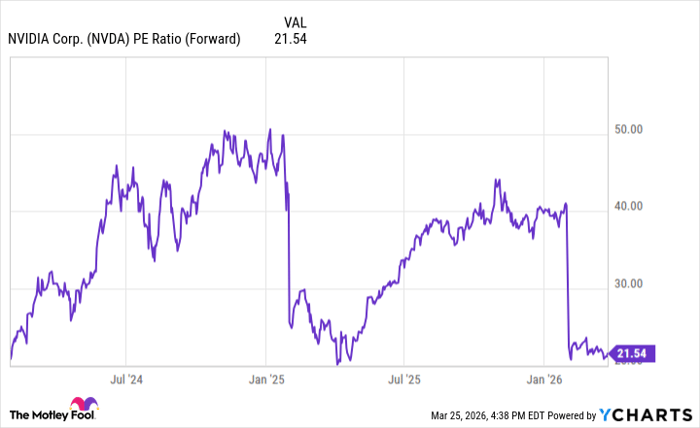
NVDA PE Ratio (Forward) data by YCharts
In reality, these trends illustrate that investors are not yet pricing in ancillary AI-driven growth from quantum simulation royalties, hybrid cloud integrations, and enterprise software licensing. These opportunities sit far beyond the next chip launch.
The market still sees Nvidia as a hardware vendor, but smart investors are recognizing that the company is becoming the de facto operating system for the quantum age. With $1,000, an investor can ride steady data center growth while still capturing asymmetric upside when quantum supremacy arrives.
Should you buy stock in Nvidia right now?
Before you buy stock in Nvidia, consider this:
The Motley Fool Stock Advisor analyst team just identified what they believe are the 10 best stocks for investors to buy now… and Nvidia wasn’t one of them. The 10 stocks that made the cut could produce monster returns in the coming years.
Consider when Netflix made this list on December 17, 2004... if you invested $1,000 at the time of our recommendation, you’d have $503,861!* Or when Nvidia made this list on April 15, 2005... if you invested $1,000 at the time of our recommendation, you’d have $1,026,987!*
Now, it’s worth noting Stock Advisor’s total average return is 884% — a market-crushing outperformance compared to 179% for the S&P 500. Don't miss the latest top 10 list, available with Stock Advisor, and join an investing community built by individual investors for individual investors.
See the 10 stocks »
*Stock Advisor returns as of March 31, 2026.
Adam Spatacco has positions in Nvidia. The Motley Fool has positions in and recommends IonQ and Nvidia. The Motley Fool has a disclosure policy.
Recommended Articles


