




Did Investors Get Too Far Ahead of the Artificial Intelligence (AI) Revolution? The Market Is Starting to Say Yes.
Key Points
Artificial Intelligence is a powerful technology.
The internet was a powerful technology.
Being a powerful technology didn't stop dot-com stocks from collapsing after a rapid advance.
- 10 stocks we like better than Roundhill Magnificent Seven ETF ›
Investors have a long and storied history of finding a good idea and then collectively investing in it. The end result is lemming-like behavior that pushes stocks up to unsustainable heights. This is how bubbles arise. However, at some point, the reality of the investment idea and the price investors are paying collide, and investors start selling, triggering a rush for the exits. That's when the bubble bursts.
The bubble-and-burst dynamic is so common that entire books have been written about it, with examples dating back to the Tulip Bulb Mania of the 1600s. So the fear about an artificial intelligence bubble isn't something to be ignored. If history is any guide, this technological advance will lead to investment excess. There are signs that it may have already reached that point.
Will AI create the world's first trillionaire? Our team just released a report on the one little-known company, called an "Indispensable Monopoly" providing the critical technology Nvidia and Intel both need. Continue »
Artificial intelligence is important, but so was the internet
Tulip bulbs may seem like a silly example of investment excess, but that didn't stop the price of tulip bulbs from skyrocketing and then crashing. More recent examples of bubbles are a bit more serious. In fact, the last big bubble involved a technology of immense importance: the Internet.

Image source: Getty Images.
The dot-com bubble at the turn of the century was huge. The technology-heavy Nasdaq-100 index rose sharply, then lost more than 80% of its value. The bear market took a couple of years to play out and was filled with relief rallies, with tech stocks rising sharply before continuing their declines. It was a very difficult period for investors.
The internet was very real, and it did change the world. But investors got too far ahead of the internet, and many paid a steep price for their exuberance. Artificial intelligence (AI) is very real, and it will likely change the world, too. But AI stocks could be at an important inflection point just like dot-com stocks were over 25 years ago.
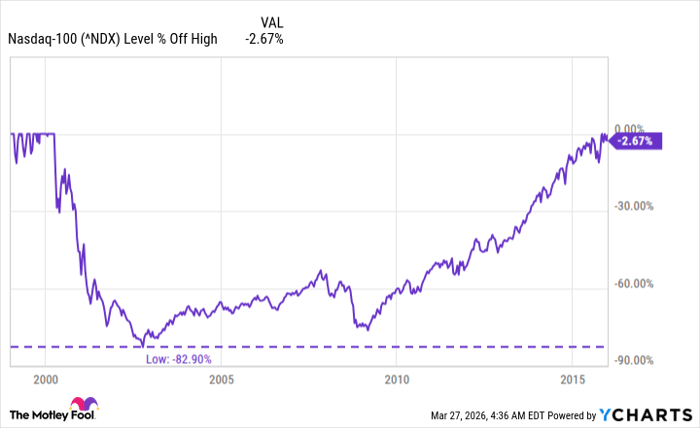
^NDX data by YCharts
The Magnificent Seven are down again
The poster child for the AI revolution is Nvidia (NASDAQ: NVDA). The chipmaker's stock is down around 17% from its 2025 high-water mark. Roundhill Magnificent Seven ETF (NYSEMKT: MAGS) is a collection of high-profile stocks led by Nvidia that drove the market higher for years. That ETF is down roughly as much as Nvidia. That's still correction territory, not a bear market, which requires a fall of 20% or more.
What's interesting is that Nvidia and Roundhill Magnificent Seven ETF both fell more than 20% in early 2025. At that point, concerns about economic growth emerged. Investors are again concerned about economic growth, only this time, a major geopolitical conflict has driven energy prices sharply higher. Higher energy prices are already leading companies to raise prices, thanks to higher transportation costs.
However, the conflict in the Middle East is also impacting businesses in other ways. For example, fertilizer supplies are being impacted. That will make it more costly to produce food or lead to lower crop yields if farmers skimp on these vital plant nutrients. Chemicals and other products made from oil and natural gas are also at issue. A recession seems a much more realistic threat this time around, noting that energy markets will take time to return to normal even after the conflict ends.
The most worrying sign for AI more generally is that some of the early AI market darlings are now deeply out of favor. For example, SoundHound (NASDAQ: SOUN) is down around 75% from its 2025 highs. The highest risk stocks tend to break first when a bubble does, eventually, burst.
Recessions, bear markets, and the long road back
If there is a recession and AI stocks fall, the Nasdaq-100 chart above is a chilling warning. The dot-com crash played out over a couple of years, and it took more than a decade for the index to work its way back to break even. It may be too early to say the AI bubble has officially burst, but taking some money off the table wouldn't be the worst decision to make, either, given that the risk of a recession seems greater now than it did in early 2025.
Should you buy stock in Roundhill Magnificent Seven ETF right now?
Before you buy stock in Roundhill Magnificent Seven ETF, consider this:
The Motley Fool Stock Advisor analyst team just identified what they believe are the 10 best stocks for investors to buy now… and Roundhill Magnificent Seven ETF wasn’t one of them. The 10 stocks that made the cut could produce monster returns in the coming years.
Consider when Netflix made this list on December 17, 2004... if you invested $1,000 at the time of our recommendation, you’d have $503,861!* Or when Nvidia made this list on April 15, 2005... if you invested $1,000 at the time of our recommendation, you’d have $1,026,987!*
Now, it’s worth noting Stock Advisor’s total average return is 884% — a market-crushing outperformance compared to 179% for the S&P 500. Don't miss the latest top 10 list, available with Stock Advisor, and join an investing community built by individual investors for individual investors.
See the 10 stocks »
*Stock Advisor returns as of March 28, 2026.
Reuben Gregg Brewer has no position in any of the stocks mentioned. The Motley Fool has positions in and recommends Nvidia and SoundHound AI. The Motley Fool has a disclosure policy.
Recommended Articles


