




Carnival Gets Hit By the Iran War. Can the Cruise Stock Bounce Back?
Key Points
Carnival beat estimates but cut its full-year profit forecast due to higher fuel costs.
The company introduced new long-term growth targets.
Management has weathered global crises before.
- 10 stocks we like better than Carnival Corp. ›
Carnival (NYSE: CCL) shares were heading lower on Friday, even though the world's largest cruise operator beat estimates in its fiscal first-quarter earnings report.
In the last quarter before the war in Iran roiled the global travel market, Carnival reported revenue of $6.17 billion, up 6.1% from the quarter a year ago and ahead of estimates of $6.14 billion.
Will AI create the world's first trillionaire? Our team just released a report on the one little-known company, called an "Indispensable Monopoly" providing the critical technology Nvidia and Intel both need. Continue »
Management noted record net yields, or revenue per passenger cruise day, and strong close-in demand, or bookings made shortly before departure, showing strong demand to start the fiscal year.
Profits also improved with generally accepted accounting principles (GAAP) operating income increasing from $543 million to $607 million, and adjusted earnings per share rising from $0.13 to $0.20, beating the consensus at $0.18.
Carnival continues to make progress with paying down the large debt balance it acquired during the pandemic, and it reduced its interest expense from $377 million to $291 million. Booking trends remain strong, hitting a new record, a positive leading indicator for future revenue.
However, investors were more focused on Carnival's guidance, given the upheaval in the Middle East. For the full year, management still expects solid growth, calling for net yields to rise 2.75% on a constant currency basis, noting higher ticket prices and strength in onboard spending, but sees cruise costs before fuel up 3.1% in constant currency.
Higher fuel costs are expected to eat into the bottom line as the company lowered its full-year adjusted earnings per share guidance from $2.48 down to $2.21, which it attributed to a headwind of $0.38 due to the spike in oil prices. Notably, Carnival does not hedge on fuel prices, and the company said that a 10% change in fuel cost impacts its bottom line for the year by $160 million, or $0.11 share.
Similarly, it cut its adjusted earnings before interest, taxes, depreciation, and amortization (EBITDA) from $7.63 billion to $7.19 billion.
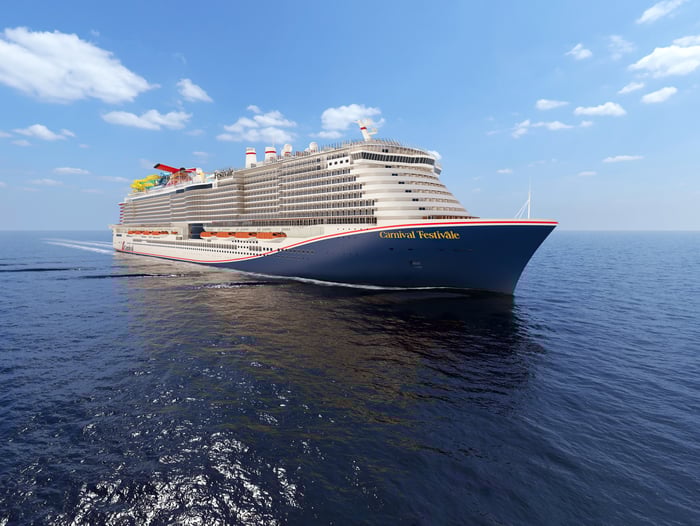
Image source: Carnival.
Carnival's long-term goals
Carnival also unveiled a new set of long-term targets after the company beat its previous SEA Change targets nearly twice as fast as it expected.
Its new program PROPEL calls for:
- Greater than 16% return on invested capital
- More than 50% adjusted EPS growth from 2025
- More than 40% of cash from operations distributed to shareholders (approximately $14 billion)
Management is aiming to achieve all of those goals by 2029 and get to a 2.75 net debt/adjusted EBITDA ratio. To achieve that, the company plans to refurbish its fleet and destinations in the Caribbean and Alaska, and leverage scale and technology.
Where Carnival goes from here
Predicting where oil prices go or what happens with the war isn't a smart way to invest. The conflict could cause a global recession, or it could be over in a few weeks with the Strait of Hormuz back open.
Carnival's forecast for the year assumes Brent crude prices will average $90 in April and May, $85 in the third quarter, and $80 for the fourth quarter, so if oil falls below those marks, it should benefit the company's bottom line.
Like other companies in the travel space, Carnival's financial results are exposed to factors beyond its control, but management's execution over the past few years, as it's rebuilt the business following the pandemic, paid down debt, and delivered record results, has been phenomenal. It also speaks to the ongoing demand for cruises even in a volatile discretionary spending environment.
CEO Josh Weinstein noted, "We have managed through so many challenges, 9/11, the global financial crisis, the Arab Spring, COVID-19, and the Ukraine War," and the company has managed to grow its business and come back stronger.
2026 seems likely to be a volatile year for Carnival, but the business is solid enough to recover over the long term, especially given the stock's attractive valuation at a forward P/E of just 11 now. Investors may have to be patient, but the long-term future still looks bright for Carnival.
Should you buy stock in Carnival Corp. right now?
Before you buy stock in Carnival Corp., consider this:
The Motley Fool Stock Advisor analyst team just identified what they believe are the 10 best stocks for investors to buy now… and Carnival Corp. wasn’t one of them. The 10 stocks that made the cut could produce monster returns in the coming years.
Consider when Netflix made this list on December 17, 2004... if you invested $1,000 at the time of our recommendation, you’d have $503,268!* Or when Nvidia made this list on April 15, 2005... if you invested $1,000 at the time of our recommendation, you’d have $1,049,793!*
Now, it’s worth noting Stock Advisor’s total average return is 898% — a market-crushing outperformance compared to 182% for the S&P 500. Don't miss the latest top 10 list, available with Stock Advisor, and join an investing community built by individual investors for individual investors.
See the 10 stocks »
*Stock Advisor returns as of March 27, 2026.
Jeremy Bowman has no position in any of the stocks mentioned. The Motley Fool recommends Carnival Corp. The Motley Fool has a disclosure policy.
Recommended Articles


