




Tech Stocks Have Lost Over $1 Trillion in Value This Year. Is It Time to Panic -- or Buy?
Key Points
The technology sector has been leading the market higher for several years.
Investors have a bad habit of pushing investment themes to extremes.
When the last technology bubble burst, the pain lasted for years.
- 10 stocks we like better than Roundhill Magnificent Seven ETF ›
Wall Street has a very short memory. That's both good and bad, since remembering the emotional and financial pain of deep bear markets would likely keep most people from ever investing again. But forgetting history means you are doomed to repeat it. With technology stocks losing so much value so far in 2026, a little historical review can help you decide if it's time to jump into tech stocks or not.
The dot-com bubble was huge
More than 25 years ago, a revolutionary technology was set to change the world: the internet. That sounds silly today, given how ubiquitous the internet is now. However, if you are old enough, you remember a time when finding information meant a trip to the library and opening a physical book.
Will AI create the world's first trillionaire? Our team just released a report on the one little-known company, called an "Indispensable Monopoly" providing the critical technology Nvidia and Intel both need. Continue »

Image source: Getty Images.
The internet has, indeed, lived up to the hype. The technology has changed the world. But back at the turn of the century, investors had pushed so-called dot-com stocks to amazing valuation levels. Even companies with no earnings could see their stocks soar based just on the number of clicks their websites generated. The bubble eventually burst in 2000, with the tech-heavy Nasdaq-100 losing 80% of its value before it started to turn higher again. The decline took around two years to play out.
Those two facts are worth repeating. The decline lasted two years, and it reduced the value of the Nasdaq-100 index by 80%.
The current tech drawdown doesn't compare
The magnificent seven stocks that have basically led the market higher have pulled back sharply in 2026. Roundhill Magnificent Seven ETF (NYSEMKT: MAGS) is down about 10% in less than three months. Nvidia (NASDAQ: NVDA), the poster child for the artificial intelligence sector, is down by a similar amount.
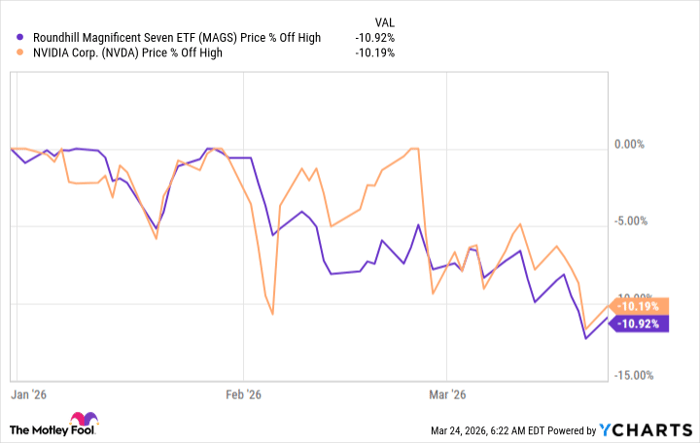
MAGS data by YCharts
The dollar value of the current tech pullback is large, but the actual percentage decline is still modest by historical standards. In fact, the exchange-traded fund meant to track the so-called Magnificent Seven hasn't even entered bear-market territory, which won't happen until the decline hits 20%. If you are worried about the AI bubble bursting, this decline is nowhere near the point where you would think the bubble has finally popped.
That leads to two different views of the situation. More aggressive investors might see the current pullback as a correction. That could make it a temporary opportunity to buy tech stocks again before they resume their upward climb. That view, however, requires you to believe that already high valuations can continue to rise.
Roundhill Magnificent Seven ETF's average price-to-earnings ratio of 28.5x is roughly in-line with the S&P 500 index's average P/E of 27.5x. The S&P 500 index is trading just 5% below its all-time highs. For reference, Nvidia's P/E is 35x, well above the market and the average for the Magnificent Seven. Only the most aggressive investors should see the current tech pullback as a time to buy technology stocks while they are "on sale."
Most investors should tread with caution
At the end of the day, the technology sector's pullback in 2026 isn't particularly large. It most certainly isn't enough to suggest that the AI bubble has burst.
While it may not be time to panic, more conservative investors might want to consider taking some profits just in case this drawdown actually turns into a technology bear market. And if the AI bubble does actually pop, if history is any guide, the declines could be huge, and it could take years before tech stocks start to turn higher again.
That said, the other lesson from the dot-com bubble is that overbuilding during the bubble helped to support the technology's widespread adoption. So there could be even bigger opportunities ahead, including well beyond technology stocks, for AI after the current exuberance fades.
Should you buy stock in Roundhill Magnificent Seven ETF right now?
Before you buy stock in Roundhill Magnificent Seven ETF, consider this:
The Motley Fool Stock Advisor analyst team just identified what they believe are the 10 best stocks for investors to buy now… and Roundhill Magnificent Seven ETF wasn’t one of them. The 10 stocks that made the cut could produce monster returns in the coming years.
Consider when Netflix made this list on December 17, 2004... if you invested $1,000 at the time of our recommendation, you’d have $497,659!* Or when Nvidia made this list on April 15, 2005... if you invested $1,000 at the time of our recommendation, you’d have $1,095,404!*
Now, it’s worth noting Stock Advisor’s total average return is 912% — a market-crushing outperformance compared to 185% for the S&P 500. Don't miss the latest top 10 list, available with Stock Advisor, and join an investing community built by individual investors for individual investors.
See the 10 stocks »
*Stock Advisor returns as of March 26, 2026.
Reuben Gregg Brewer has no position in any of the stocks mentioned. The Motley Fool has positions in and recommends Nvidia. The Motley Fool has a disclosure policy.
Recommended Articles


