




3 Important Reminders for Investors When the Stock Market Hits "Extreme Fear"
Key Points
The current market reading may register as "extreme", but it's not actually all that unusual.
Smart investors recognize that any substantial pullback can be a long-term buying opportunity.
Recoveries are not only reliable, but typically take shape sooner than you might expect.
- 10 stocks we like better than S&P 500 Index ›
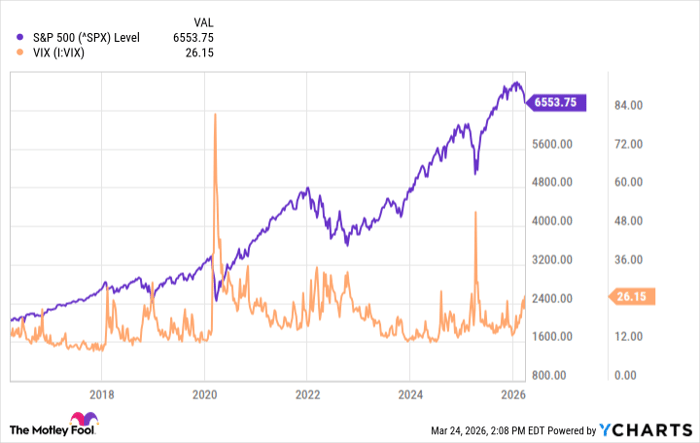
With only the occasional short-lived reprieve, since the beginning of this year investor worry has grown as stocks have lost ground. The CBOE S&P 500 Volatility index -- often referred to as the market's "fear gauge," or VIX -- has risen to a multi-month high. Often, once such an extreme level is reached, it precedes a full-blown market correction that catapults the VIX to a multi-year peak. Investors are understandably nervous about what it all means right now.
If you're one of these nervous investors, here are three important things to remember.
Will AI create the world's first trillionaire? Our team just released a report on the one little-known company, called an "Indispensable Monopoly" providing the critical technology Nvidia and Intel both need. Continue »
1. None of this is actually all that unusual
Although it feels like it's been a while since the stock market has seriously struggled, sizable setbacks aren't actually all that uncommon... even in the middle of bull markets.
Data compiled by mutual fund company Fidelity puts things in perspective, indicating that the S&P 500 (SNPINDEX: ^GSPC) has suffered at least one setback in excess of 5% in all but three years since 1980, while in nearly half of those years the S&P 500 took a tumble of 10% or more. Fear (as measured by the VIX) soared each and every time it happened.
Yet each time it happened, the market eventually reached new record highs.
^SPX data by YCharts
2. Yes, this is a buying opportunity
And it's that last highlight that should inspire nervous investors to reframe their view of what's happening right now -- the fact that every single pullback the market's been through since its existence has been a buying opportunity.
This presumes, of course, you're thinking long-term. If you're only looking to plug into the market's next near-term bullish swing or short-term bounce, you're arguably playing with fire.
3. Just don't get too picky about price
Why's that? Because timing the market is difficult enough to do in any time frame, but it's practically impossible to do with any successful consistency in the short run.
There's certainly always a timing "guru" out there that will suggest otherwise. They're usually selling access to their secret algorithm, though; just check their track record. There's a reason that even most ordinary mutual fund managers underperform their benchmark indexes.

Image source: Getty Images.
It's true! As Standard & Poor's ongoing analysis of large-cap mutual funds available to U.S. investors indicates, over the past five years, 89% of these funds underperformed the S&P 500. For the past decade, the number exceeds 85%. It's a testament to the difficulty of trying to perfectly time the entry and exit of any trade -- a struggle verified by the persistent underperformance of most hedge funds.
The point is, holding out for the exact market bottom is likely to do more long-term harm than good simply because you're not likely to know when and where the ultimate bottom is being made. Just buying quality stocks while they're down from a major high at any price is rewarding enough in the long run.
This might help inspire you to not overthink it: exchange-traded fund (ETF) giant Invesco calculates the market's average time to recover from a pullback of 5% to 10% is a mere three months, while a correction of between 10% and 20% only takes an average of eight months to unwind. Even if you're just capturing a decent-sized chunk that recovery, you're doing well enough, and possibly better than most.
Should you buy stock in S&P 500 Index right now?
Before you buy stock in S&P 500 Index, consider this:
The Motley Fool Stock Advisor analyst team just identified what they believe are the 10 best stocks for investors to buy now… and S&P 500 Index wasn’t one of them. The 10 stocks that made the cut could produce monster returns in the coming years.
Consider when Netflix made this list on December 17, 2004... if you invested $1,000 at the time of our recommendation, you’d have $497,659!* Or when Nvidia made this list on April 15, 2005... if you invested $1,000 at the time of our recommendation, you’d have $1,095,404!*
Now, it’s worth noting Stock Advisor’s total average return is 912% — a market-crushing outperformance compared to 185% for the S&P 500. Don't miss the latest top 10 list, available with Stock Advisor, and join an investing community built by individual investors for individual investors.
See the 10 stocks »
*Stock Advisor returns as of March 26, 2026.
James Brumley has no position in any of the stocks mentioned. The Motley Fool has no position in any of the stocks mentioned. The Motley Fool has a disclosure policy.
Recommended Articles


