




SoFi: The Short Thesis
Key Points
SoFi is a one-stop-shop digital bank that generates most of its revenue from student and personal lending.
In its report, Muddy Waters asserts that SoFi has inflated fair value gains on its loan portfolios.
According to the firm, SoFi uses loan charge-off and discount rates that are much too low to calculate its fair value gains, which are part of a larger "financial engineering treadmill."
- 10 stocks we like better than SoFi Technologies ›
The independent research firm and short-seller, Muddy Waters Research, recently published a 28-page short report on the popular digital bank SoFi (NASDAQ: SOFI). SoFi pitches itself as a one-stop-shop digital bank that can meet all financial needs, largely targeting a high-income population.
The bank's products and services include personal, student, and home mortgage loans, an online investment brokerage, depository accounts, and other personal finance tools. SoFi also owns a bank technology business that provides core processing and payments technology to fintechs and other banks.
Will AI create the world's first trillionaire? Our team just released a report on the one little-known company, called an "Indispensable Monopoly" providing the critical technology Nvidia and Intel both need. Continue »
Muddy Waters said it was shorting SoFi due to what it believes are improper accounting practices, financial engineering, and a complex web of off-balance-sheet transactions that distort the business's actual performance.
Here is the short thesis for SoFi.
Image source: Getty Images.
The fair value marks are a core issue
The first thing to understand about SoFi is that the company generates most of its revenue from lending, specifically personal unsecured loans. It does this by originating loans that it sells directly to investors, including private credit. SoFi originates loans that it holds on its balance sheet for several months before selling them to investors through various distribution channels and its loan platform business (LPB).
SoFi chooses to mark its loans to fair value each quarter, using a discounted cash flow analysis to arrive at the marks, which includes inputs such as weighted average loan yield, annual default rate, prepayment rates, and a discount rate to determine the present value of future cash flows.
For many quarters now, the fair value adjustments have been positive for both the company's student and personal loan portfolios. At the end of 2025, the cumulative fair value adjustments were over $1.1 billion on the personal loan book and over $723 million on the student loan book.
Muddy Waters argues that these fair value marks are incorrectly calculated, which in turn makes earnings before interest, taxes, depreciation, and amortization (EBITDA) look hundreds of millions of dollars better than it really is. Muddy Waters claims that SoFi is using inputs in its DCF statement that are "materially misleading," whether it's the charge-off rate (expected loan losses) or discount rate.
Loan charge-offs appear too low
For instance, SoFi reported a personal loan net charge-off rate of 2.80% in the fourth quarter of 2025. But Muddy Waters said this does not reflect delinquent loans the company sells prior to having to classify a loan as a charge-off, which must occur after a buyer is late on payments for 120 days. The charge-off rate also does not disclose loan charge-offs that occur in off-balance-sheet variable interest entities (VIEs).
Now, SoFi publicly discloses that its personal loan charge-off rate would have been 4.4% had it not sold delinquent loans. But this still does not include loans that the bank sells to VIEs that it retains servicing on.
Using court documents to conduct its research, Muddy Waters essentially alleges that SoFi has been selling loans to a pass-through entity, typically Cantor Fitzgerald.
Then SoFi makes a secured loan to a third party, which is typically a trust, at a below-market rate. The trust then uses the loan to buy the loans from Cantor and pledges the same SoFi loans it just bought from Cantor back to SoFi as collateral. Then, SoFi books a premium on the servicing asset of those loans to validate its fair value marks to the market.
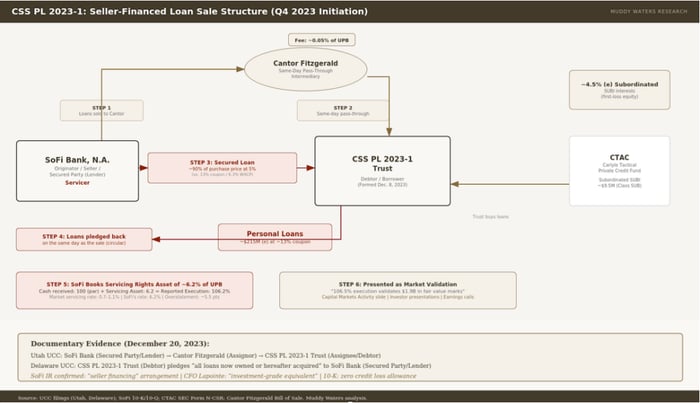
Image source: Muddy Waters Research.
Muddy Waters alleges that if the charge-offs from the VIEs were included, SoFi's personal loan charge-off rate would be closer to 6%. The firm also points to public data from rating agencies Fitch and DRBS on SoFi's asset-backed securitizations (ABS). Both rating agencies have continually revised their default assumptions for SoFi ABS loan pools higher in recent years, and both suggest an annual default rate of about 5%, which Muddy Waters believes will only continue to rise to its assumption of closer to 6%.
The servicing rights asset is marked too high
Muddy Waters also believes SoFi is using an inflated servicing rights asset (SRA), a premium the servicing company takes to reflect servicing income likely to be generated over the loan's remaining life. The 6.2% rate for personal loans and the 2.9% rate for student loans are well above market rates, Muddy Waters claims.
Muddy Waters also notes that the SRA in SoFi's LPB is also much lower than the premium SoFi takes on loan sales. The LPB is a business in which SoFi originates loans on behalf of third parties, such as private credit. SoFi earns origination and servicing fees from these transactions. This is important because the SRA accounts for a large share of the gains SoFi makes on loan sales.
Other irregularities
Muddy Waters also believes that the LPB business and off-balance sheet transactions require significant capital. SoFi has to provide loss protection for the LPB business in order to get investors on board. Secured loans used for off-balance-sheet transactions are also capital-intensive. This explains why SoFi raised billions of capital in 2024 and 2025, effectively increasing its diluted shares outstanding by about 30% between 2024 and 2025.
In addition to the low charge-off rate, Muddy Waters said it does not understand the low discount rates SoFi uses in calculating the fair value marks. In 2025, SoFi used a 3.89% discount rate to calculate the fair value marks for its student loan portfolio, which was 27 basis points below the 10-year Treasury Yield. It seems odd to imply that student loans are less risky than U.S. government-backed bonds.
Muddy Waters also found other irregularities. For instance, SoFi capitalized $194 million in marketing costs, in what Muddy Waters believes is an attempt to boost the company's adjusted EBITDA.
Muddy Waters also says it found $312 million of unrecorded debt in the LPB business. When inputting higher charge-off and discount rates into the DCF model for fair value marks, adjusting down the SRA, and correctly accounting for capitalized marketing spend and the alleged unrecorded liabilities, Muddy Waters revises SoFi's adjusted EBITDA down by 90% to about $103 million.
The research firm also believes that much of this financial engineering has been conducted by management to earn performance bonuses. While management has not reported any stock sales, Muddy Waters notes that CEO Anthony Noto and CFO Chris Lapointe have extracted over $58 million through instruments called prepaid variable forward contracts, which allow large investors to tap the liquidity of their stock while deferring taxes and avoiding a formal sale.
How to approach the stock?
SoFi was not happy with the short report. The company issued a response, calling it "inaccurate" and saying it "demonstrate[s] a fundamental lack of understanding of our financial statements and business." SoFi also said it intends to explore potential legal action.
Following the report, Noto also purchased about half a million shares of SoFi stock.
Ultimately, the report is very complex. While I can't verify the off-balance-sheet allegations, I do think there are several aspects of SoFi's business that are concerning.
The fair value marks have been a consistent red flag for some time, as several Wall Street analysts have noted previously. SoFi uses much more favorable inputs in its DCF marks than its peers do, even though it makes similar loans. SoFi's competitors often report selling personal loans at a discount to fair value and therefore taking negative fair value marks.
Personal lending is a high-loss business, and I see no indication that SoFi is any better at it than anyone else. I think reports from the ratings agencies support this argument. I would also point out the cyclicality of the personal loan business that investors should be aware of.
In a high-rate environment, like the one in 2022 and 2023, institutional loan buyers face a higher cost of capital, so they demand higher returns, meaning personal lenders have to charge higher loan rates, effectively pricing many borrowers out of the market. A high-rate environment, or a recession, can also send loan buyers to the sidelines if they are worried about deteriorating credit.
While SoFi has the ability to hold loans on the balance sheet for an extended period, I do think that a difficult environment for loan buyers would really hit LPB hard and lead to a significant decline in revenue in that segment.
Muddy Waters has taken some flak on social media for publicly stating in its report that it plans to cover most, if not all, of its short position after publishing its report. But I'm guessing this is because it can be difficult to short stocks with extremely popular followings like SoFi.
At face value, SoFi's valuation has become more attractive. The stock trades at 29 times forward earnings, nearly 14 times adjusted EBITDA, and about 5 times forward adjusted revenue.
But I would be very worried about what could happen to adjusted EBITDA if Muddy Waters' claims prove true.
I myself have never really understood the fascination with SoFi, as it runs many commoditized businesses that customers simply choose based on who offers the most competitive rate. While management frequently discusses the advantage of being a purely digital bank, most banking products are now offered online.
I wouldn't necessarily short the company because it could be risky given the stock's loyal following, but I also wouldn't buy it.
Should you buy stock in SoFi Technologies right now?
Before you buy stock in SoFi Technologies, consider this:
The Motley Fool Stock Advisor analyst team just identified what they believe are the 10 best stocks for investors to buy now… and SoFi Technologies wasn’t one of them. The 10 stocks that made the cut could produce monster returns in the coming years.
Consider when Netflix made this list on December 17, 2004... if you invested $1,000 at the time of our recommendation, you’d have $503,592!* Or when Nvidia made this list on April 15, 2005... if you invested $1,000 at the time of our recommendation, you’d have $1,076,767!*
Now, it’s worth noting Stock Advisor’s total average return is 913% — a market-crushing outperformance compared to 185% for the S&P 500. Don't miss the latest top 10 list, available with Stock Advisor, and join an investing community built by individual investors for individual investors.
See the 10 stocks »
*Stock Advisor returns as of March 24, 2026.
Bram Berkowitz has no position in any of the stocks mentioned. The Motley Fool has no position in any of the stocks mentioned. The Motley Fool has a disclosure policy.
Recommended Articles


