




Should You Buy Gold After Its 19% Correction? Here's What History Says.
Key Points
Investors use gold as a hedge against heightened economic and political uncertainty, because it has been a reliable store of value for thousands of years.
The shiny yellow metal rose 64% last year, trouncing its average annual return of 8% over the last 30 years.
There is room for gold to continue trending higher from here, but investors should manage their expectations.
- 10 stocks we like better than SPDR Gold Shares ›
Gold has been a widely recognized store of value for thousands of years, and it's still legal tender in many U.S. states today. However, given the astronomical (and rising) value of a single ounce, you probably won't find anybody trading the yellow metal for groceries or gas.
Most gold demand comes from investors who use it to hedge against inflation, economic uncertainty, and political turmoil. Buying physical metal is the surest way to achieve this, but many investors opt for exchange-traded funds (ETFs) like the SPDR Gold Shares ETF (NYSEMKT: GLD) because they are cost effective and far more convenient to own.
Will AI create the world's first trillionaire? Our team just released a report on the one little-known company, called an "Indispensable Monopoly" providing the critical technology Nvidia and Intel both need. Continue »
Gold soared by 64% in 2025, and while it's hanging on to a modest gain in 2026, it's down by around 19% from its January peak. Could this dip be the ultimate long-term buying opportunity? Here's what history says.

Image source: Getty Images.
The factors driving gold higher
Gold's status as a store of value largely stems from its scarcity. Only 219,890 tons of the yellow metal have been pulled from the ground throughout human history, compared to 1.7 million tons of silver and billions of tons of other commodities like coal and iron ore.
Gold is an excellent conductor of electricity, which would normally make it very useful in semiconductors and electronic devices, but because of its limited supply and high cost, manufacturers opt for other options like silver instead. Therefore, outside of jewellery making, gold isn't really used in industrial settings.
Investors like Warren Buffett have steered clear of gold because it doesn't produce any revenue or earnings, whereas other investors like Ray Dalio and Paul Tudor Jones love the yellow metal as a hedge against inflation and an increasing money supply.
Until 1971, the U.S. operated under the gold standard which prevented the government from printing additional money unless it had an equal amount of physical metal to match. Since abandoning that mechanism, money supply has exploded, causing the U.S. dollar to lose around 90% of its purchasing power. As a result, gold's value has skyrocketed in dollar terms:
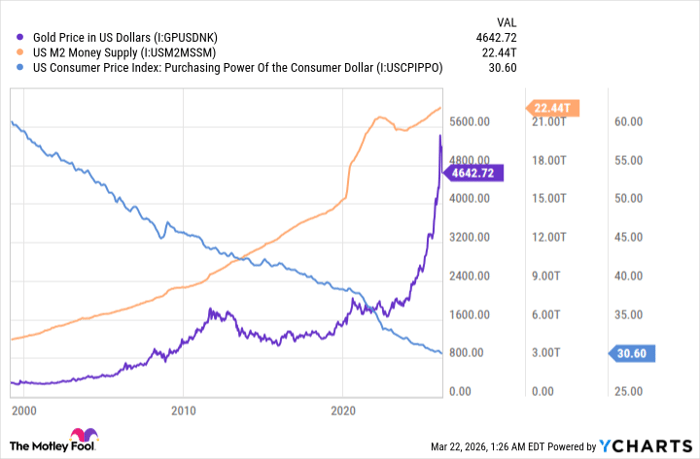
Gold Price in US Dollars data by YCharts
The U.S. government ran a $1.8 trillion budget deficit during fiscal 2025 (ended Sept. 30), and it's on track for another multitrillion-dollar deficit in fiscal 2026. As a result, the national debt rose to a record high of $39 trillion last week.
Paul Tudor Jones says that throughout history, governments often try to "inflate away their debt" by printing more money, which is why his hedge fund, Tudor Investment Corporation, increased its position in the SDPR Gold Shares ETF by a whopping 49% during the final quarter of 2025. For similar reasons, Ray Dalio recently recommended investors park 15% of their portfolios in gold.
History points to more upside, but investors should manage their expectations
Annual returns of more than 60% certainly aren't normal for gold. In fact, it has averaged an annual gain of just 8% over the last 30 years, underperforming the S&P 500 (SNPINDEX: ^GSPC) stock market index, which returned 10.7% per year over the same period.
A rising money supply and a declining dollar are technically tailwinds for all hard assets, not just gold, and since stocks also produce internal revenue and earnings growth, it's no surprise the S&P consistently delivers higher returns.
That doesn't mean investors should pile into the stock market and ignore gold. Diversification is the key to success over the long term, and while it makes sense to assign a higher weighting to stocks because of their superior performance, owning a small amount of gold can help protect investors during times of heightened economic and political uncertainty. Therefore, the recent 19% dip might be a good entry point.
As I mentioned at the top, the SPDR Gold Shares ETF is a convenient way to own gold. It doesn't require physical storage or insurance (which can be expensive), and it can be bought and sold instantly through any major investing platform, whereas physical metal can be tricky to sell in a pinch.
The ETF isn't free to own because it has an expense ratio of 0.4%, which is the proportion of the fund deducted each year to cover management costs. This means an investment of $50,000 will incur an annual fee of around $200, but that is probably still cheaper than storing and insuring an equivalent amount of physical metal.
Should you buy stock in SPDR Gold Shares right now?
Before you buy stock in SPDR Gold Shares, consider this:
The Motley Fool Stock Advisor analyst team just identified what they believe are the 10 best stocks for investors to buy now… and SPDR Gold Shares wasn’t one of them. The 10 stocks that made the cut could produce monster returns in the coming years.
Consider when Netflix made this list on December 17, 2004... if you invested $1,000 at the time of our recommendation, you’d have $495,179!* Or when Nvidia made this list on April 15, 2005... if you invested $1,000 at the time of our recommendation, you’d have $1,058,743!*
Now, it’s worth noting Stock Advisor’s total average return is 898% — a market-crushing outperformance compared to 183% for the S&P 500. Don't miss the latest top 10 list, available with Stock Advisor, and join an investing community built by individual investors for individual investors.
See the 10 stocks »
*Stock Advisor returns as of March 24, 2026.
Anthony Di Pizio has no position in any of the stocks mentioned. The Motley Fool has no position in any of the stocks mentioned. The Motley Fool has a disclosure policy.
Recommended Articles


