




Taiwan Semiconductor Controls 72% of the Global Chip Market, and the Stock Could Surge in 2026
Key Points
Taiwan Semiconductor controls 72% of the semiconductor foundry market.
It produces chips for every major chip designer from Apple to Nvidia.
The company is demonstrating incredible growth with even more projected through the end of the decade.
- 10 stocks we like better than Taiwan Semiconductor Manufacturing ›
The semiconductor industry is one of most important in the world.
Virtually all modern technology relies on semiconductors in some way shape or form, from the device you're reading this on to the most sophisticated supercomputers in the world.
Will AI create the world's first trillionaire? Our team just released a report on the one little-known company, called an "Indispensable Monopoly" providing the critical technology Nvidia and Intel both need. Continue »
Semiconductors are the reason the iPhone in your pocket has millions of times the computational horsepower in it than NASA had when it put men on the moon.
And the majority of these chips, about 60% of the world's supply, are produced in Taiwan by a single company, Taiwan Semiconductor Manufacturing (NYSE: TSM).
That company is also the reason 90% of the most advanced semiconductor chips are also made in Taiwan.
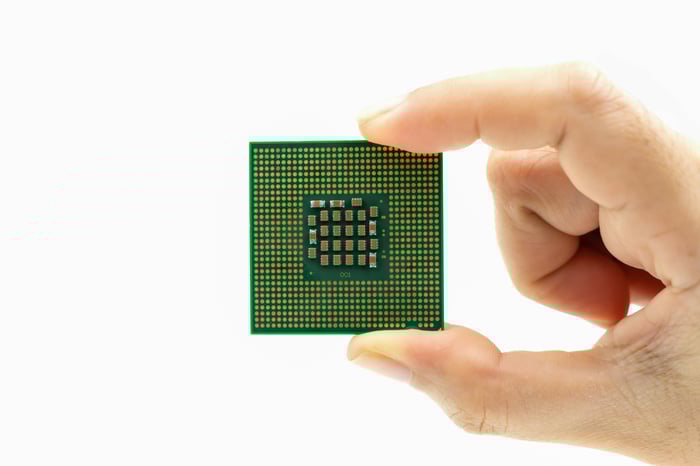
Image source: Getty Images.
The invisible monopoly
In all, Taiwan Semiconductor has a near-monopoly in the semiconductor market. It controls 72% of the pure foundry market as of the end of Q3 2025. Its nearest competitor is Samsung (OTC: SSNL.F) with a paltry 7% market share.
But the reason it flies under the radar is the fact that Taiwan Semiconductor is a pure foundry company. It doesn't design any of the chips it produces. All it does is provide the raw manufacturing base needed by the companies that do design chips.
And the company's list of clients includes every major chip designer in the world.
Taiwan Semiconductor's two biggest customers are Apple and Nvidia.
However, it also produces chips for Advanced Micro Devices, Broadcom, Intel, Qualcomm, and many more.
So, if it just produces chips, how does it have such a stranglehold on the market? Couldn't those chip designers go to someone else or, better yet, build their own manufacturing base?
An unassailable fortress
They could, but semiconductor factories are incredibly expensive. The extreme ultraviolet (EUV) lithography machines needed to make advanced semiconductors cost almost half a billion dollars per unit.
It initially cost Taiwan Semiconductor $12 billion to build its factory in Arizona. That investment has since swelled to $165 billion to expand that one factory to three.
By comparison, Intel, looking to claw back some market share from Taiwan Semiconductor is looking to spend $100 billion in Ohio to build its own manufacturing center. But that project has repeatedly been delayed and the first plant at the complex is now not scheduled to be completed until 2030.
By that time, Taiwan Semiconductor's Arizona expansion should be just about complete with production in factory No. 2 slated for 2028 and No. 3 by the end of the decade.
So, to say the company has a strong moat protecting its dominance would be something of an understatement. Nobody is building up to Taiwan Semiconductor's production capabilities easily.
The perks of (near) monopoly
And having a near-monopoly on an industry as critical as semiconductors is about as lucrative as you'd think.
Taiwan Semiconductor generated $122.4 billion in revenue for 2025, up 35.9% over 2024 and its diluted earnings per share (EPS) for the year grew 46.4%.
Plus, despite how expensive it is to build and maintain semiconductor factories, the company has a net profit margin of 45%.
That growth is set to continue as well. The company projects 2026 revenue will increase 30% over 2025 and anticipates a revenue compound annual growth rate (CAGR) of 25% through 2029.
Taiwan Semiconductor is sitting pretty as the king of the semiconductor industry and its reign looks like it will be a long one.
Should you buy stock in Taiwan Semiconductor Manufacturing right now?
Before you buy stock in Taiwan Semiconductor Manufacturing, consider this:
The Motley Fool Stock Advisor analyst team just identified what they believe are the 10 best stocks for investors to buy now… and Taiwan Semiconductor Manufacturing wasn’t one of them. The 10 stocks that made the cut could produce monster returns in the coming years.
Consider when Netflix made this list on December 17, 2004... if you invested $1,000 at the time of our recommendation, you’d have $495,179!* Or when Nvidia made this list on April 15, 2005... if you invested $1,000 at the time of our recommendation, you’d have $1,058,743!*
Now, it’s worth noting Stock Advisor’s total average return is 898% — a market-crushing outperformance compared to 183% for the S&P 500. Don't miss the latest top 10 list, available with Stock Advisor, and join an investing community built by individual investors for individual investors.
See the 10 stocks »
*Stock Advisor returns as of March 22, 2026.
James Hires has no position in any of the stocks mentioned. The Motley Fool has positions in and recommends Advanced Micro Devices, Apple, Intel, Nvidia, Qualcomm, and Taiwan Semiconductor Manufacturing and is short shares of Apple. The Motley Fool recommends Broadcom. The Motley Fool has a disclosure policy.
Recommended Articles


