




1 Glorious Growth Stock Down 84% to Buy on the Dip in March
Key Points
Docusign's contract management software allowed businesses to continue making deals during the worst of the COVID-19 pandemic.
Demand faded when social conditions returned to normal after 2022, which sent Docusign stock plunging.
Docusign's new AI-powered agreement management platform is breathing life back into its business, and it could ignite a recovery in its stock.
- 10 stocks we like better than Docusign ›
Docusign (NASDAQ: DOCU) went public in 2018 at a price of $29 per share, and by September 2021, the stock had soared more than tenfold to an all-time high of $310. The company's digital agreement management software experienced blistering demand during the COVID-19 pandemic, because it allowed businesses to continue closing deals even in the face of social restrictions and lockdowns.
Unfortunately, demand tapered off when conditions returned to normal, and Docusign stock has since plummeted by 84% from its 2021 peak. But the company continues to innovate. It launched an entirely new platform called Intelligent Agreement Management (IAM) in 2024, which uses artificial intelligence (AI) to make contract management processes even simpler.
Will AI create the world's first trillionaire? Our team just released a report on the one little-known company, called an "Indispensable Monopoly" providing the critical technology Nvidia and Intel both need. Continue »
IAM is experiencing strong demand, which is driving steady growth in Docusign's overall revenue and earnings. As a result, its beaten-down stock is starting to look attractive, and here's why it could be a great long-term buy.

Image source: Getty Images.
IAM is a game-changer for businesses
Citing a study by global consulting firm Deloitte, Docusign says businesses collectively waste 55 billion hours every year due to poor contract management processes, costing them a staggering $2 trillion in economic value. The company calls this the "agreement trap," and it formulated the IAM platform to rectify it.
IAM offers an expanding list of AI features, like Agreement Desk, which is a centralized digital hub where all parties to a contract can collaborate on the details. An AI agent lays out the required steps, makes recommendations, and can even populate data to streamline the drafting process. Agreement Desk keeps a transparent log of all changes so that every stakeholder can track the process.
Then there is Navigator, a digital repository where businesses can store all of their agreements. Using AI, it pulls data from every contract and makes it discoverable via a search function, so employees no longer have to dig through thousands of pages manually to find the information they need. Docusign says over 200 million agreements had been uploaded to Navigator as of Jan. 31, up from 150 million in December, so adoption is skyrocketing.
Steady revenue and earnings growth
Docusign generated $3.2 billion in total revenue during its fiscal year 2026 (ended Jan. 31), which was a modest 8% increase from the previous year. The IAM platform was launched just 18 months ago, and it's already generating $350 million in annual recurring revenue (ARR), which is more than 10% of Docusign's total ARR. If adoption continues at the current pace, IAM could drive an acceleration in the company's overall top-line growth.
Docusign also had a strong year at the bottom line, with $309.1 million in generally accepted accounting principles (GAAP) net income. That was down from its profit of $1.06 billion in fiscal 2025, but that particular result was heavily influenced by a large one-off tax benefit.
If we exclude one-off items and also non-cash expenses like stock-based compensation, Docusign's fiscal 2026 non-GAAP (adjusted) profit came in at $803.1 million, which was actually a 7% increase from fiscal 2025.
The company achieved these results by carefully managing costs. Its total operating expenses grew by less than 5% during fiscal 2026, and since its revenue increased at a much faster pace, more money flowed to the bottom line. When the gap between the amount of money coming in and the amount of money going out widens, the net result is more profit.
Docusign stock is trading at an attractive level
Docusign stock is currently trading at a price-to-sales (P/S) ratio of just 3.1, which is close to the cheapest level since it went public in 2018. It's also a very steep discount to its long-term average P/S ratio of 12.4, suggesting the stock might be undervalued right now.
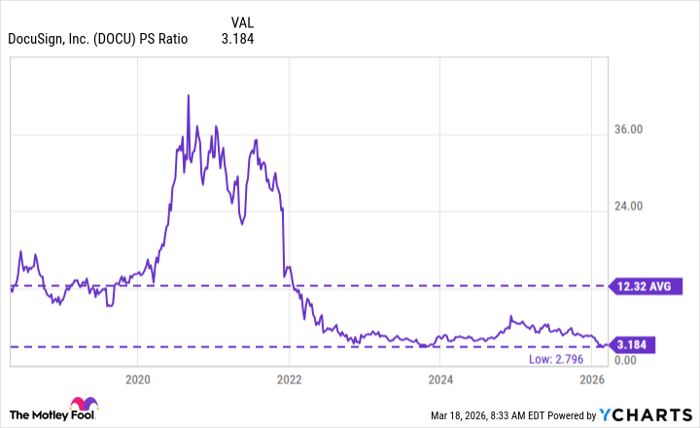
Data by YCharts.
Docusign stock is probably trading closer to fair value when using the price-to-earnings (P/E) ratio instead, which assesses the company's profit instead of its revenue. Docusign generated GAAP earnings of $1.48 per share during fiscal 2026, so with a stock price of $47.54 at the close on March 17, its P/E ratio is around 32.1. That is a slight premium to the Nasdaq-100 technology index, which trades at a P/E ratio of 30.4.
With that said, Docusign management believes the company's revenue growth could accelerate during fiscal 2027 (its current year), thanks to the incredible momentum in the IAM platform. This might also result in significantly higher earnings as long as the company's costs continue to grow at a modest pace, so it's possible that the stock is cheaper than it appears at face value right now.
In any case, investors who are willing to hold Docusign stock for a long-term period of three to five years could do well, as this timeframe will give the IAM platform time to blossom.
Should you buy stock in Docusign right now?
Before you buy stock in Docusign, consider this:
The Motley Fool Stock Advisor analyst team just identified what they believe are the 10 best stocks for investors to buy now… and Docusign wasn’t one of them. The 10 stocks that made the cut could produce monster returns in the coming years.
Consider when Netflix made this list on December 17, 2004... if you invested $1,000 at the time of our recommendation, you’d have $494,747!* Or when Nvidia made this list on April 15, 2005... if you invested $1,000 at the time of our recommendation, you’d have $1,094,668!*
Now, it’s worth noting Stock Advisor’s total average return is 911% — a market-crushing outperformance compared to 186% for the S&P 500. Don't miss the latest top 10 list, available with Stock Advisor, and join an investing community built by individual investors for individual investors.
See the 10 stocks »
*Stock Advisor returns as of March 21, 2026.
Anthony Di Pizio has no position in any of the stocks mentioned. The Motley Fool has positions in and recommends Docusign. The Motley Fool has a disclosure policy.
Recommended Articles


