




Skeptics Fear Autonomous Vehicles Will Destroy Uber. Here's Why They May Be Wrong.
Key Points
Autonomous vehicles could expand the ride-hailing market.
Early deployments suggest AVs may increase demand.
Uber’s demand network remains a powerful advantage.
- 10 stocks we like better than Uber Technologies ›
For years, the rise of robotaxis has been framed as an existential threat to Uber Technologies (NYSE: UBER). The logic seems straightforward: if autonomous vehicles eventually replace human drivers, companies building the technology -- such as Waymo or Tesla -- could bypass ride-hailing platforms altogether.
But Uber believes the opposite could happen. Rather than shrinking the ride-hailing market, autonomous vehicles could actually expand it. If that view proves correct, the technology that many investors fear could end up actually strengthening Uber's long-term opportunity.
Will AI create the world's first trillionaire? Our team just released a report on the one little-known company, called an "Indispensable Monopoly" providing the critical technology Nvidia and Intel both need. Continue »
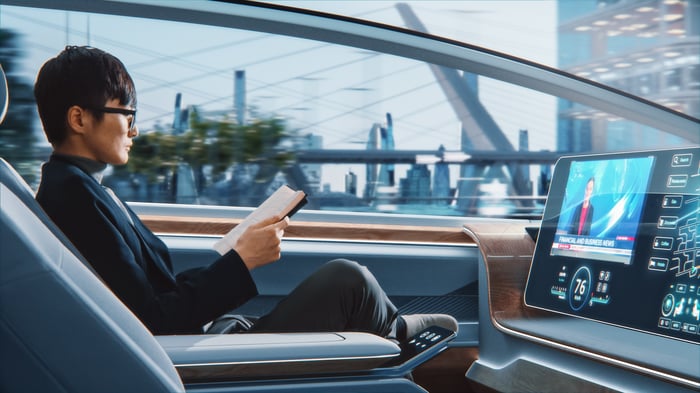
Image source: Getty Images.
A supply-driven marketplace
Uber's argument begins with a simple observation about how ride-hailing markets grow. Historically, the category has been supply-led. When more drivers enter a city, wait times fall, prices become more competitive, and the service becomes more reliable. As a result, more customers choose to take rides.
Autonomous vehicles represent another form of supply. According to Uber, increasing the number of available vehicles should make rides more affordable and improve estimated time of arrival (ETAs), thereby encouraging more trips. In other words, AVs could expand the total addressable market rather than redistribute existing rides.
Early evidence from AV deployments
Uber points to early data from cities where autonomous vehicles already operate on its network. In Austin and Atlanta, for example, hundreds of AVs have joined the Uber platform. The results are notable.
According to Uber, these operating zones have seen significantly faster trip growth than other U.S. markets, driven by both an increase in first-time riders and higher trip frequency among existing customers.
Even more interesting, the growth didn't come at the expense of human drivers. In fact, Uber reports that both the number of drivers and average driver earnings per hour increased year over year in those cities. That suggests the addition of autonomous vehicles did not simply replace human drivers. Instead, the overall market expanded.
Lower prices can unlock new demand
The economics behind this thesis are fairly intuitive. Transportation demand is highly sensitive to price and convenience. As rides become cheaper and easier to access, people tend to travel more frequently. Lower-cost autonomous rides could unlock entirely new use cases for ride-hailing, such as:
- daily commuting.
- replacing personal car ownership.
- frequent short-distance errands.
- expanded suburban transportation.
This is probably why Uber describes the long-term opportunity as multitrillion-dollar in scale. Of course, that growth would depend on autonomous technology eventually becoming reliable, safe, and cost-effective at scale. But the quick idea is that the overall mobility market could become significantly larger than it is today as we progress to meet those conditions.
Why is Uber well positioned to benefit?
If autonomous vehicles increase ride demand, Uber's platform could remain central to the ecosystem.
The company already operates one of the world's largest mobility marketplaces, with sophisticated routing algorithms, dynamic pricing systems, payment infrastructure, and a large base of riders. Those capabilities allow Uber to efficiently match supply with demand across thousands of cities. To get a sense of its scale, Uber enabled 3.75 billion trips in the fourth quarter of 2025!
In that sense, Uber doesn't necessarily need to build autonomous vehicles itself. Instead, it can focus on aggregating demand and connecting riders with whatever form of supply exists, whether that supply comes from human drivers or autonomous fleets.
Uber's broader strategy reflects this approach. The company is partnering with multiple autonomous technology companies rather than building its own self-driving platform.
Still, the transition will take time
Despite the huge opportunity ahead, it's also important to keep the current scale of autonomous vehicles in perspective. Even with rapid technological progress, AV trips still account for roughly 0.1% of global rideshare trips today. In other words, the industry remains in its early stages. Regulatory hurdles, safety validation, and cost challenges mean widespread adoption will likely take years.
What does it mean for investors?
The debate around autonomous vehicles often centers on which company will build the best robotaxi. But the bigger question may be who controls the demand network. If autonomous vehicles ultimately make ride-hailing cheaper and more accessible, the total mobility market could expand dramatically.
And if Uber continues to serve as the platform connecting riders with vehicles, the company could benefit from that growth, even in a driverless future.
Should you buy stock in Uber Technologies right now?
Before you buy stock in Uber Technologies, consider this:
The Motley Fool Stock Advisor analyst team just identified what they believe are the 10 best stocks for investors to buy now… and Uber Technologies wasn’t one of them. The 10 stocks that made the cut could produce monster returns in the coming years.
Consider when Netflix made this list on December 17, 2004... if you invested $1,000 at the time of our recommendation, you’d have $494,747!* Or when Nvidia made this list on April 15, 2005... if you invested $1,000 at the time of our recommendation, you’d have $1,094,668!*
Now, it’s worth noting Stock Advisor’s total average return is 911% — a market-crushing outperformance compared to 186% for the S&P 500. Don't miss the latest top 10 list, available with Stock Advisor, and join an investing community built by individual investors for individual investors.
See the 10 stocks »
*Stock Advisor returns as of March 20, 2026.
Lawrence Nga has no position in any of the stocks mentioned. The Motley Fool has positions in and recommends Tesla and Uber Technologies. The Motley Fool has a disclosure policy.
Recommended Articles


