




Greg Abel Just Took a Page Out of Warren Buffett's Playbook, and It's Great News for Berkshire Hathaway Stock
Key Points
Warren Buffett handed the reins to his chosen successor, Greg Abel, to start 2026.
Berkshire generated exceptional returns during Buffett's six-decade tenure, outperforming the S&P 500 by a wide margin.
Buffett returned a whopping $77.8 billion to shareholders during his final years as CEO, and it appears Abel will follow in his footsteps.
- 10 stocks we like better than Berkshire Hathaway ›
Warren Buffett served as the chief executive officer of the Berkshire Hathaway (NYSE: BRKA)(NYSE: BRKB) holding company from 1965 until the end of 2025, when he stepped down and handed the reins to his chosen successor, Greg Abel. Buffett will continue as board chairman, so he isn't out of the picture entirely.
During Buffett's six decades as CEO, Berkshire stock delivered a compound annual return of 19.7%, crushing the S&P 500 (SNPINDEX: ^GSPC), which returned an average of 10.5% per year during the same period. In dollar terms, a $1,000 investment in Berkshire in 1965 would have grown to an eye-popping $48.4 million at the end of 2025, whereas the same investment in the S&P 500 would have been worth just $399,702.
Will AI create the world's first trillionaire? Our team just released a report on the one little-known company, called an "Indispensable Monopoly" providing the critical technology Nvidia and Intel both need. Continue »
Buffett returned a truckload of money to shareholders through stock buybacks during his final few years as CEO, and in an interview earlier this month, Abel announced he is following in his predecessor's footsteps. Here's why this is great news for Berkshire stock.
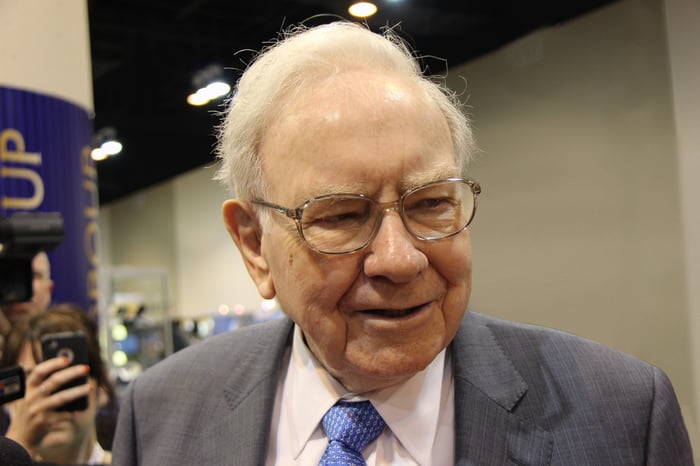
Image source: The Motley Fool.
Buffett turned Berkshire into a $1 trillion conglomerate
Berkshire Hathaway was a struggling textiles manufacturer when Buffett took a controlling stake in 1965. Upon realizing that its core business simply wasn't viable, he turned it into a holding company for his various investments. It is now a $1 trillion conglomerate with numerous wholly owned subsidiaries, a $306 billion portfolio of publicly traded stocks, and a whopping $373 billion in cash.
Berkshire owns insurance companies like GEICO Insurance, General Re, and National Indemnity Company, in addition to utilities like PacifiCorp and Northern Natural Gas. It also owns logistics companies like BNSF Railway, which operates one of America's largest freight railroad networks. These subsidiaries produce a ton of cash flow, which funds other acquisitions and investments for Berkshire.
Berkshire invests a lot of that money in the public markets. Through its $306 billion stock portfolio, the conglomerate owns minority stakes in dozens of different companies, including media giants like The New York Times Co., restaurant chains like Domino's Pizza, payment powerhouses like Visa, and technology titans like Apple (NASDAQ: AAPL).
Apple is actually Berkshire's single largest holding. Buffett invested about $38 billion in the iPhone maker between 2016 and 2023, and the stake was worth a staggering $170 billion heading into 2024. To cash in some of those gains and reduce risk, Buffett, Abel, and their respective teams have gradually sold about 75% of Berkshire's Apple position since then, but it still represents 18.6% (or $57 billion) of the conglomerate's portfolio.
The sales have added to Berkshire's growing cash pile, and it's getting harder for the company's portfolio managers to find new investment opportunities that are large enough to actually move the needle. For some perspective, 477 of the 500 companies in the S&P 500 index are worth less than Berkshire's $373 billion cash position.
Stock buybacks are back!
Buffett used to return cash to shareholders when he felt Berkshire couldn't make good use of it. Companies typically do this by paying dividends or by buying back stock, but Buffett preferred the latter for two reasons.
First, buybacks are very flexible. Buffett could authorize them at his discretion, as long as Berkshire had at least $30 billion in cash on hand. Second, investors don't realize the financial benefits of buybacks until they sell their Berkshire shares, so they can defer the tax liability to a time of their choosing. Dividends, on the other hand, provide a stream of taxable income.
Buffett authorized a whopping $77.8 billion worth of buybacks between 2018 and mid-2024, which is about twice as much as Berkshire has ever invested in any single company. However, there were no repurchases in the second half of 2024, or in 2025. This is likely because Buffett wanted to leave Berkshire with as much cash as possible to give Abel the best chance of success as the new CEO.
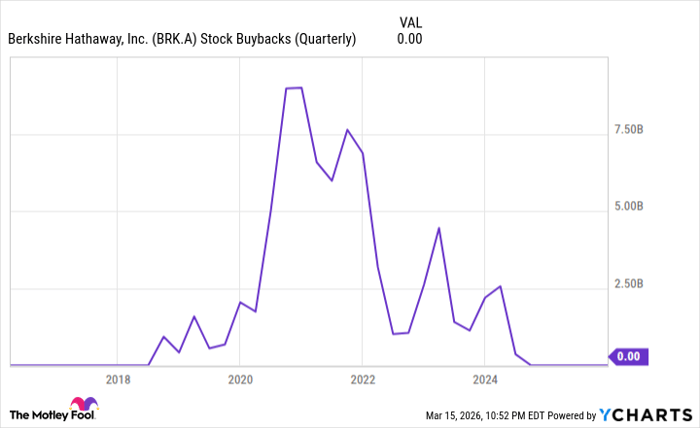
BRK.A Stock Buybacks (Quarterly) data by YCharts.
But in an interview with CNBC earlier this month, Abel said that the buybacks have officially resumed. He didn't provide any figures, but this is great news for shareholders who will now see their holdings increase in value. It will also allow Berkshire to reduce its hefty cash position.
There is no guarantee that Abel will dedicate as much money to buybacks as Buffett did, but if the conglomerate continues to struggle finding suitable investment opportunities, I would expect an increasing amount of money to flow to investors from here.
Should you buy stock in Berkshire Hathaway right now?
Before you buy stock in Berkshire Hathaway, consider this:
The Motley Fool Stock Advisor analyst team just identified what they believe are the 10 best stocks for investors to buy now… and Berkshire Hathaway wasn’t one of them. The 10 stocks that made the cut could produce monster returns in the coming years.
Consider when Netflix made this list on December 17, 2004... if you invested $1,000 at the time of our recommendation, you’d have $508,877!* Or when Nvidia made this list on April 15, 2005... if you invested $1,000 at the time of our recommendation, you’d have $1,115,328!*
Now, it’s worth noting Stock Advisor’s total average return is 936% — a market-crushing outperformance compared to 189% for the S&P 500. Don't miss the latest top 10 list, available with Stock Advisor, and join an investing community built by individual investors for individual investors.
See the 10 stocks »
*Stock Advisor returns as of March 19, 2026.
Anthony Di Pizio has no position in any of the stocks mentioned. The Motley Fool has positions in and recommends Apple, Berkshire Hathaway, Domino's Pizza, The New York Times Co., and Visa and is short shares of Apple. The Motley Fool has a disclosure policy.
Recommended Articles


