




The Best AI Stocks to Invest $1,000 in Right Now
Key Points
Taiwan Semiconductor Manufacturing produces most of the advanced AI chips used in data centers.
The company expects its AI accelerator revenue to compound at a mid-to-high-50% rate from 2024 to 2029.
Amazon is building more data centers and developing its own AI chips.
- 10 stocks we like better than Taiwan Semiconductor Manufacturing ›
For a while, there were questions about whether or not artificial intelligence (AI) was pure hype or the next big thing. The answer largely depends on whom you ask, but one thing seems clear: AI tools have become a part of many people's daily lives and aren't going anywhere. It will inevitably evolve (like any other technology), but the broader shift is real.
That said, there are plenty of AI companies that likely won't stand the test of time. That's why if you're interested in investing in AI stocks, you should lean toward companies built to thrive regardless of how the technology develops. The following two companies fit that description and play very different roles in AI.
Will AI create the world's first trillionaire? Our team just released a report on the one little-known company, called an "Indispensable Monopoly" providing the critical technology Nvidia and Intel both need. Continue »
Image source: The Motley Fool.
1. Taiwan Semiconductor Manufacturing
Taiwan Semiconductor Manufacturing (NYSE: TSM), or TSMC for short, isn't a traditional AI stock in the sense that it has tools that can create recipes or workouts for you, or help you vibecode (create apps using natural language). However, it undoubtedly has one of the most important roles in AI.
TSMC is a semiconductor foundry, meaning companies design their own chips and then take those designs to TSMC to actually make them. Apple uses them for iPhone chips, AMD uses them for processors, and Nvidia uses them for its graphics processing units (GPUs), just to name a few. It's the world's largest foundry by a considerable margin.
For AI to function as we know it today, it relies on tons of physical hardware that acts as the brains of everything. This includes GPUs, central processing units (CPUs), and AI accelerators.
Companies like Nvidia and AMD design many of these chips, but TSMC brings most of them to life. Many estimates indicate that its market share in the advanced AI chip industry is well into the upper 90% range.
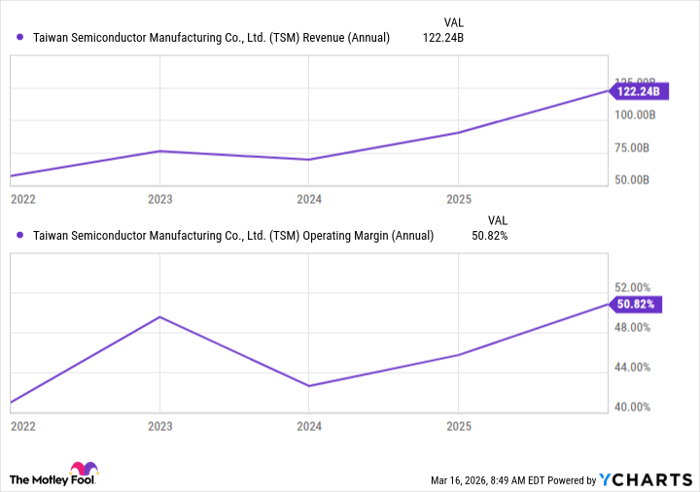
The recent jump in demand for AI chips is paying off for TSMC. In 2025, its revenue grew nearly 36% to $122.4 billion, its gross margins rose from 56.1% to 59.9%, its operating margins rose from 45.7% to 50.8%, and its cash flow increased by over 24%.
TSM Revenue (Annual) data by YCharts.
Not only has TSMC benefited from increased demand, but it has also been able to flex its pricing power as the go-to manufacturer. That's a great spot to be in as companies rush to build AI infrastructure.
Chips for AI accelerators accounted for a high-teens percentage of total revenue in 2025, and it expects sales from this market to compound at a mid-to-high-50% annual rate from 2024 to 2029. If you're looking for AI exposure without having to bet on a winner on the software side, TSMC is a great go-to.
2. Amazon
The average person knows Amazon (NASDAQ: AMZN) for its booming e-commerce business, but it also runs one of the world's most important businesses, Amazon Web Services (AWS). It's the world's largest cloud platform, powering countless websites and apps that millions rely on.
It is one of the few hyperscalers, a term for large-scale cloud providers that supply much of the computing power AI needs. In 2026, the company plans around $200 billion in capital expenditures, with much of it going to building its AI infrastructure and expanding its capacity, ideally enabling it to bring on more customers looking to build and develop their own AI tools.
Not only does this include building more data centers, but it also involves developing in-house AI chips to reduce reliance on Nvidia and other third-party companies. Right now, it has its AWS Trainium chip, which focuses on machine learning; its Graviton chip, which focuses on broad cloud workloads; and its Inferentia chip, a lower-cost option.
The more Amazon is able to do in-house -- whether it's developing its own AI chips, owning its own data centers, or having its own AI models -- the more it's able to cut costs and put those profits to work elsewhere.
There have been concerns about management's spending plans, but it's playing the long game and has the bank account to do so. It finally passed Walmart as the world's highest-revenue public company in 2025, bringing in $716.9 billion, and its other non-AWS segments continue to grow.
It's been a rough start to 2026 for Amazon's stock (down over 8% year to date through March 16), but the long-term appeal remains strong.
Should you buy stock in Taiwan Semiconductor Manufacturing right now?
Before you buy stock in Taiwan Semiconductor Manufacturing, consider this:
The Motley Fool Stock Advisor analyst team just identified what they believe are the 10 best stocks for investors to buy now… and Taiwan Semiconductor Manufacturing wasn’t one of them. The 10 stocks that made the cut could produce monster returns in the coming years.
Consider when Netflix made this list on December 17, 2004... if you invested $1,000 at the time of our recommendation, you’d have $508,877!* Or when Nvidia made this list on April 15, 2005... if you invested $1,000 at the time of our recommendation, you’d have $1,115,328!*
Now, it’s worth noting Stock Advisor’s total average return is 936% — a market-crushing outperformance compared to 189% for the S&P 500. Don't miss the latest top 10 list, available with Stock Advisor, and join an investing community built by individual investors for individual investors.
See the 10 stocks »
*Stock Advisor returns as of March 18, 2026.
Stefon Walters has positions in Apple, Taiwan Semiconductor Manufacturing, and Walmart. The Motley Fool has positions in and recommends Advanced Micro Devices, Amazon, Apple, Nvidia, Taiwan Semiconductor Manufacturing, and Walmart and is short shares of Apple. The Motley Fool has a disclosure policy.
Recommended Articles


