




Can Sandisk Become the Next Trillion-Dollar Stock?
Key Points
Sandisk is poised to deliver a big jump in revenue and earnings, driven by the solid demand for storage chips that's outpacing supply.
The company's earnings growth potential indicates that it will be a multibagger investment.
- 10 stocks we like better than Sandisk ›
Artificial intelligence (AI) has helped several companies achieve market capitalizations of more than $1 trillion in recent years. There is a good chance that the rapid adoption of this technology will help many more companies achieve a valuation like this in the future.
After all, AI adoption is expected to increase rapidly in the coming years. Grand View Research expects AI to generate almost $3.5 trillion in revenue in 2033, up from $391 billion last year. That's why it won't be surprising to see a company like Sandisk (NASDAQ: SNDK) achieve the trillion-dollar milestone.
Will AI create the world's first trillionaire? Our team just released a report on the one little-known company, called an "Indispensable Monopoly" providing the critical technology Nvidia and Intel both need. Continue »
The share price of the flash storage company has surged by just over 1,200% over the past year. It currently has a market cap of $105 billion. Can it replicate such growth in the future and join the trillion-dollar club?

Image source: Getty Images.
Sandisk's earnings growth prospects suggest that it still has multibagger potential
Sandisk stock's 12-fold jump in the past year is driven by the outstanding growth in the company's bottom line. The company reported a non-GAAP (adjusted) profit of $2.99 per share in fiscal 2025 (which ended in June last year), a major improvement over a loss of $3.46 per share in the preceding year. Its adjusted earnings have shot up by almost 150% in the first half of fiscal 2026 to $7.55 per share.
Importantly, analysts believe Sandisk's earnings growth will step on the gas in the second half of the year, followed by significant increases over the next couple of years.
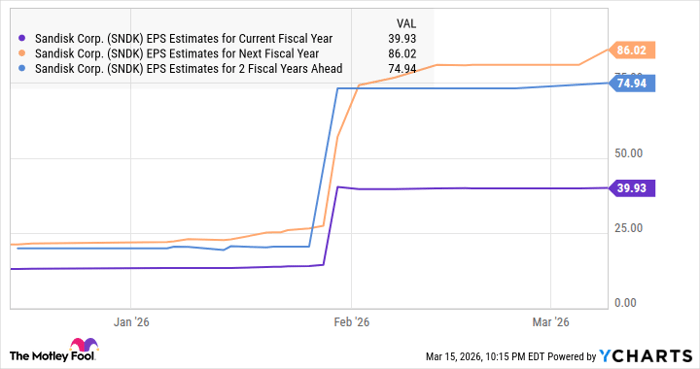
Data by YCharts.
Sandisk's guidance suggests the same. Its earnings-per-share (EPS) forecast of $13 for the current quarter would be a huge improvement over the $0.30-per-share loss it reported in the year-ago period. The exponential jump in Sandisk's bottom line is the result of an acute shortage of flash storage products, caused mainly by robust demand for enterprise solid-state drives (SSDs).
AI data centers have been turning to enterprise SSDs to meet their storage needs. That's because traditional hard-disk drives (HDDs), which are cheaper than SSDs, have reportedly been sold out until the end of 2027. In fact, Western Digital points out that it is already receiving firm purchase orders for HDD shipments in 2027 and 2028.
As AI data centers need to store huge amounts of data to run models and inference applications, they are quickly transitioning to SSDs. That's not surprising, as the ability of SSDs to quickly fetch data helps them lower the operating costs of data centers. Also, SSDs are known to occupy less space and consume less power than traditional HDDs, making them ideal for AI data centers.
So, AI data centers have been quickly buying up SSDs, leading to a sharp increase in prices. All this explains the stunning growth in Sandisk's earnings. But will it be enough to help the company enter the $1 trillion market cap club?
Can it really become a $1 trillion company?
Sandisk's current market cap suggests it will need to jump another 10x to reach $1 trillion. We saw in the chart above that it is expected to achieve earnings of $86.02 per share over the next couple of years.
The company could indeed do that, as the memory market is expected to remain supply-constrained until 2028. So, an estimated $86.02 per share in earnings multiplied by the U.S. tech sector's average earnings multiple of 39 could send Sandisk's stock price to $3,355 in the next couple of years. That's a potential fivefold jump.
While that isn't enough for the company to achieve a $1 trillion market cap, investors can still buy this AI stock as its phenomenal rally seems sustainable.
Should you buy stock in Sandisk right now?
Before you buy stock in Sandisk, consider this:
The Motley Fool Stock Advisor analyst team just identified what they believe are the 10 best stocks for investors to buy now… and Sandisk wasn’t one of them. The 10 stocks that made the cut could produce monster returns in the coming years.
Consider when Netflix made this list on December 17, 2004... if you invested $1,000 at the time of our recommendation, you’d have $508,877!* Or when Nvidia made this list on April 15, 2005... if you invested $1,000 at the time of our recommendation, you’d have $1,115,328!*
Now, it’s worth noting Stock Advisor’s total average return is 936% — a market-crushing outperformance compared to 189% for the S&P 500. Don't miss the latest top 10 list, available with Stock Advisor, and join an investing community built by individual investors for individual investors.
See the 10 stocks »
*Stock Advisor returns as of March 18, 2026.
Harsh Chauhan has no position in any of the stocks mentioned. The Motley Fool has positions in and recommends Western Digital. The Motley Fool has a disclosure policy.
Recommended Articles


