




2 Stocks Down Between 22% and 51% to Buy Right Now
Key Points
A cyclical slowdown in the financial sector is a buying opportunity for American Express investors.
Fluence is in talks with hyperscalers about 36 GWh of data center projects that haven't even hit the backlog yet.
Both stocks dropped on short-term concerns while long-term growth drivers remain intact.
- 10 stocks we like better than American Express ›
Market volatility has a way of putting quality companies on sale. Two stocks in very different industries have taken significant hits from their recent peaks. One financial titan is down 22% from its recent peak as of March 16. An energy storage innovator fell 51% from its February high.
Both sell-offs look like overreactions to short-term noise rather than fundamental problems with the underlying businesses. Read on to see why two longtime Motley Fool contributors see huge opportunities in these bearish market reactions.
Will AI create the world's first trillionaire? Our team just released a report on the one little-known company, called an "Indispensable Monopoly" providing the critical technology Nvidia and Intel both need. Continue »
Giant batteries, giant backlog, giant sell-off
Anders Bylund (Fluence Energy): Fluence Energy (NASDAQ: FLNC) stores electricity at an industrial scale. Giant batteries soak up renewable power, then release it when the grid needs it. Simple concept, messy stock chart.
As of this writing on March 16, Fluence shares are down 51% from their February peak. What happened? Investors got excited about data center construction opportunities, then threw a tantrum when those opportunities didn't turn into signed contracts right away.
Here's the thing: The business is booming.
The "bad" quarter wasn't that bad. Yes, Q1 gross margins disappointed. Two international projects had scope changes that added $20 million in costs. Management says they'll recover that money. This pause is not the same as "the business model is broken."
The backlog is enormous. $5.5 billion. Record high. Fully covers FY2026 revenue guidance. All the battery cells needed for 2026? Already contracted.
Leading data center operators haven't bought anything yet, and that's actually fine. Fluence is talking to hyperscalers about 36 GWh worth of projects.

Several people in silhouette push a few crashing chart arrows back up.
"We are working through technical reviews with them and working closely to show how our technology fits their specific needs," CEO Julian Nebreda said on the earnings call. "Many of the 36 gigawatt hours of data center projects are not yet included in our pipeline, which represents meaningful upside opportunity."
None of these discussions have converted to orders yet. But these deals take time. Massive tech companies are working through technical reviews because they need storage solutions to get AI data centers connected to the grid faster. The opportunity hasn't evaporated, it just hasn't hit the backlog line yet.
The stock has a 20% short interest. That's a lot of people betting against a company with a record backlog and a massive pipeline of potential data center business. If any of those conversations convert into signed deals, things could get interesting. And there's reason to think they will: data center operators face multi-year grid interconnection queues, and Fluence's on-site battery storage offers a workaround. When you're racing to bring AI compute online, years of waiting aren't an option.
A foundational dividend stock to build a portfolio around in 2026
Daniel Foelber (American Express): Financials are the worst-performing sector in 2026 -- down 11.2% compared to a 3.1% decline in the S&P 500 (SNPINDEX: ^GSPC). But Visa (NYSE: V), Mastercard (NYSE: MA), and American Express (NYSE: AXP) are down even more.
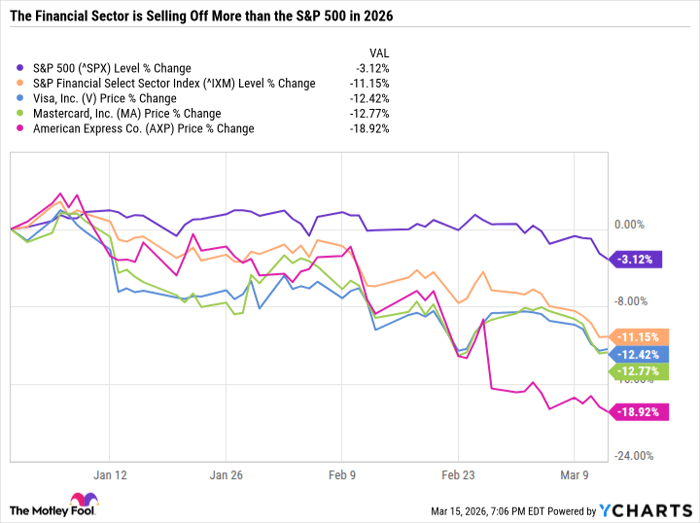
^SPX data by YCharts
The financial sector was red hot over the last few years. So, entering 2026, valuations were already somewhat overextended. To make matters worse, rising oil prices and geopolitical tensions are causing inflationary pressures on companies and consumers, which isn't good for the economy. And given the cyclical nature of financials, the sector can get hit hard during periods of slowing economic growth -- especially during recessions.
But American Express has a business model that is built to last.
Unlike Visa and Mastercard, which are pure-play payment processors that work with financial institutions to issue cards and manage credit risk, American Express issues its own cards. So it bears the credit risk, but it also collects interest income and card fees.
American Express has an exceptional track record of managing risk. It caters to affluent consumers and businesses, which helps maintain a high-quality loan pool. In the fourth quarter of fiscal 2025, just 1.3% of card member loans and receivables were 30 days or more past due. In that same quarter, American Express had a 2.1% net write-off rate (also known as the charge-off rate) -- which is the percentage of debt American Express doesn't expect to recover.
According to the Federal Reserve Bank of St. Louis, the fourth quarter 2025 average charge-off rate on credit card loans for all commercial banks was 4.1% -- showcasing American Express's elite credit management.
American Express has a long-term goal to increase revenue by 10% or more per year, with margins growing faster than revenue to support even better earnings per share growth. For fiscal 2026, it expects revenue growth of 9% to 10% and EPS of $17.30 to $17.90 -- which would be a 12.5% to 16.4% increase compared to $15.38 in fiscal 2025.
To top it all off, American Express sports a rock-solid balance sheet and generates gobs of free cash flow, which it uses to consistently repurchase stock and pay a growing dividend. In March, it announced a 16% increase to its dividend, bringing the quarterly payout to $0.95 per share -- good for a forward yield of 1.3%.
Should you buy stock in American Express right now?
Before you buy stock in American Express, consider this:
The Motley Fool Stock Advisor analyst team just identified what they believe are the 10 best stocks for investors to buy now… and American Express wasn’t one of them. The 10 stocks that made the cut could produce monster returns in the coming years.
Consider when Netflix made this list on December 17, 2004... if you invested $1,000 at the time of our recommendation, you’d have $513,407!* Or when Nvidia made this list on April 15, 2005... if you invested $1,000 at the time of our recommendation, you’d have $1,123,237!*
Now, it’s worth noting Stock Advisor’s total average return is 938% — a market-crushing outperformance compared to 188% for the S&P 500. Don't miss the latest top 10 list, available with Stock Advisor, and join an investing community built by individual investors for individual investors.
See the 10 stocks »
*Stock Advisor returns as of March 18, 2026.
American Express is an advertising partner of Motley Fool Money. Anders Bylund has no position in any of the stocks mentioned. Daniel Foelber has positions in American Express. The Motley Fool has positions in and recommends Fluence Energy, Mastercard, and Visa. The Motley Fool has a disclosure policy.
Recommended Articles


