




Wall Street Doesn't Know What to Do With This AI Stock. I Do.
Key Points
Like Tesla, Rivian is investing heavily in AI.
Shares don't seem to be valuing Rivian's AI opportunity.
- 10 stocks we like better than Rivian Automotive ›
Tesla (NASDAQ: TSLA) experienced its second straight year of declining vehicle deliveries in 2025, with volumes falling by around 9% year over year. Yet in 2024, despite declining EV sales, Tesla's stock price moved higher by more than 60%, adding another gain of roughly 10% in 2025.
Why is Tesla's stock price rising despite a struggling EV business? There are many potential catalysts, but one of the biggest is the market's expectation that the company will transition from an auto manufacturing business to a fully fledged AI company. It's not that the company will be ditching EVs entirely -- although Elon Musk did recently announce that Tesla would soon discontinue its Model S and Model X vehicles. It's just that Tesla's future will be increasingly driven by its investments and success in AI technologies. AI upside is a big reason why shares trade at nearly 15 times sales.
Will AI create the world's first trillionaire? Our team just released a report on the one little-known company, called an "Indispensable Monopoly" providing the critical technology Nvidia and Intel both need. Continue »
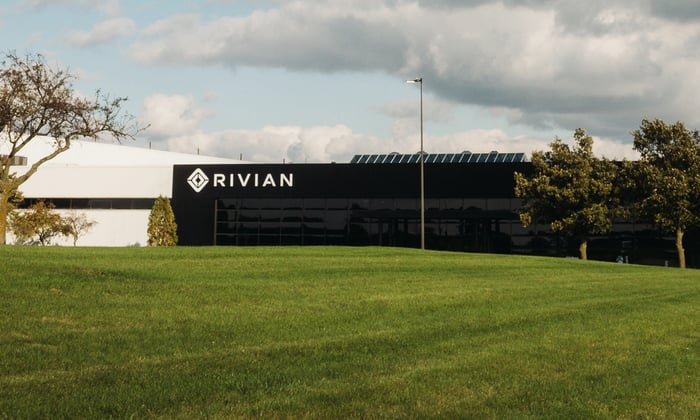
Image source: Rivian.
Rivian (NASDAQ: RIVN), another popular EV stock, is also heavily investing in AI. And yet shares trade at just 3.3 times sales, with a market cap under $20 billion versus Tesla's gargantuan $1.2 trillion valuation.
Wall Street doesn't know what to make of this emerging AI stock. By understanding what is going on, investors have a chance to buy into a potential growth superstar at a relatively large discount to its peers. There are three important factors to understand before jumping in.
1. Rivian is betting big on AI
For decades, consumers have been told that self-driving cars are just around the corner. Despite massive advancements, the world is still waiting. But now, experts are growing more confident that autonomous vehicles will soon be a reality. Global consultancy McKinsey & Co., for example, now predicts robotaxis will be available nationwide by 2030, with full self-driving capabilities available to all by 2032. Why? Because AI is a game changer for autonomy, helping distill and make complex decisions in real time like no other technology has been capable of in the past.
Rivian understands that over the next decade, consumers may purchase an EV not based on seating capacity or the number of cupholders, but for the vehicle's ability to be fully autonomous. That's why it is spending billions of dollars to advance its own AI ambitions. It even expects to produce its own AI chips in the future. By controlling its own AI software from end to end, Rivian has the potential to own its self-driving future, reducing reliance on third-party suppliers while competing head-to-head with major EV makers like Tesla.
2. Rivian's new R2 SUV will help its AI investments
AI models run on data. This is a big reason why Tesla is dominating the AI race early -- it already has millions of vehicles on the road collecting huge sets of real-world data.
Next month, Rivian expects to begin deliveries of its R2 SUV -- its first vehicle priced under $50,000. This launch will make Rivian vehicles more affordable to tens of millions of new buyers. And over time, expect these models to increase Rivian's volumes substantially, giving it far more data to train and improve its models.
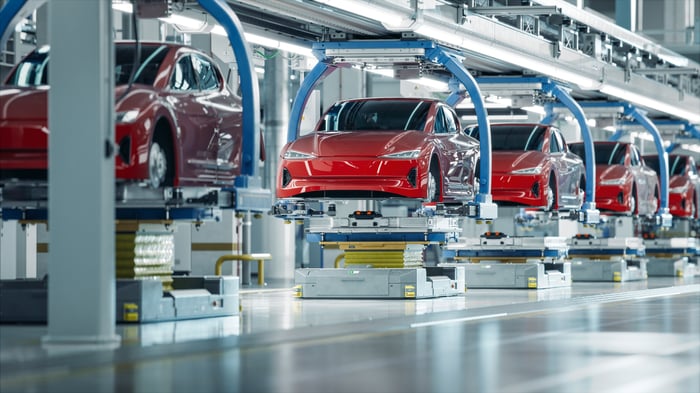
Image source: Tesla.
3. Don't expect immediate results
Rivian's AI investments are a long-term bet. As mentioned, we may not see fully self-driving cars for another four to six years. But companies that invest early will have the greatest potential to compete when that time comes. Rivian has a capital disadvantage compared to larger peers like Tesla. But its relatively minuscule valuation offers plenty of upside if the company succeeds. Wall Street doesn't yet see Rivian as a bona fide AI stock. But that should change over the coming months and years.
Should you buy stock in Rivian Automotive right now?
Before you buy stock in Rivian Automotive, consider this:
The Motley Fool Stock Advisor analyst team just identified what they believe are the 10 best stocks for investors to buy now… and Rivian Automotive wasn’t one of them. The 10 stocks that made the cut could produce monster returns in the coming years.
Consider when Netflix made this list on December 17, 2004... if you invested $1,000 at the time of our recommendation, you’d have $513,407!* Or when Nvidia made this list on April 15, 2005... if you invested $1,000 at the time of our recommendation, you’d have $1,123,237!*
Now, it’s worth noting Stock Advisor’s total average return is 938% — a market-crushing outperformance compared to 188% for the S&P 500. Don't miss the latest top 10 list, available with Stock Advisor, and join an investing community built by individual investors for individual investors.
See the 10 stocks »
*Stock Advisor returns as of March 18, 2026.
Ryan Vanzo has no position in any of the stocks mentioned. The Motley Fool has positions in and recommends Tesla. The Motley Fool has a disclosure policy.
Recommended Articles


