




The Best Stocks to Buy With $1,000 Right Now
Key Points
The market is only valuing Nvidia's stock as it will grow for one more year.
Microsoft has seldom been this cheap over the past decade.
- 10 stocks we like better than Microsoft ›
If you've got $1,000 waiting to be invested, I can think of few better stocks to buy than Nvidia (NASDAQ: NVDA) and Microsoft (NASDAQ: MSFT). Both of these are massive companies that are well positioned to take advantage of the artificial intelligence (AI) build-out.
Each of them is also trading for an attractive valuation, making them the best stocks to buy with $1,000 right now.
Will AI create the world's first trillionaire? Our team just released a report on the one little-known company, called an "Indispensable Monopoly" providing the critical technology Nvidia and Intel both need. Continue »

Image source: Getty Images.
Both stocks are trading at historically cheap levels
Nvidia and Microsoft hardly need an introduction. Nvidia is the world's largest company and makes graphics processing units (GPUs) and other products that give Nvidia the best accelerated computing ecosystem available. This popularity has been prevalent throughout the AI buildup, as its products are incredibly popular.
Microsoft's business may seem ho-hum with its Office product suite, but there's so much more to Microsoft than that. Its fastest-growing segment, Azure, is its cloud computing wing, and it's handling huge demand for its computing resources from several AI hyperscalers like OpenAI, the makers of ChatGPT. While Azure is Microsoft's most prominent segment, Microsoft is also seeing strength all around its business.
Despite both companies being at their best, neither of them trades where they normally do. Nvidia trades for a mere 22 times forward earnings, about the lowest it has been over the past few years.
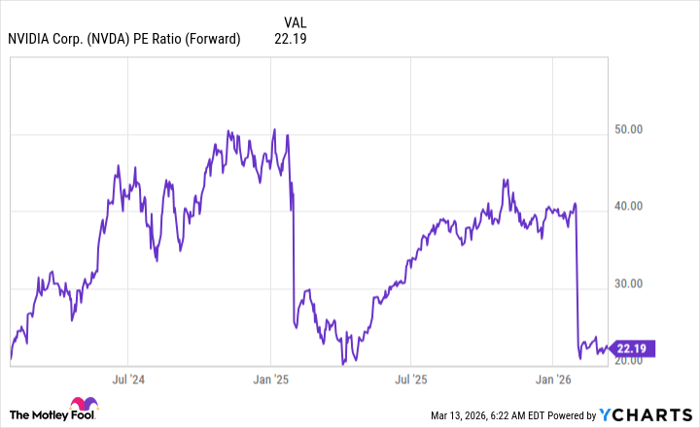
NVDA PE Ratio (Forward) data by YCharts.
That's about the same price as the S&P 500, which trades for 21.7 times forward earnings. This valuation basically projects that Nvidia is going to grow for this year, then deliver market-matching growth after that. However, from all of the AI build-out projections, it's clear that this isn't true, as elevated AI spending is expected to persist throughout 2030. This makes Nvidia a no-brainer buy right now.
Microsoft may not be as cheap as Nvidia, but it is attractively priced compared to where it has been in the past. For Microsoft, I'm using the operating price-to-earnings (P/E) ratio, as it isn't as skewed as when you use net income due to fluctuations in investments. From this standpoint, Microsoft stock has seldom been this cheap over the past decade.
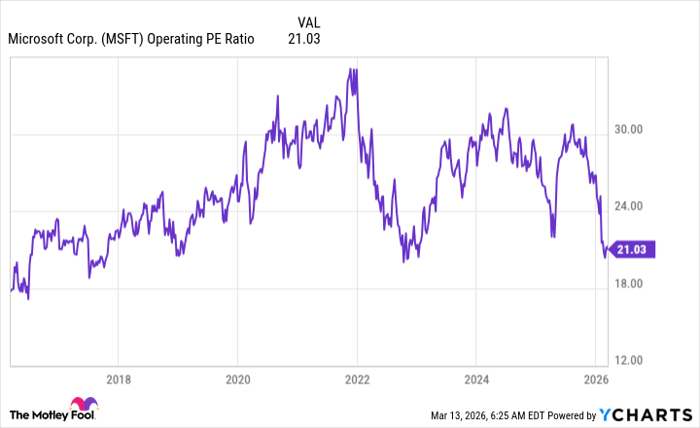
MSFT Operating PE Ratio data by YCharts.
It's not often you get the chance to turn back the clock and invest in one of the biggest winners of the past decade, but that's exactly what the market is giving you in Microsoft's stock right now.
I think both Nvidia and Microsoft are some of the best AI stocks to buy right now. Even if you remove the AI tag, they are still genius buys, and investors will make a nice profit on these stocks over the next few years as they realize growth and return to more sane valuation levels.
Should you buy stock in Microsoft right now?
Before you buy stock in Microsoft, consider this:
The Motley Fool Stock Advisor analyst team just identified what they believe are the 10 best stocks for investors to buy now… and Microsoft wasn’t one of them. The 10 stocks that made the cut could produce monster returns in the coming years.
Consider when Netflix made this list on December 17, 2004... if you invested $1,000 at the time of our recommendation, you’d have $514,000!* Or when Nvidia made this list on April 15, 2005... if you invested $1,000 at the time of our recommendation, you’d have $1,105,029!*
Now, it’s worth noting Stock Advisor’s total average return is 930% — a market-crushing outperformance compared to 187% for the S&P 500. Don't miss the latest top 10 list, available with Stock Advisor, and join an investing community built by individual investors for individual investors.
See the 10 stocks »
*Stock Advisor returns as of March 17, 2026.
Keithen Drury has positions in Microsoft and Nvidia. The Motley Fool has positions in and recommends Microsoft and Nvidia. The Motley Fool has a disclosure policy.
Recommended Articles


