



If you correct the mistake within two years of the missed deadline (by taking the RMD), the penalty could be reduced to 10%. In that scenario, the penalty would be $1,000 instead of $2,500.

Should You Take Your First RMD in 2026 or Wait Until April 2027? The Tax Trade-Off Explained
Source Motley_fool
Key Points
Required minimum distributions (RMDs) begin the year you turn 73 years old.
You have until April 1 of the following year to take your first RMD, but until Dec. 31 every other year.
If you delay your first RMD until April 1, you'll still need to take that year's RMD by Dec. 31.
- The $23,760 Social Security bonus most retirees completely overlook ›
Accounts like 401(k)s and traditional IRAs have up-front tax breaks that allow you to deduct your contributions from your taxable income. In return, you're required to pay taxes on the withdrawals you make from these accounts in retirement.
To avoid a situation where a retiree doesn't withdraw from these accounts to avoid paying taxes, the IRA has required minimum distributions (RMDs) that kick in the year you turn 73 years old.
Will AI create the world's first trillionaire? Our team just released a report on the one little-known company, called an "Indispensable Monopoly" providing the critical technology Nvidia and Intel both need. Continue »
Generally, you're required to take your RMDs by Dec. 31 of a given year, except the year you turn 73. That year, you can delay your RMDs until April 1 of the following year. For example, if you turn 73 in 2026, you'll have until April 1, 2027, to take your RMD.
However, just because you can delay until April doesn't mean everyone should. Let's take a look at which option makes sense.
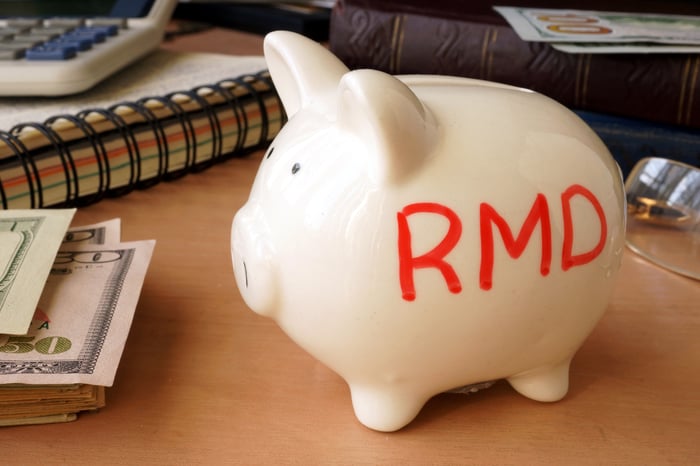
Image source: Getty Images.
The tax trade-off of waiting until April
The first thing to note is that even if you delay your first RMD until April of the following year, you'll still need to take that year's RMD by Dec. 31. For instance, if you delay 2026's RMD until April 1, 2027, you'll still need to take 2027's RMD by Dec. 31, 2027.
If you decide to delay your RMD until next April, you would find yourself in a situation where you'll have two RMDs added to your taxable income for the year, increasing how much you owe in taxes. Depending on how much your RMDs are, you could find yourself in a higher tax bracket once both RMDs are added to your taxable income.
Taking your first RMD by Dec. 31 also helps you avoid a situation where the higher income from two RMDs potentially puts you in a position to owe taxes on your Social Security benefits because the relevant income pushes you above the IRS threshold.
Although taking your RMD by Dec. 31 is the "safe" choice, delaying until April could make sense if you expect your income that year to be lower and the two RMDs wouldn't cause too much of a tax hit.
How to calculate your RMD
Your RMD is based on two factors: the total value of your retirement account(s) at the end of the previous year and the age you'll turn in the current year. For example, if you're currently 76 but turn 77 this year, 77 would be the age used. However, in this case, we'll stick with 73 since it's the first year of your RMDs.
Once you know those, determining your exact RMD is a two-step process:
- Refer to the IRS life expectancy table to find your life expectancy factor (LEF). The Uniform Lifetime Table is what applies to most retirees, unless your spouse is your sole beneficiary and they're more than 10 years younger than you. In that case, you'll use the Joint Life Expectancy Table.
- Divide your account balance(s) at the end of the previous year by your LEF.
At age 73, your LEF would be 26.5 if you're using the Uniform Lifetime Table. Below is how much your RMD would be based on different account balances at the end of 2025:
| Account Value(s) at the End of 2025 | Required Minimum Distribution |
|---|---|
| $250,000 | $9,434 |
| $500,000 | $18,868 |
| $1 million | $37,736 |
| $1.5 million | $56,604 |
| $2 million | $75,472 |
Table by author. RMDs rounded up to the nearest dollar.
What happens if you don't take your RMD?
Failing to take your RMD could result in a penalty equal to 25% of the amount you were supposed to withdraw but didn't. For example, if your RMD is $35,000 and you only withdraw $25,000, your penalty would be $2,500 (25% of $10,000).
Ideally, you'd stay up to date on your RMDs and could avoid the penalty altogether.
The $23,760 Social Security bonus most retirees completely overlook
If you're like most Americans, you're a few years (or more) behind on your retirement savings. But a handful of little-known "Social Security secrets" could help ensure a boost in your retirement income.
One easy trick could pay you as much as $23,760 more... each year! Once you learn how to maximize your Social Security benefits, we think you could retire confidently with the peace of mind we're all after. Join Stock Advisor to learn more about these strategies.
View the "Social Security secrets" »
The Motley Fool has a disclosure policy.
Disclaimer: For information purposes only. Past performance is not indicative of future results.
Recommended Articles

MicroStrategy stock is up nearly 3% at press time, trading above $137 as markets opened on March 9. Strategy just announced another 17,994 BTC purchase for $1.28 billion.The stock trades 57% lower ove
With the US-Iran conflict reshaping global markets, oil surging past $94 a barrel, and tech infrastructure becoming a direct military target, equities across sectors are repricing risk in real time. A
Cardano has managed a modest price recovery, offering a rare positive signal amid an otherwise challenging backdrop. The uptick provides brief relief but fails to address the deeper structural concern
Bittensor (TAO) surged 19.19% in the last 24 hours, fueled by a wave of demand tied to its AI-powered subnet ecosystem.The rally coincided with a viral social media moment from Templar, one of TAO’s m
The Ethereum Foundation sold 5,000 ETH to BitMine to fund research, grants, and development.


