




When Elon Musk Talks, Nasdaq and the S&P 500 Must Listen
Key Points
In just a few months, SpaceX could hold one of the biggest IPOs in history -- $1.75 trillion.
Media report that Elon Musk wants the Nasdaq-100 and S&P 500 to change their rules to admit SpaceX early.
Index inclusion could force more investors to buy SpaceX stock.
- These 10 stocks could mint the next wave of millionaires ›
"Where does an 800-pound gorilla sit? Anywhere it wants to."
This ancient proverb/children's riddle took on new life in the stock market last week, when rumors began floating that the biggest "gorilla" in the space industry is throwing its weight around Wall Street, demanding special treatment from both the Nasdaq stock exchange and the S&P 500 itself.
Will AI create the world's first trillionaire? Our team just released a report on the one little-known company, called an "Indispensable Monopoly" providing the critical technology Nvidia and Intel both need. Continue »
Apparently, no one wants to say "no" to Elon Musk.
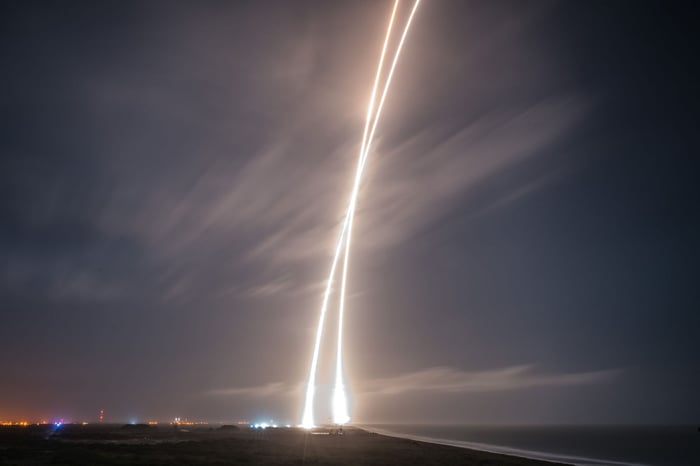
Image source: SpaceX.
What's up on the Nasdaq this week?
Let's start this story with the Nasdaq, where Reuters reports Musk is demanding "early index entry" for SpaceX into the Nasdaq-100 index, which tracks the performance of the 100 biggest companies on the Nasdaq.
Musk is preparing to IPO SpaceX, you see, and at an apparent $1.75 trillion valuation.
Yes
-- Elon Musk (@elonmusk) March 2, 2026
As part of its IPO preparations, SpaceX will decide whether to list its shares on the NYSE or the Nasdaq. Both stock exchanges want the listing, not just for the prestige of having SpaceX on their exchange, but also for the transaction fees a SpaceX listing would generate over time.
Musk may be using this desire to win the SpaceX listing to bully Nasdaq into bending its rules. Ordinarily, Nasdaq waits about a year after a company IPOs to give its stock price a chance to settle into an accepted valuation before deciding whether it deserves a place in the index.
Nasdaq, however, is considering setting up a new "Fast Entry" procedure for popular large-cap stocks. This would permit a newly IPO'ed stock to join the Nasdaq-100 in as little as a month -- assuming its market capitalization ranks among the 40 biggest stocks on the index. If SpaceX IPOs at $1.75 trillion, it would easily fit this new definition, ranking No. 6 behind Nvidia (NASDAQ: NVDA), Apple (NASDAQ: AAPL), Microsoft (NASDAQ: MSFT), Amazon (NASDAQ: AMZN), and Alphabet (NASDAQ: GOOG) (NASDAQ: GOOGL).
Just as importantly for SpaceX, inclusion will require fund managers who track the index to purchase SpaceX shares once SpaceX joins the Nasdaq-100. This would create buying pressure, lifting SpaceX's stock price after the IPO. What's more, inclusion in a widely held index such as the Nasdaq-100 (or S&P 500) -- both widely held by institutional investors -- can reduce the impact of early investors selling the stock after its post-IPO lockup periods expire, preventing large sales from driving the stock price down too much.
Best case scenario: A popular SpaceX IPO shoots higher on IPO day, then receives a second wind when fund managers are forced to buy it for their funds tracking the Nasdaq-100 index. Later, widespread institutional ownership helps SpaceX stock hold onto these gains.
Win. Win. Win!
SpaceX and the S&P 500
The story surrounding the S&P 500 is similar. Bloomberg reported last week that S&P Dow Jones Indices LLC, a subsidiary of S&P Global (NYSE: SPGI), may "fast-track SpaceX's entry after its IPO" into this index as well.
Once again, doing so would require the index to change its own rules to accommodate Elon Musk's wishes -- cutting the ordinary lag between IPO and index inclusion from 12 months to... something less than 12 months. Once again, a buying frenzy would ensue.
And once again, a successful entry would include SpaceX in a popular, widely imitated index tied to some $24 trillion in global investments. Any selling by early SpaceX investors, cashing in their SpaceX shares post-IPO, would be mitigated by owners of funds that imitate the S&P 500 holding onto their indexed shares (and by extension, their SpaceX shares), providing ballast and reducing the price volatility of SpaceX stock.
What could go wrong?
Is there any downside to any of the above for SpaceX investors? In the short term, probably not. Musk's machinations -- assuming this is what is going on -- would appear calculated to turbocharge his SpaceX IPO, drive the stock price higher, and then help keep it there.
Granted, valuation may matter for SpaceX eventually, after the buying pressure from index inclusion subsides. Even widely held S&P 500 stocks can still go down once enough investors decide they're too expensive.
Updating the math from my most recent valuation of SpaceX, which was based on a $1.5 trillion IPO, to the new expected valuation of $1.75 trillion, I estimate SpaceX may IPO at a price-to-sales ratio as high as 110, and a price-to-earnings ratio of more than 580.
At those kinds of prices, I won't risk investing in SpaceX. Will you?
Where to invest $1,000 right now
When our analyst team has a stock tip, it can pay to listen. After all, Stock Advisor’s total average return is 930%* — a market-crushing outperformance compared to 187% for the S&P 500.
They just revealed what they believe are the 10 best stocks for investors to buy right now, available when you join Stock Advisor.
See the stocks »
*Stock Advisor returns as of March 16, 2026.
Rich Smith has no position in any of the stocks mentioned. The Motley Fool has positions in and recommends Alphabet, Amazon, Apple, Microsoft, Nvidia, and S&P Global and is short shares of Apple. The Motley Fool has a disclosure policy.
Recommended Articles


