




Satya Nadella Says "All Software Is Being Rewritten." Here's 1 of the Best Artificial Intelligence (AI) Stocks to Own for 2026.
Key Points
Taiwan Semiconductor is the main chip manufacturer for Nvidia, Apple, AMD, and others.
It controls 72% of the global pure-foundry chip industry.
The company has been growing fast and is projecting further rapid growth through 2029.
- 10 stocks we like better than Taiwan Semiconductor Manufacturing ›
Microsoft CEO Satya Nadella said last year that as much as 30% of Microsoft's code was being written by artificial intelligence (AI). I can only imagine that number is higher now.
Humans are still definitely needed to maintain quality, a fact proved by Microsoft appointing Charlie Bell, former head of the company's security business, to now focus exclusively on maintaining the quality of the company's products. He reports directly to Nadella.
Will AI create the world's first trillionaire? Our team just released a report on the one little-known company, called an "Indispensable Monopoly" providing the critical technology Nvidia and Intel both need. Continue »
Microsoft clearly doesn't plan on cutting the amount of its code written by AI. Nadella himself said it was steadily increasing, and CTO Kevin Scott predicted that by 2030, 95% of the company's code might be written by AI.
With that in mind, what is the best way to play AI becoming a permanent part of the IT industry? By my math, one of the best single-ticker ways to play it is Taiwan Semiconductor Manufacturing (NYSE: TSM).
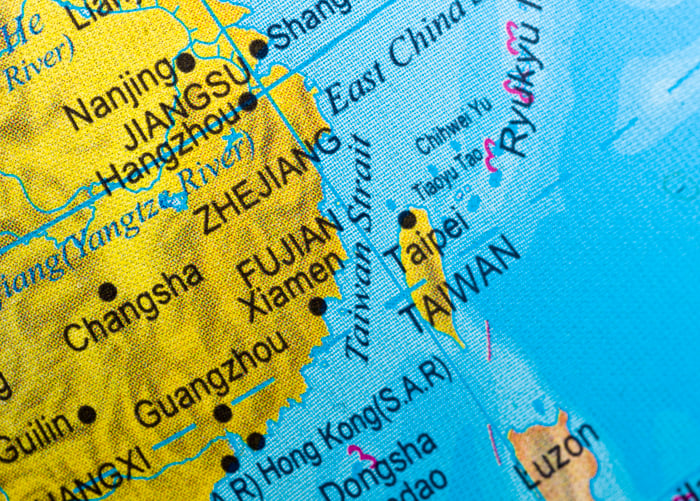
Image source: Getty Images.
Small island, big footprint
Taiwan is where a full 60% of all the world's semiconductor chips are produced.
But the country's footprint is even bigger than that implies because 90% of the world's advanced semiconductor chips, those 7 nanometers (nm) or smaller, are produced in Taiwan.
And those are the chips you need to run the high-end AI programs Microsoft and others are using to write their code.
Microsoft uses a lot of Nvidia hardware to run its AI. So does pretty much everyone else. IOT Analytics reports that Nvidia controls 92% of the data center GPU market. Its nearest competitor is Advanced Micro Devices at 4%.
But those Nvidia graphics processor units (GPUs) are manufactured by Taiwan Semiconductor. So are its competitor AMD's, along with Apple, Broadcom, Qualcomm and others, either in whole or in part.
In fact, Nvidia's top-of-the-line Blackwell chip is produced at a Taiwan Semiconductor factory in Arizona.
Creating an even bigger footprint
The semiconductor chip market, and by extension the AI data center hardware market, simply does not exist without Taiwan Semiconductor, which doesn't design any of the chips it produces.
Taiwan Semiconductor is a "pure foundry" company. All it does is produce chips on contract. But it's utterly dominant in the space, with 72% market share as of Q3 2025. Samsung is in second place with 7%.
You've heard of pick-and-shovel plays, I'm sure. But Taiwan Semiconductor is the pick-and-shovel play for the AI industry and the tech industry more broadly.
And the company is expanding its footprint beyond Taiwan to build up its global dominance. The semiconductor factory in Arizona I mentioned is being expanded by Taiwan Semiconductor to produce more chips in the U.S., and ultimately the company plans to have six factories and two advanced packaging facilities in the state.Taiwan Semiconductor also has plans drawn up to expand its manufacturing footprint in Japan and Germany.
And all that expansion is not coming at the cost of the company's bottom line, which remains incredibly healthy.
Trillion-dollar baby
Right now, Taiwan Semiconductor is one of only two non-American companies with a market cap of $1 trillion or more. Its latest results reflect its size and influence well.
2025 saw the company's revenue top $122.4 billion, an increase of 35.9% over 2024. Its diluted earnings per share (EPS) grew 46.4%. Taiwan Semiconductor also maintains stellar profitability with a 45% net profit margin.
The company is also projecting 30% revenue growth for 2026 and a revenue compound annual growth rate (CAGR) of 25% through 2029.
Finally, Taiwan Semiconductor is trading at a price-to-earnings-to growth (PEG) ratio of 1.2 right now, which means it's very close to fair value relative to future earnings projections.
Put all that together, and you have a solid long-term buy-and-hold prospect from the one-ticker pick-and-shovel play of the entire global tech industry.
And if Microsoft wants to generate 95% of its code with AI by 2030, it's going to need a lot more hardware, which Taiwan Semiconductor will gladly produce, and in all likelihood continue its growth streak moving forward.
Should you buy stock in Taiwan Semiconductor Manufacturing right now?
Before you buy stock in Taiwan Semiconductor Manufacturing, consider this:
The Motley Fool Stock Advisor analyst team just identified what they believe are the 10 best stocks for investors to buy now… and Taiwan Semiconductor Manufacturing wasn’t one of them. The 10 stocks that made the cut could produce monster returns in the coming years.
Consider when Netflix made this list on December 17, 2004... if you invested $1,000 at the time of our recommendation, you’d have $514,000!* Or when Nvidia made this list on April 15, 2005... if you invested $1,000 at the time of our recommendation, you’d have $1,105,029!*
Now, it’s worth noting Stock Advisor’s total average return is 930% — a market-crushing outperformance compared to 187% for the S&P 500. Don't miss the latest top 10 list, available with Stock Advisor, and join an investing community built by individual investors for individual investors.
See the 10 stocks »
*Stock Advisor returns as of March 14, 2026.
James Hires has no position in any of the stocks mentioned. The Motley Fool has positions in and recommends Advanced Micro Devices, Apple, Microsoft, Nvidia, Qualcomm, and Taiwan Semiconductor Manufacturing and is short shares of Apple. The Motley Fool recommends Broadcom. The Motley Fool has a disclosure policy.
Recommended Articles


