




This ETF Has Given Investors a Golden Opportunity
Key Points
Exchange-traded funds aren’t just about stocks.
ETFs have also opened up new ways for investors to get exposure to different asset classes.
This commodity-based fund was the first of its kind in an area that’s red-hot right now.
- 10 stocks we like better than SPDR Gold Shares ›
One nice thing about investing with exchange-traded funds is that you're not just limited to stock market investments. There are now ETFs available for a wide array of different asset classes, ranging from bonds, cash equivalents, real estate, and cryptocurrency. It's now possible for investors to create an entire diversified portfolio solely using exchange-traded funds of various types.
However, it wasn't always like this. It took pioneers in the ETF universe to come up with ways to expand into new types of markets. One particularly interesting story comes from the commodity world, where SPDR Gold Shares (NYSEMKT: GLD) has been a highly successful ETF over time. With gold having recently soared to $5,000 per ounce, interest in the precious metal has never been higher. That makes now a timely moment for the Voyager Portfolio to look more closely at this fund, and in this first article in a three-part series, you'll learn about the history of SPDR Gold Shares and how it come to occupy a leading position in the ETF world.
Will AI create the world's first trillionaire? Our team just released a report on the one little-known company, called an "Indispensable Monopoly" providing the critical technology Nvidia and Intel both need. Continue »
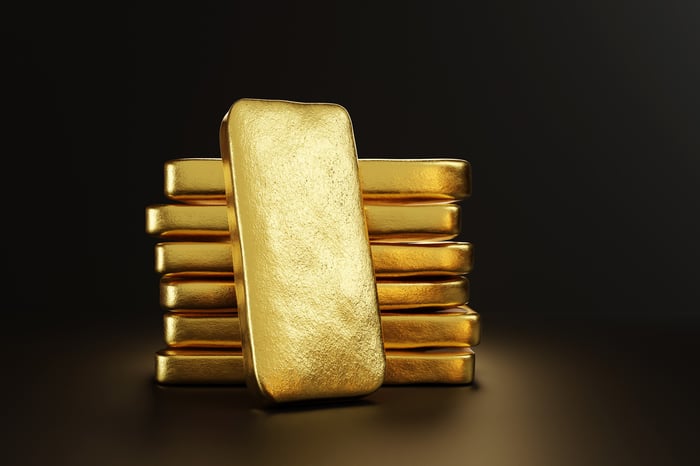
Image source: Getty Images.
All that glitters used to be hard to buy
Few ETFs have made as big a difference in their respective markets as SPDR Gold. Consider: the SPDR S&P 500 ETF (NYSEMKT: SPY) might have been the first exchange-traded index fund, but there were plenty of existing index mutual funds that were already available for investors. SPDR S&P 500 merely made it possible to get exposure to an important stock market index at any time during the trading day.
By contrast, SPDR Gold filled a void in the investing universe that many advocates for the precious metal desperately wanted to eliminate. Before SPDR Gold, if you wanted to invest in gold, you pretty much needed to go to a coin dealer and buy physical coins or bars yourself. That presented a couple of problems. First, the dealer would inevitably charge a sizable markup when you bought gold coins, and if you later wanted to sell them, you'd often receive a discounted price that introduced a hefty spread between the dealer's bid and ask prices. Moreover, every time you wanted to buy or sell, you'd have to visit the dealer's physical location, or else deal with expensive mail delivery with insurance and other complications. And lastly, once you had the gold, you had to figure out what to do with it. Whether you bought a safe for your home, rented a safe deposit box at a local bank, or took other measures, securing your gold came at a cost as well.
SPDR Gold offers an alternative
In that context, SPDR Gold represented a major shift in investing sentiment when it came to buying and selling gold. The idea behind SPDR Gold was that the ETF would issue shares that represented one-tenth of an ounce of gold. With the money from selling the shares, the fund would go out and actually buy physical gold bullion and hold it in a central location. Even though shareholders couldn't directly exchange their shares for actual gold, just knowing that the gold was there was enough to back up the value of the shares.
SPDR Gold had huge benefits. You could buy and sell shares just like any other stock or ETF, using electronic brokerages and never having to deal with a coin dealer or physical gold yourself. SPDR Gold took care of obtaining, storing, and insuring the gold bullion in its possession, charging a relatively modest annual expense ratio to defray those costs.
A golden era
With SPDR Gold available, gold investing got popular. But despite its recent popularity, it hasn't always looked like that attractive an investment. The second of three articles on SPDR Gold looks at the gold ETF's returns and how shareholders have fared in its over 20-year history.
Should you buy stock in SPDR Gold Shares right now?
Before you buy stock in SPDR Gold Shares, consider this:
The Motley Fool Stock Advisor analyst team just identified what they believe are the 10 best stocks for investors to buy now… and SPDR Gold Shares wasn’t one of them. The 10 stocks that made the cut could produce monster returns in the coming years.
Consider when Netflix made this list on December 17, 2004... if you invested $1,000 at the time of our recommendation, you’d have $514,000!* Or when Nvidia made this list on April 15, 2005... if you invested $1,000 at the time of our recommendation, you’d have $1,105,029!*
Now, it’s worth noting Stock Advisor’s total average return is 930% — a market-crushing outperformance compared to 187% for the S&P 500. Don't miss the latest top 10 list, available with Stock Advisor, and join an investing community built by individual investors for individual investors.
See the 10 stocks »
*Stock Advisor returns as of March 14, 2026.
Dan Caplinger has no position in any of the stocks mentioned. The Motley Fool has no position in any of the stocks mentioned. The Motley Fool has a disclosure policy.
Recommended Articles


