




Why Stock Indexes Ended This Week in the Red
Key Points
The Iranian blockade of the Strait of Hormuz sent oil prices soaring this week.
Energy stocks rose but make up less than 4% of the S&P 500, limiting their impact.
Goldman Sachs and Home Depot each dropped 6%, dragging down the Dow.
- 10 stocks we like better than Dow Jones Industrial Average ›
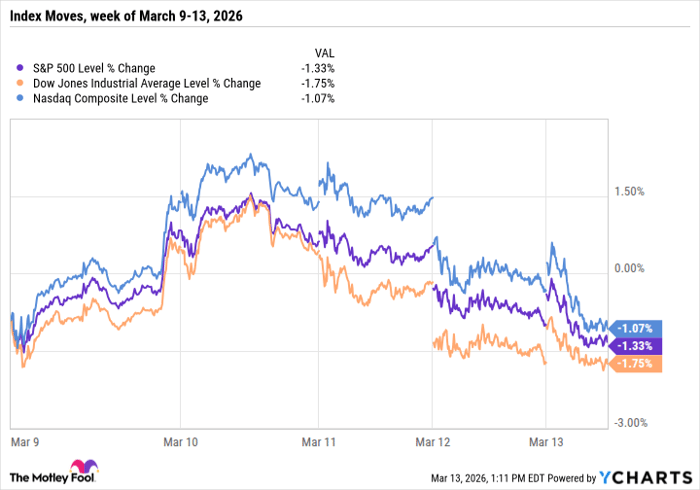
The stock market is ending a rough week. The leading stock indexes rose on Monday and Tuesday as the conflict in Iran seemed destined for a quick resolution. But the fighting only intensified from there, including an Iranian blockade of oil shipments through the critical Strait of Hormuz, which led to skyrocketing oil prices.
That's bad news in an era when AI data centers are consuming more electricity than ever, often generated by burning oil or natural gas. The combination of intense energy demand and limited supply also raises questions about the global economy. So the Iranian crisis is weighing on tech stocks, banks, and consumer goods giants alike. The only winners this week have been -- you guessed it -- energy producers and utility services.
Will AI create the world's first trillionaire? Our team just released a report on the one little-known company, called an "Indispensable Monopoly" providing the critical technology Nvidia and Intel both need. Continue »
^SPX data by YCharts
Energy stocks can't carry the market alone
As expected, most market indexes ended the week on a low note. Sure, energy stocks with limited operations in the Persian Gulf rose significantly but that wasn't enough to outweigh the secondary effects of high oil prices.
After all, the entire energy sector accounts for just 3.4% of the S&P 500's (SNPINDEX: ^GSPC) total market value. Most of the energy giants trade on the New York Stock Exchange, so the energy footprint on the Nasdaq Composite (NASDAQINDEX: ^IXIC) index works out to just 1% of the tech-heavy stock list.
And the only energy stock in the Dow Jones Industrial Average (DJINDICES: ^DJI) is Chevron (NYSE: CVX). With a share price just below $200, it carries a 2.4% weight on this price-weighted index. Even a large Chevron jump would barely move the Dow's needle overall.
The Magnificent 7 had a terrible week
The Dow took heavy hits from a 6% price drop in Goldman Sachs (NYSE: GS) this week, followed by another 6% retreat for Home Depot (NYSE: HD). The S&P 500 and Nasdaq Composite took their leading cues from several of the Magnificent 7 stocks, each losing more than $100 billion of market value over the same period.
Amazon (NASDAQ: AMZN) took the deepest cuts, with its market cap shrinking by $120 billion compared to last Friday. Amazon is investing $200 billion in AI-processing data centers this year, so there's a direct link to rising power costs.

Image source: Getty Images.
The Iranian conflict will probably continue to set the market's overall tone until it winds down. It may feel like a bear market, but the downdraft is still far too weak for that moniker. The three top indexes still trade less than 7% below their recent all-time peaks, and this week's total drops clocked in below the 2% mark across the board.
The bearish tag only appears after S&P 500 drawdowns of at least 20% from a recent high. The storm clouds are gathering, centered around Iran and the Strait of Hormuz. It's too early to panic, but you may want to prepare for some rough seas.
Should you buy stock in Dow Jones Industrial Average right now?
Before you buy stock in Dow Jones Industrial Average, consider this:
The Motley Fool Stock Advisor analyst team just identified what they believe are the 10 best stocks for investors to buy now… and Dow Jones Industrial Average wasn’t one of them. The 10 stocks that made the cut could produce monster returns in the coming years.
Consider when Netflix made this list on December 17, 2004... if you invested $1,000 at the time of our recommendation, you’d have $508,607!* Or when Nvidia made this list on April 15, 2005... if you invested $1,000 at the time of our recommendation, you’d have $1,122,746!*
Now, it’s worth noting Stock Advisor’s total average return is 933% — a market-crushing outperformance compared to 188% for the S&P 500. Don't miss the latest top 10 list, available with Stock Advisor, and join an investing community built by individual investors for individual investors.
See the 10 stocks »
*Stock Advisor returns as of March 13, 2026.
Anders Bylund has positions in Amazon. The Motley Fool has positions in and recommends Amazon, Chevron, Goldman Sachs Group, and Home Depot. The Motley Fool has a disclosure policy.
Recommended Articles


