




Will Walmart's Digital Push Pay Off in 2026?
Key Points
Return on invested capital is the clearest indicator of digital efficiency.
Walmart’s store network can be a strategic advantage if it improves fulfillment economics.
- 10 stocks we like better than Walmart ›
Walmart (NASDAQ: WMT) has spent the past several years building digital scale. E-commerce continues to grow at a healthy pace, its online marketplace where others sell things is growing, and same-day pickup and delivery fueled by online ordering now reach a large portion of U.S. households.
On the surface, the digital strategy looks successful. But scale alone is not the real test of success.
Will AI create the world's first trillionaire? Our team just released a report on the one little-known company, called an "Indispensable Monopoly" providing the critical technology Nvidia and Intel both need. Continue »
In 2026, the more important question is whether Walmart's digital expansion translates into higher returns on capital -- or merely preserves competitiveness in a tougher retail environment.

Image source: Getty Images.
Closing the gap is not the same as gaining an edge
Walmart has significantly narrowed the digital gap with Amazon. Its store network now functions as a fulfillment engine, enabling faster pickup and delivery without building an entirely new logistics footprint. That infrastructure advantage is real.
However, digital growth in retail can be economically complex. E-commerce often carries lower margins due to fulfillment costs, returned items, and promotional (sales) intensity. Growth without operating leverage can dilute profitability rather than enhance it.
In other words, the issue in 2026 is whether Walmart's omnichannel model produces superior economics. If digital growth improves asset utilization and lowers per-unit fulfillment costs, the store base becomes a bigger structural advantage. If it simply offsets competitive pressure, there is no enhancement of scale advantage.
Spending to improve
Maintaining digital competitiveness requires ongoing investment. Walmart continues to allocate money to technology and supply chain enhancements. These investments aim to increase productivity and reduce friction in both physical and online channels.
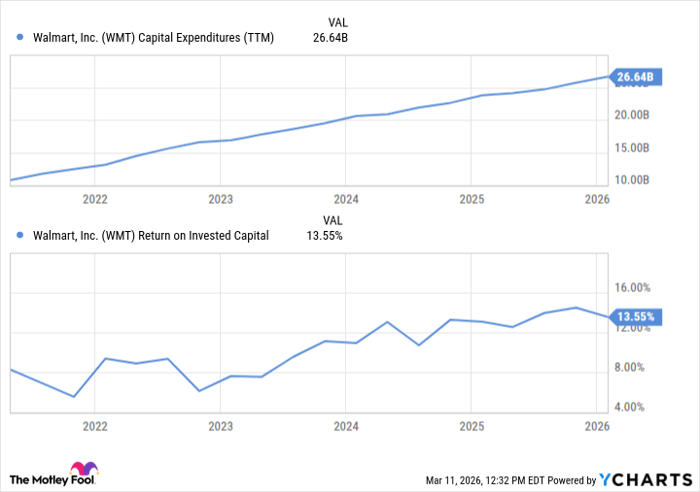
WMT Capital Expenditures (TTM) data by YCharts
At Walmart's size -- more than $700 billion in annual revenue -- even modest increases in capital expenditures amount to significant dollars. For the current fiscal year, Walmart says it is targeting capital expenditures at roughly 3.5% of sales; 3.5% of $700 billion is $24.5 billion. If return on invested capital remains flat while digital investment grows, shareholders are funding maintenance rather than improvement.
What does success look like?
True digital success should show up in three places:
- Gradual improvement in operating leverage, which looks at how much increases in the top line increase the bottom line.
- Stable or improving return on invested capital despite higher investment.
- Margin resilience even in competitive pricing environments.
If those conditions materialize, Walmart's digital effors become a compounding advantage. Its physical footprint, combined with data and automation, could yield a hybrid model difficult to replicate.
If not, Walmart remains a strong retailer, but one investing heavily simply to hold its position.
For long-term investors, 2026 will help clarify whether Walmart's digital strategy deepens its competitive advantage or merely sustains it.
Should you buy stock in Walmart right now?
Before you buy stock in Walmart, consider this:
The Motley Fool Stock Advisor analyst team just identified what they believe are the 10 best stocks for investors to buy now… and Walmart wasn’t one of them. The 10 stocks that made the cut could produce monster returns in the coming years.
Consider when Netflix made this list on December 17, 2004... if you invested $1,000 at the time of our recommendation, you’d have $511,735!* Or when Nvidia made this list on April 15, 2005... if you invested $1,000 at the time of our recommendation, you’d have $1,140,464!*
Now, it’s worth noting Stock Advisor’s total average return is 946% — a market-crushing outperformance compared to 191% for the S&P 500. Don't miss the latest top 10 list, available with Stock Advisor, and join an investing community built by individual investors for individual investors.
See the 10 stocks »
*Stock Advisor returns as of March 13, 2026.
Lawrence Nga has no position in any of the stocks mentioned. The Motley Fool has positions in and recommends Amazon and Walmart. The Motley Fool has a disclosure policy.
Recommended Articles


