




Warren Buffett's Final $373 Billion Warning Sent Shockwaves Through Wall Street
Key Points
On Dec. 31, after more than half a century at the helm, Warren Buffett stepped down from the CEO role at Berkshire Hathaway.
The stock market is historically expensive, as evidenced by Berkshire's enormous cash pile and Buffett's persistent net selling of stocks leading up to his retirement.
However, patience has paid off handsomely throughout Buffett's investing career.
- 10 stocks we like better than Berkshire Hathaway ›
For more than half a century, billionaire Warren Buffett manned the wheel at Berkshire Hathaway (NYSE: BRKA)(NYSE: BRKB), ultimately turning his conglomerate into a trillion-dollar business. During his tenure as CEO, the Oracle of Omaha oversaw a greater than 6,000,000% cumulative return in his company's Class A shares (BRK.A), which absolutely crushes the returns of the benchmark S&P 500 (SNPINDEX: ^GSPC), ageless Dow Jones Industrial Average (DJINDICES: ^DJI), and growth-fueled Nasdaq Composite (NASDAQINDEX: ^IXIC).
But on Dec. 31, 2025, Berkshire Hathaway's pillar hung up his proverbial work coat for the final time and retired as CEO (though he remains chairman of Berkshire's board).
Will AI create the world's first trillionaire? Our team just released a report on the one little-known company, called an "Indispensable Monopoly" providing the critical technology Nvidia and Intel both need. Continue »
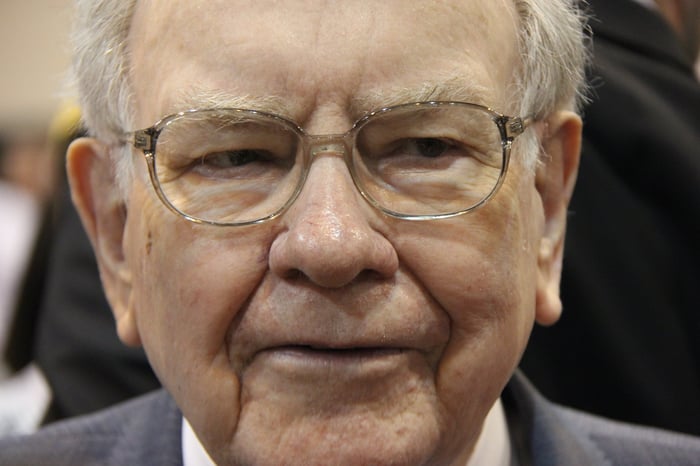
Warren Buffett retired as Berkshire Hathaway's CEO on Dec. 31, 2025. Image source: The Motley Fool.
Although Warren Buffett is no longer responsible for Berkshire's day-to-day operations or its $319 billion investment portfolio, we're still witnessing the lasting impact of his actions, as evidenced in his company's fourth-quarter operating results, released on Feb. 28.
While most investors tend to focus on headline figures, such as sales, profits, and margins, it's Warren Buffett's final $373 billion warning that's sending shockwaves through Wall Street.
The Oracle of Omaha enters retirement with a $373 billion warning for investors
Although Berkshire Hathaway acquired roughly five dozen companies across a variety of sectors during Warren Buffett's tenure as CEO, it's the Oracle of Omaha's investing prowess that was most lauded.
Apple and Bank of America have been among Berkshire's biggest winners on a nominal-dollar basis, while Moody's, Coca-Cola, and American Express are some of Buffett's greatest long-term success stories. The Buffett name is practically synonymous with value-focused, long-term investing.
But in all 13 quarters (Oct. 1, 2022 – Dec. 31, 2025) leading up to Warren Buffett's retirement as CEO, he was a net seller of stocks. Accounting for the $3.16 billion in net stock sales overseen during Buffett's final quarter, he sold an aggregate of $186.7 billion more in stocks than he purchased over a 39-month stretch.
Persistently selling stock, coupled with the operating profits that Berkshire's owned businesses have generated (e.g., BNSF and GEICO), has dramatically boosted his company's cash on hand (including cash equivalents and U.S. Treasuries). Since Buffett's selling streak began, Berkshire Hathaway's cash has more than tripled to a near-record $373.3 billion, as of Dec. 31, 2025.
If perennial value investor Warren Buffett is sitting on his hands and not putting his cash to work, this $373 billion serves as a warning to Wall Street.
The stock market is historically expensive -- and Berkshire's boss knew it!
For years, the stock market has been relatively unstoppable. With the exception of the 2022 bear market, the S&P 500 has gained at least 16% in six of the last seven years. We've also witnessed the Dow Jones Industrial Average hit 50,000 and the Nasdaq Composite briefly top 24,000.
Catalysts have been abundant for Wall Street, with the rise of artificial intelligence, the advent of quantum computing, a Federal Reserve rate-easing cycle, and better-than-expected corporate earnings fueling gains.
But the stock market is also historically expensive -- and the Oracle of Omaha knew it.
Warren Buffett Indicator hits an all-time high of 224%, the most expensive stock market valuation in history 🚨🚨 pic.twitter.com/BgIiOkFlfl
-- Barchart (@Barchart) January 11, 2026
Although value is subjective (i.e., there isn't a perfect blueprint to value all stocks), Warren Buffett's favorite valuation metric, the market cap-to-GDP ratio, now commonly known as the Buffett indicator, cuts through the heart of this subjectivity.
In a 2001 interview with Fortune magazine, Berkshire's boss referred to the market cap-to-GDP ratio as "probably the best single measure of where valuations stand at any given moment." This ratio, which has been back-tested to December 1970, has averaged approximately 87% over the last 56 years. In other words, the cumulative value of all publicly traded companies has averaged 87% of U.S. gross domestic product (GDP) over the long term.
In January 2026, the Buffett indicator hit an all-time high of more than 221%! Historically, when the Buffett indicator has pushed well beyond its average, a significant decline in equities has eventually followed.
It's a similar story for the S&P 500's Shiller Price-to-Earnings (P/E) Ratio, which is also known as the Cyclically Adjusted P/E Ratio (CAPE Ratio). Whereas the Shiller P/E has averaged roughly 17.3 when back-tested to January 1871, it's been vacillating between 39 and 41 over the last four months.
While Buffett was known to bend or break some of his unwritten investing rules on rare occasions, he was unwavering when it came to value and getting a good deal.
Image source: Getty Images.
Patience paid off handsomely for Warren Buffett and Berkshire's shareholders
Although Buffett's $373 billion warning to Wall Street foreshadows significant corrections to come in the Dow Jones Industrial Average, S&P 500, and Nasdaq Composite, Buffett's long-term approach to investing has conclusively shown that patience can be highly rewarding.
As an investor of more than eight decades, Berkshire's boss fully understood that stock market corrections, bear markets, and elevator-down crashes are inevitable events and akin to the price of admission to the world's greatest wealth creator. But rather than try to time when these events would occur, Buffett always positioned Berkshire Hathaway for future success.
The reason? Warren Buffett was keenly aware of the disproportionate nature of stock market cycles. Whereas corrections, bear markets, and crashes tend to resolve quickly, bull markets commonly extend for years. Buffett knew that stock market downturns can lead to short-term price dislocations in great businesses, allowing him to take stakes in great companies at an attractive price point.
Long-winded bull markets have occasionally led Buffett to sit on his proverbial hands and wait for stock valuations to come back into his wheelhouse. This is what we witnessed in the 13 quarters leading up to the retirement of Berkshire's billionaire boss.
History teaches us that valuations are, eventually, going to become attractive again. When they do, Buffett's successor, Greg Abel, is going to have a treasure chest of capital to pounce on potential price dislocations.
Should you buy stock in Berkshire Hathaway right now?
Before you buy stock in Berkshire Hathaway, consider this:
The Motley Fool Stock Advisor analyst team just identified what they believe are the 10 best stocks for investors to buy now… and Berkshire Hathaway wasn’t one of them. The 10 stocks that made the cut could produce monster returns in the coming years.
Consider when Netflix made this list on December 17, 2004... if you invested $1,000 at the time of our recommendation, you’d have $519,015!* Or when Nvidia made this list on April 15, 2005... if you invested $1,000 at the time of our recommendation, you’d have $1,086,211!*
Now, it’s worth noting Stock Advisor’s total average return is 941% — a market-crushing outperformance compared to 194% for the S&P 500. Don't miss the latest top 10 list, available with Stock Advisor, and join an investing community built by individual investors for individual investors.
See the 10 stocks »
*Stock Advisor returns as of February 28, 2026.
Bank of America is an advertising partner of Motley Fool Money. American Express is an advertising partner of Motley Fool Money. Sean Williams has positions in Bank of America. The Motley Fool has positions in and recommends Apple, Berkshire Hathaway, and Moody's. The Motley Fool has a disclosure policy.
Recommended Articles


