




Where Will Micron Technology Stock Be in 3 Years?
Key Points
The HBM market's potential growth over the next three years is likely to be a solid catalyst for Micron stock.
Micron can outperform Wall Street estimates in fiscal 2028, paving the way for significant upside for investors.
- 10 stocks we like better than Micron Technology ›
The past three years have been fantastic for Micron Technology (NASDAQ: MU) investors, as a $1,000 investment made in its shares three years ago is now worth an impressive $7,100. What's worth noting is that a significant chunk of these gains has arrived in the past year, once it became evident that Micron is playing a critical role in the global artificial intelligence (AI) infrastructure build-out.
Micron stock has benefited from the supply-constrained memory market. AI-fueled memory demand has significantly outpaced the available supply, resulting in a sharp spike in memory prices. The favorable pricing environment has been a boon for Micron's revenue and earnings, and the market has rewarded the stock handsomely for its terrific growth.
Will AI create the world's first trillionaire? Our team just released a report on the one little-known company, called an "Indispensable Monopoly" providing the critical technology Nvidia and Intel both need. Continue »
But will this catalyst last for the next three years and help Micron deliver more gains?

Image source: Micron Technology.
The memory supercycle is expected to last until 2028
Memory demand isn't going to slow down anytime soon, driven primarily by the booming demand for data center-specific memory chips known as high-bandwidth memory (HBM). HBM consumption is increasing at a breathtaking pace. That isn't surprising, as HBM plays a pivotal role in moving large amounts of data at high speeds in AI data centers, while consuming less energy than traditional dynamic random-access memory (DRAM) chips.
This explains why Micron is bullish about the growth of the global HBM market, pointing out in its December 2024 earnings call: "The HBM market will exhibit robust growth over the next few years. In 2028, we expect the HBM total addressable market (TAM) to grow 4 times from the $16 billion level in 2024 and to exceed $100 billion by 2030."
What's worth noting is that Micron pointed out in its December 2025 earnings call that it expects the HBM market's revenue to hit $100 billion in 2028, two years earlier than expected. The aggressive investment in AI data centers explains this upgraded forecast. Nvidia, for instance, is anticipating data center capital expenditures (capex) to increase at a 40% annual rate through 2030. As HBM plays an important role in AI data center chips, it should remain in strong demand over this period as well.
So, it is easy to see why key memory industry players like Micron and SK Hynix are forecasting the shortage to last until 2028. This should pave the way for further price increases, which is precisely why Micron's impressive rally could continue for the next three years.
Here's how much upside investors can expect from the stock
Micron finished its fiscal 2025 (which ended on Aug. 28, 2025) with $8.29 per share in adjusted earnings. The following chart makes it clear that its bottom-line growth is poised to take off.
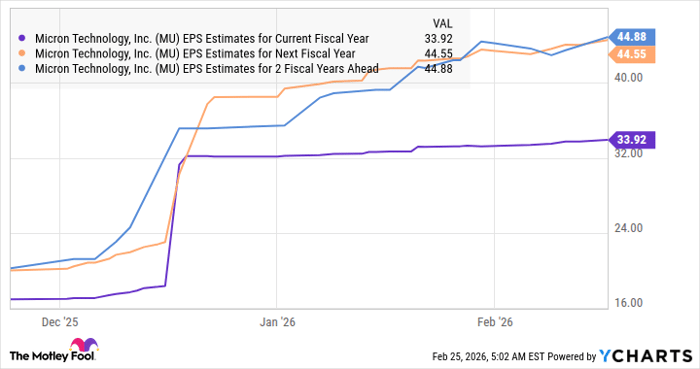
MU EPS Estimates for Current Fiscal Year data by YCharts
Analysts aren't expecting a major jump in Micron's earnings in fiscal 2028 as compared to fiscal 2027 levels. But the persistent supply shortage in the memory industry, as discussed above, indicates that it could clock another year of terrific earnings growth in fiscal 2028.
Even if we assume Micron's earnings hit $44.88 per share after three years and it trades at 25 times forward earnings at that time (in line with the Nasdaq-100 index and using the index as a proxy for tech stocks), its stock could hit $1,135. That would be a potential jump of 171% from current levels, which means that this AI stock remains worth buying even now.
Should you buy stock in Micron Technology right now?
Before you buy stock in Micron Technology, consider this:
The Motley Fool Stock Advisor analyst team just identified what they believe are the 10 best stocks for investors to buy now… and Micron Technology wasn’t one of them. The 10 stocks that made the cut could produce monster returns in the coming years.
Consider when Netflix made this list on December 17, 2004... if you invested $1,000 at the time of our recommendation, you’d have $519,015!* Or when Nvidia made this list on April 15, 2005... if you invested $1,000 at the time of our recommendation, you’d have $1,086,211!*
Now, it’s worth noting Stock Advisor’s total average return is 941% — a market-crushing outperformance compared to 194% for the S&P 500. Don't miss the latest top 10 list, available with Stock Advisor, and join an investing community built by individual investors for individual investors.
See the 10 stocks »
*Stock Advisor returns as of February 28, 2026.
Harsh Chauhan has no position in any of the stocks mentioned. The Motley Fool has positions in and recommends Micron Technology and Nvidia. The Motley Fool has a disclosure policy.
Recommended Articles


