




Billionaire Bill Ackman Sold Alphabet and Bought These 2 Undervalued Artificial Intelligence (AI) Stocks Instead
Key Points
For the last few years, Bill Ackman's largest exposure to artificial intelligence (AI) was through his hedge fund's stake in Alphabet.
During the fourth quarter, his hedge fund reduced its position in Alphabet and rotated capital elsewhere.
He is traditionally known as a value investor, and his latest buys reflect this mindset.
- 10 stocks we like better than Amazon ›
Bill Ackman is a billionaire investor and serves as CEO of Pershing Square Capital Management. He's best known as a value investor, and often concentrates Pershing Square's portfolio among a small cohort of stocks spread across various industries.
Over the last few years, Ackman has dabbled with artificial intelligence (AI) stocks. His first big splash in that space came in early 2023 when Pershing Square initiated a position in Alphabet (NASDAQ: GOOGL) (NASDAQ: GOOG) -- acquiring 2.2 million and 8.1 million of the company's Class A and Class C shares, respectively.
Will AI create the world's first trillionaire? Our team just released a report on the one little-known company, called an "Indispensable Monopoly" providing the critical technology Nvidia and Intel both need. Continue »
According to Pershing Square's latest 13F filing, Ackman decided to take some of the gains from that investment off the table and rotate capital elsewhere. During the fourth quarter, the hedge fund reduced its Class A position by 86% while trimming its Class C holding by a modest 2%.
Let's dig into which AI stocks Ackman currently sees value in and assess if smart investors should follow his lead into them.
1. Doubling down on Amazon
Last April, Ackman revealed that his firm had initiated a position in another member of the "Magnificent Seven": Amazon (NASDAQ: AMZN). During the second quarter, Pershing Square bought 5.8 million shares of the e-commerce and cloud computing specialist.
Recent filings reveal that Ackman doubled down on Amazon during the fourth quarter, adding another 3.8 million shares to Pershing Square's position. Why might he have traded some exposure in Alphabet for a larger position in Amazon? I can think of a couple of reasons.
First, Amazon and Alphabet are both building vertically integrated AI ecosystems. Each company is a leader in cloud infrastructure, with Amazon Web Services (AWS) holding the largest market share (28%). Alphabet's Google Cloud is in third place with a 14% share.
In addition, similar to Alphabet's custom silicon work with Broadcom, Amazon is designing proprietary chips in an effort to reduce its overdependence on Nvidia's architectures. At the moment, Amazon is expanding its use of its own Trainium and Inferentia chips.
Beyond data centers, custom silicon, and the cloud, Alphabet and Amazon are both also exploring AI capabilities across consumer electronics, autonomous vehicles, robotics, and quantum computing.
This raises the question: Why sell Alphabet and buy Amazon stock right now? While I generally do not encourage market timing, I think it may have played a role in Ackman's latest decisions.
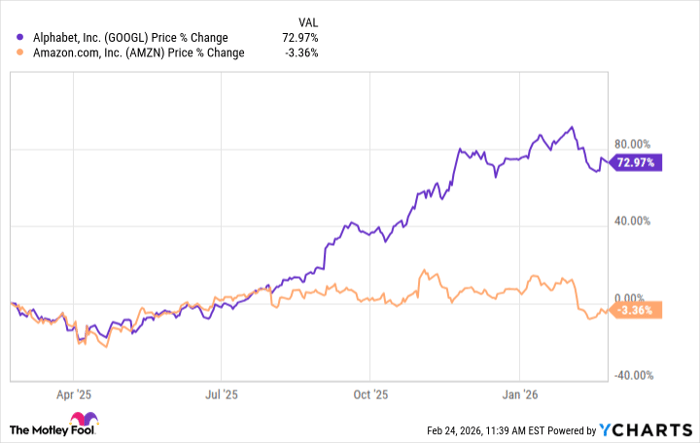
GOOGL data by YCharts.
Over the last year, Alphabet stock has experienced a considerable gain. Meanwhile, shares of Amazon have dropped slightly. So given Alphabet's abnormally high return over that short time period, Ackman may have decided to take some gains off the table. From there, rotating capital into Amazon -- which did not experience an Alphabet-style run-up last year -- seems reasonable.
Image source: Amazon.
2. Meta: The underdog of AI
In the fourth quarter, Pershing Square added one new position to its portfolio, buying 2.7 million shares of Meta Platforms (NASDAQ: META).
Meta might just be the most misunderstood AI opportunity among megacap technology stocks. Skeptics argue that Meta's AI use cases are limited given the company's ad-heavy business model. Moreover, the bears are certainly concerned that Meta's leadership will not allocate its AI budget efficiently, given how it overspent on its metaverse ambitions for years.
If you look at the underlying trends, though, Meta's AI business appears to be off the charts. Specifically, the company's Advantage+ product is operating at a reported $60 billion annual revenue run rate, per management's last update.
The Advantage+ suite brings new levels of automation to the realm of digital advertising compared to the previous tools available to marketers. Thanks to progress in machine learning algorithms, Meta's customers are realizing higher returns on investment on their advertising campaigns.
The lucrative opportunity here is that Meta can expand Advantage+ across its entire ecosystem -- spanning more than 3.6 billion daily active people using Facebook, Instagram, and WhatsApp.
In theory, this should make Meta's advertising platform stickier as its customers come to rely on Advantage+ over competing tools. In the long run, AI should help Meta command robust unit economics from its user base, given the company's efforts to drive higher engagement.
Are Amazon and Meta good stocks to buy right now?
Over the last month or so, Amazon and Meta have experienced meaningful valuation corrections. Amazon stock sold off considerably after the company set out plans for materially higher-than-expected capital expenditures in 2026. Meanwhile, Meta remains in a "prove it to me" mode as some investors continue to doubt whether its AI spending will pay off.
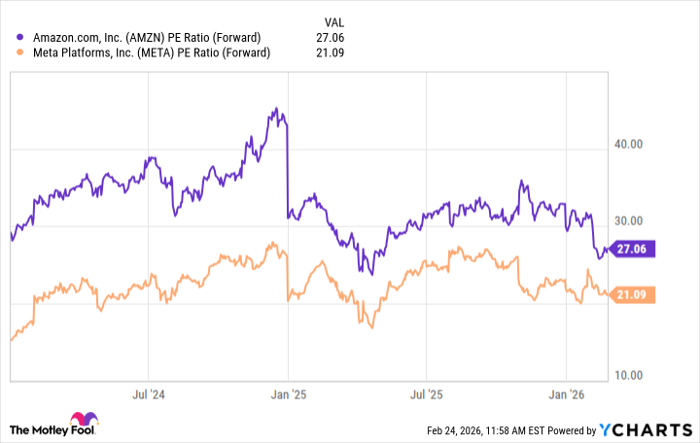
AMZN PE Ratio (Forward) data by YCharts.
As the tech sector continues to experience sell-offs and pronounced volatility, both Amazon and Meta are now trading near their cheapest forward price-to-earnings ratios since the AI revolution began.
These dynamics suggest that investors are allowing near-term uncertainties to outweigh the long-term upsides for Amazon and Meta. Meanwhile, institutional money managers like Ackman appear to be looking at the bigger picture -- one that suggests both Amazon and Meta will continue to be major winners of the AI boom.
For these reasons, I think following Ackman and buying the dip in Amazon and Meta could be a wise choice for retail investors with long-term time horizons.
Should you buy stock in Amazon right now?
Before you buy stock in Amazon, consider this:
The Motley Fool Stock Advisor analyst team just identified what they believe are the 10 best stocks for investors to buy now… and Amazon wasn’t one of them. The 10 stocks that made the cut could produce monster returns in the coming years.
Consider when Netflix made this list on December 17, 2004... if you invested $1,000 at the time of our recommendation, you’d have $456,188!* Or when Nvidia made this list on April 15, 2005... if you invested $1,000 at the time of our recommendation, you’d have $1,133,413!*
Now, it’s worth noting Stock Advisor’s total average return is 916% — a market-crushing outperformance compared to 194% for the S&P 500. Don't miss the latest top 10 list, available with Stock Advisor, and join an investing community built by individual investors for individual investors.
See the 10 stocks »
*Stock Advisor returns as of February 27, 2026.
Adam Spatacco has positions in Alphabet, Amazon, Meta Platforms, and Nvidia. The Motley Fool has positions in and recommends Alphabet, Amazon, Meta Platforms, and Nvidia. The Motley Fool recommends Broadcom. The Motley Fool has a disclosure policy.
Recommended Articles


