




Is This Super Software Stock a Buy After Its Dramatic 86% Decline? Here's What Wall Street Thinks
Key Points
Bill Holdings' portfolio of software products help small and medium-sized businesses streamline their accounts payable and accounts receivable processes.
Bill's revenue growth is slowing because management is focusing more on profitability, but investors are disappointed with this strategy.
Bill stock is the cheapest it has been since going public in 2019, and Wall Street thinks it might be time to buy.
- 10 stocks we like better than Bill Holdings ›
Bill Holdings (NYSE: BILL) offers a portfolio of software products designed to help small and medium-sized businesses (SMBs) manage their accounts receivable, accounts payable, and budgeting workflows more efficiently. Software stocks have fallen out of favor recently as investors worry that artificial intelligence (AI) will shrink the workforce (and therefore demand for software licenses), and also help businesses build their own software, thus reducing their reliance on external vendors.
I don't think those concerns apply to Bill for two reasons:
Where to invest $1,000 right now? Our analyst team just revealed what they believe are the 10 best stocks to buy right now, when you join Stock Advisor. See the stocks »
- Most of Bill's clients are SMBs that don't have big workforces to begin with. Plus, most of its revenue comes from transaction fees, not software licensing fees.
- SMBs are unlikely to have the internal expertise to replicate Bill's software suite, even with the help of AI.
With all of that said, Bill stock has been declining since the 2021 tech boom ran out of steam, and it's currently down 86% from its record high. The stock is currently the cheapest it has ever been by at least one widely used valuation metric, and the majority of the analysts tracked by The Wall Street Journal think it's time to buy, with not a single one recommending selling. Here's why their bullish stance might be justified.

Image source: Getty Images.
Bill adds significant value for its customers
Small business owners are often stretched thin. They have to be product experts, salespeople, marketing strategists, bookkeepers, and more, so Bill is trying to put some time back into their pockets. The company developed a cloud-based digital inbox where SMBs can receive invoices directly to eliminate messy paper trails. From there, the platform routes each invoice to the necessary person for approval, where it can be paid with a single click.
Bill also streamlines the accounts receivable process. Its platform enables SMBs to rapidly generate one-off invoices, or it can automatically create recurring invoices for regular clients. Plus, it tracks incoming payments to ensure money always comes in on time. Bill says its customers get paid twice as fast as SMBs that aren't using its platform, which is an attractive value proposition.
Around 73% of Bill's revenue comes from transaction fees whenever an SMB sends or receives a payment using its platform. Only 17% of its revenue comes from software licensing subscriptions that are charged on a per-user basis, so the company won't be overly exposed if technologies like AI shrink its customers' workforces.
Plus, Bill has a rock-solid network of 9,500 accounting firms (and growing) that recommend its products to their clients, which creates a powerful moat. Its software makes their jobs much easier at tax time, so it's a win for everyone involved.
Revenue growth is slowing, which is worrying investors
Part of the reason Bill stock soared to a record high of over $330 in 2021 is because its revenue was soaring. It grew by 51% in fiscal 2021 (ended June 30, 2021), and then by a whopping 169% in fiscal 2022 (ended June 30, 2022). However, the company was spending aggressively on customer acquisition to fuel that growth, which resulted in steep losses at the bottom line.
Bill is spending far more cautiously these days to deliver profitability, but the trade-off is much slower growth. The company generated $810.4 million in revenue during the first half of fiscal 2026 (ended Dec. 31, 2025), which was up by a modest 12% year over year.
On the plus side, after stripping out one-off and non-cash expenses like stock-based compensation, Bill delivered an adjusted profit of $143.5 million for the period, so its new strategy appears to be working.
Nevertheless, investors typically don't like it when a company takes its foot off the gas, because slower growth often means slower returns. But Bill's business is far more sustainable now, which should bode well for the long term in my opinion.
Wall Street is bullish on Bill stock
The Wall Street Journal tracks 24 analysts who cover Bill stock, and 15 have given it a buy rating. The other nine recommend holding, so none recommend selling. The analysts have an average price target of $57.73, which suggests the stock could climb by 25% over the next 12 months or so, but the Street-high target of $84 implies a much greater upside of 82%.
I think both targets are realistic. Bill had 498,500 customers as of Dec. 31, which is a drop in the bucket compared to the estimated 72 million SMBs in its addressable market. Plus, those SMBs process $135 trillion in business-to-business payment volume each year, which presents the company with a massive financial opportunity.
Following the 86% decline in Bill stock, it's now trading at a price-to-sales (P/S) ratio of just 3, which is near the cheapest level since it went public in 2019.
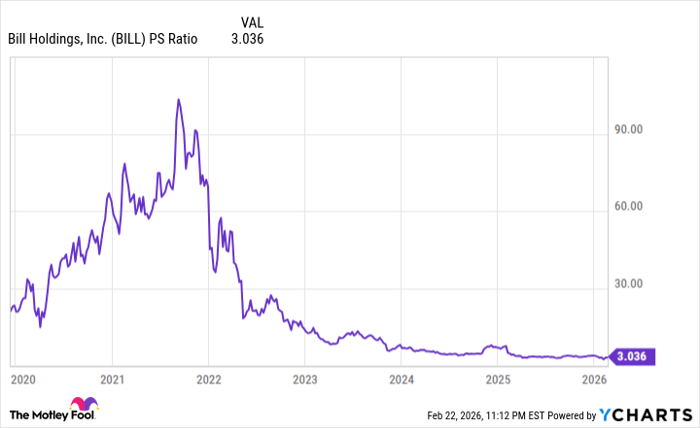
BILL PS Ratio data by YCharts
Therefore, while the current downtrend in Bill stock is extremely powerful, its valuation is starting to look very attractive -- which could attract fresh buyers. The combination of the company's steady growth and enormous addressable market could make Bill a solid long-term investment, especially in light of Wall Street's bullish sentiment.
Should you buy stock in Bill Holdings right now?
Before you buy stock in Bill Holdings, consider this:
The Motley Fool Stock Advisor analyst team just identified what they believe are the 10 best stocks for investors to buy now… and Bill Holdings wasn’t one of them. The 10 stocks that made the cut could produce monster returns in the coming years.
Consider when Netflix made this list on December 17, 2004... if you invested $1,000 at the time of our recommendation, you’d have $409,970!* Or when Nvidia made this list on April 15, 2005... if you invested $1,000 at the time of our recommendation, you’d have $1,174,241!*
Now, it’s worth noting Stock Advisor’s total average return is 889% — a market-crushing outperformance compared to 192% for the S&P 500. Don't miss the latest top 10 list, available with Stock Advisor, and join an investing community built by individual investors for individual investors.
See the 10 stocks »
*Stock Advisor returns as of February 24, 2026.
Anthony Di Pizio has no position in any of the stocks mentioned. The Motley Fool has positions in and recommends Bill Holdings. The Motley Fool has a disclosure policy.
Recommended Articles


