




Stock Market Crash in 2026? Bad News About President Trump's Tariffs and a Warning From the Federal Reserve Explain Why It's Possible.
Key Points
In November, the Federal Reserve's Financial Stability Report warned that the S&P 500's valuation was near the upper end of its historical range.
Elevated valuations are particularly worrisome because recent studies suggest President Trump's tariffs will be a headwind to economic growth.
The S&P 500 finished January with a forward PE multiple above 22, an expensive valuation that has historically preceded bear markets.
- 10 stocks we like better than S&P 500 Index ›
In September, Federal Reserve Chair Jerome Powell warned investors that stocks were expensive, but the S&P 500 (SNPINDEX: ^GSPC) has since added about 3%. Not a substantial return, but large enough to say the market has brushed aside the warning to some degree.
However, recent studies suggest President Trump's tariffs will slow economic growth, despite his assurances to the contrary. High valuations alone could cause stocks to drop, but the market could fall sharply (or even crash) if tariffs become a material headwind for the economy.
Where to invest $1,000 right now? Our analyst team just revealed what they believe are the 10 best stocks to buy right now, when you join Stock Advisor. See the stocks »
Here's what investors should know.
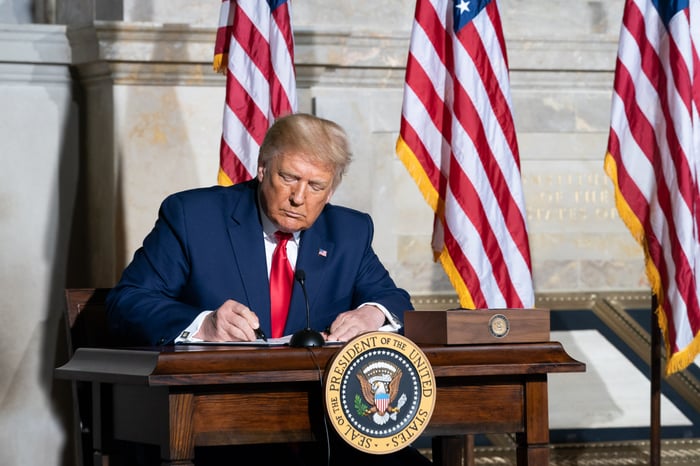
Image source: Official White House Photo by Joyce N. Boghosian.
Bad news about President Trump's tariffs: U.S. companies and consumers are paying the bill
President Trump's tariffs have raised the average tax on U.S. imports roughly fivefold to 13%, though some sources put that percentage a few points higher or lower. Regardless, the average tax on imports is near its highest level in 90 years.
Trump has consistently argued that tariffs will help the U.S. economy and recently claimed the burden has "fallen overwhelmingly on foreign producers and middlemen, including large corporations that are not from the U.S." But recent studies suggest the opposite is true.
- Research published by the National Bureau of Economic Research states, "Costs are largely borne by the United States, as exporters have, on average, not dropped their prices." The authors estimate U.S. companies and consumers paid 94% of the tariffs in 2025.
- Research published by the Federal Reserve Bank of New York states, "Our results show that the bulk of the tariff incidence continues to fall on U.S. firms and consumers." The authors estimate foreign exporters absorbed 14% of the tariff costs in November, while U.S. companies and consumers paid the remaining 86%.
- Research published by the Kiel Institute states, "American importers and consumers bear nearly the entire cost." The authors estimate foreign exporters have absorbed only 4% of the tariffs, while the remaining 96% has been passed through to U.S. buyers.
- The Congressional Budget Office (CBO) estimates foreign exporters will absorb 5% of the tariffs, while the remaining 95% will be split between U.S. companies and consumers.
Here's the big picture: Every dollar in tariff revenue the government siphons away from U.S. companies and consumers is a dollar they could have spent elsewhere to support the economy. In other words, tariffs leave businesses and consumers with less purchasing power, which slows economic growth.
The Federal Reserve's warning: The stock market is very expensive by historical standards
The CBO says the Trump administration's tariffs will "result in real GDP that is lower than it otherwise would have been if those tariffs had not been implemented." That is bad news for the stock market because slower economic growth portends lower corporate earnings, and stocks are typically valued as a multiple of corporate earnings.
That bad news comes at a particularly inopportune time because the S&P 500 has maintained an elevated valuation for several months. In September, Fed Chair Jerome Powell warned, "equity prices are fairly highly valued." In November, the Federal Reserve's Financial Stability Report said the S&P 500 had a forward price-to-earnings (PE) ratio "close to the upper end of its historical range."
The situation has not improved. The S&P 500 finished January with a forward PE multiple of 22.2, well above the 10-year average of 18.8. The index has only sustained a similar valuation during two other periods in last four decades: the dot-com bubble and the Covid-19 pandemic. Both incidents ultimately led to bear markets, during which the S&P 500 fell 49% and 34%, respectively.
By definition, forward PE ratios are calculated based on forward earnings estimates, meaning stocks are already expensive by historical standards even if earnings grow as fast as Wall Street anticipates. But if analysts have overestimated forward earnings -- a possibility made more likely by tariffs -- the stock market could decline sharply, or even crash, in the future.
Should you sell your entire portfolio? Absolutely not. Trying to time the market could easily backfire. For instance, productivity gains from artificial intelligence could offset economic weakness created by tariffs, in which case stocks could avoid a bear market despite high valuations. However, you should be cautious when putting money into the market. Start with small positions, and never buy stocks you would feel uncomfortable holding during through a steep sell-off.
Should you buy stock in S&P 500 Index right now?
Before you buy stock in S&P 500 Index, consider this:
The Motley Fool Stock Advisor analyst team just identified what they believe are the 10 best stocks for investors to buy now… and S&P 500 Index wasn’t one of them. The 10 stocks that made the cut could produce monster returns in the coming years.
Consider when Netflix made this list on December 17, 2004... if you invested $1,000 at the time of our recommendation, you’d have $414,554!* Or when Nvidia made this list on April 15, 2005... if you invested $1,000 at the time of our recommendation, you’d have $1,120,663!*
Now, it’s worth noting Stock Advisor’s total average return is 884% — a market-crushing outperformance compared to 193% for the S&P 500. Don't miss the latest top 10 list, available with Stock Advisor, and join an investing community built by individual investors for individual investors.
See the 10 stocks »
*Stock Advisor returns as of February 18, 2026.
Trevor Jennewine has no position in any of the stocks mentioned. The Motley Fool has no position in any of the stocks mentioned. The Motley Fool has a disclosure policy.
Recommended Articles


