




Best Consumer Stock to Buy Right Now: Costco or Home Depot?
Key Points
Despite its already massive size, Costco continues to open new warehouses around the world.
Home Depot faces cyclical demand, but the industry backdrop supports long-term growth.
Investors will choose their top stock based on whether they prioritize value or quality.
- 10 stocks we like better than Costco Wholesale ›
With $270 billion in fiscal 2025 net sales, Costco Wholesale (NASDAQ: COST) is one of the top players in the general merchandise retailing category. Its shares have generated a total return of 199% in the past five years (as of Feb. 13).
On the other hand, Home Depot's (NYSE: HD) share price is up just 41% during the same time. But this is the industry heavyweight in what is a massive home improvement market.
Will AI create the world's first trillionaire? Our team just released a report on the one little-known company, called an "Indispensable Monopoly" providing the critical technology Nvidia and Intel both need. Continue »
Between these two leading retail stocks, which is the best one to buy right now?
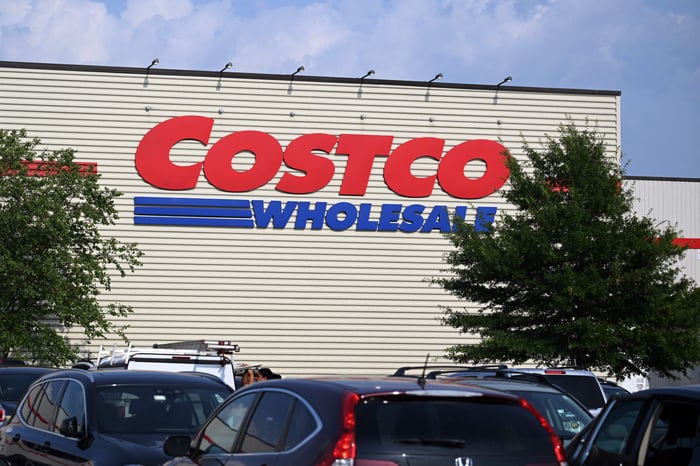
Image source: Getty Images.
Costco is a steady performer, and it's expanding by opening new warehouses
It seems that not a quarter or year goes by that Costco isn't reporting same-store sales growth. Even in fiscal 2020, when the COVID-19 pandemic ravaged the economy, the business saw same-store sales rise 7.7%. This is a clear signal that Costco experiences stable demand regardless of macro conditions. That can provide peace of mind for investors.
The main draw is the value proposition, as Costco excels at selling high-quality goods at cheap prices. This is possible because of its massive scale, allowing it to obtain merchandise at favorable costs. This alone is enough to drive loyalty.
But it's the membership business model that supports stickiness and repeat visits. Costco's membership base expanded by 5.2% year over year in the first quarter of fiscal year 2026 (ended Nov. 23, 2025) to 81.4 million. The worldwide renewal rate is a healthy 89.7%. This brings in a recurring and high-margin revenue stream.
And the growth story isn't finished. Costco currently has 921 warehouses. Management's goal in the future is to get to a pace of 30 net new openings each year. There is plenty of opportunity both within and outside of the U.S., which is an encouraging trend.
Net income has climbed at a compound annual rate of 11.4% in the past five years. Besides funding regular payouts, these profits boost returns by supporting Costco's sizable and occasional special dividends.
Home Depot faces cyclical demand, but there's opportunity to take market share
Home Depot was thriving during the pandemic years, posting double-digit revenue growth in fiscal 2020 and fiscal 2021. People were flush with cash and spending more time than ever at home. Money went to renovations and upgrades.
Demand has softened in recent years, though. And this highlights how Home Depot differs from Costco. Home Depot faces cyclical demand that ebbs and flows with interest rates and consumer confidence. Home Depot registered positive same-store sales of just 0.2% in the third quarter of fiscal year 2025 (ended Nov. 2, 2025). With consumers pulling back on big-ticket purchases, it makes sense why the business is feeling the pain.
However, Home Depot is the clear leader in a gargantuan industry that's estimated to be worth $1 trillion. It has brand recognition, a large physical store footprint, supply chain and omnichannel capabilities, and inventory availability. These favorable traits should continue to draw in customers.
The industry backdrop can also work to the benefit of Home Depot. The average age of a home in the U.S. was 40 years in 2022, up meaningfully from 35 years in 2012. Older houses require more upkeep.
Home Depot's management says there are trillions of dollars in untapped home equity in the U.S., since residential real estate prices have climbed a lot over the past several years. This can eventually be accessed to pay for upgrades, supporting long-term demand.
Do you prefer a cheap valuation or high quality?
Costco is the higher-quality business. Most investors would not argue with that. But the valuation isn't cheap. Shares trade at a steep price-to-earnings (P/E) ratio of 54.6. Value investors might run away from Costco. But investors who want to own the best companies will still be interested.
This isn't to say that Home Depot, which trades at a P/E multiple of 26.8, is exactly cheap. It's a struggling business. However, it's the better option for those who care less about quality in favor of getting a better deal in the market between these two retailers.
Should you buy stock in Costco Wholesale right now?
Before you buy stock in Costco Wholesale, consider this:
The Motley Fool Stock Advisor analyst team just identified what they believe are the 10 best stocks for investors to buy now… and Costco Wholesale wasn’t one of them. The 10 stocks that made the cut could produce monster returns in the coming years.
Consider when Netflix made this list on December 17, 2004... if you invested $1,000 at the time of our recommendation, you’d have $414,554!* Or when Nvidia made this list on April 15, 2005... if you invested $1,000 at the time of our recommendation, you’d have $1,120,663!*
Now, it’s worth noting Stock Advisor’s total average return is 884% — a market-crushing outperformance compared to 193% for the S&P 500. Don't miss the latest top 10 list, available with Stock Advisor, and join an investing community built by individual investors for individual investors.
See the 10 stocks »
*Stock Advisor returns as of February 17, 2026.
Neil Patel has no position in any of the stocks mentioned. The Motley Fool has positions in and recommends Costco Wholesale and Home Depot. The Motley Fool has a disclosure policy.
Recommended Articles


