




BlackRock & State Street Rejected Her ETF. It Just Returned 5X Its Category Average.
Key Points
The Freedom 100 Emerging Markets ETF's return of 99% over the past five years is 5 times that of the iShares Emerging Markets ETF.
Its strategy of excluding countries and companies with high exposure to personal, political, and economic risks gives it a high-quality tilt.
With $2.5 billion in assets, investors have started to take notice.
- 10 stocks we like better than Ea Series Trust - Freedom 100 Emerging Markets ETF ›
Who doesn't love a good underdog story?
The exchange-traded fund (ETF) industry has largely been dominated by three heavyweights: Vanguard, State Street, and BlackRock. With other major issuers, such as Schwab, Invesco, and JPMorgan Chase, also looming, it's become increasingly difficult for the little guy to gain traction.
Where to invest $1,000 right now? Our analyst team just revealed what they believe are the 10 best stocks to buy right now, when you join Stock Advisor. See the stocks »
But every once in a while, someone breaks through.
Enter Perth Tolle. Originally a private wealth advisor at Fidelity, she founded Life & Liberty Indexes with a simple premise. When investing in emerging markets, countries with greater levels of personal, political, and economic freedoms are more likely to outperform the broader emerging markets indexes.
In 2017, the Freedom 100 EM Index was launched. Tolle initially pitched an ETF based on the index to several major players, including BlackRock and State Street, but they declined to take it on. In 2018, Alpha Architect agreed to help bring it to market, and in 2019, the Freedom 100 Emerging Markets ETF (NYSEMKT: FRDM), which tracks that index, debuted.

Source: Getty Images.
What is the Freedom 100 Emerging Markets ETF?
The investment process behind this ETF is pretty straightforward. After applying a minimum market cap screen for 24 eligible emerging market economies, each country is scored across 87 different freedom variables. These include levels of violent crime, terrorist activity, corruption, due process laws, freedom of speech, legal system quality, monetary system quality, and regulation.
State-owned enterprises are wisely excluded since profit is often not their primary objective. Qualifying components get market-cap-weighted across included countries.
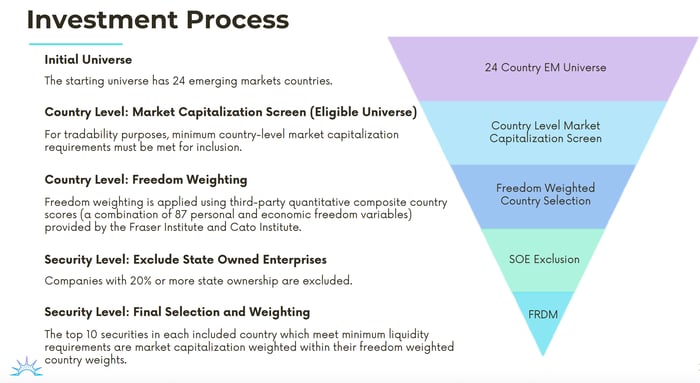
Image source: Freedom ETFs.
Overall, this is a smart concept that hits on many fronts. All the fund is really doing is pulling out the countries and stocks with the greatest opportunity set for success. By eliminating countries and companies that are facing challenges due to any number of political or economic factors, you put a heavy quality tilt in the portfolio that favors outperformance over time.
And outperform it has!
Over the past five years, its 99% total return is nearly 5 times that of the iShares MSCI Emerging Markets ETF (NYSEMKT: EEM).
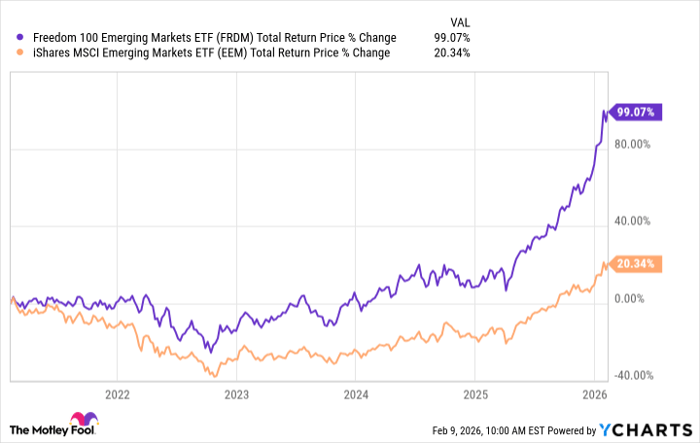
FRDM Total Return Price data by YCharts. ETF = exchange-traded fund.
Perhaps more impressive is that excluding state-owned enterprises or choosing a quality tilt over the past few years hasn't been an automatic source of extra returns. In fact, neither of those paths has really added to returns at all if you look at the major indexes.
But the Freedom 100 Emerging Markets ETF has managed to pull it off. Its precise selection strategy has managed to pick winners and avoid losers to create a lot of alpha for shareholders.
And investors have taken notice, too. The fund is up to about $2.5 billion in assets under management (AUM). It may not ever compete with the bigger players in terms of sheer size, but its performance record can stand up to any of them!
Should you buy stock in Ea Series Trust - Freedom 100 Emerging Markets ETF right now?
Before you buy stock in Ea Series Trust - Freedom 100 Emerging Markets ETF, consider this:
The Motley Fool Stock Advisor analyst team just identified what they believe are the 10 best stocks for investors to buy now… and Ea Series Trust - Freedom 100 Emerging Markets ETF wasn’t one of them. The 10 stocks that made the cut could produce monster returns in the coming years.
Consider when Netflix made this list on December 17, 2004... if you invested $1,000 at the time of our recommendation, you’d have $414,554!* Or when Nvidia made this list on April 15, 2005... if you invested $1,000 at the time of our recommendation, you’d have $1,120,663!*
Now, it’s worth noting Stock Advisor’s total average return is 884% — a market-crushing outperformance compared to 193% for the S&P 500. Don't miss the latest top 10 list, available with Stock Advisor, and join an investing community built by individual investors for individual investors.
See the 10 stocks »
*Stock Advisor returns as of February 15, 2026.
JPMorgan Chase is an advertising partner of Motley Fool Money. David Dierking has no position in any of the stocks mentioned. The Motley Fool has positions in and recommends JPMorgan Chase. The Motley Fool recommends BlackRock. The Motley Fool has a disclosure policy.
Recommended Articles


