




President Donald Trump and Wall Street Want Lower Interest Rates -- but Fed Chair Nominee Kevin Warsh May Have Other Plans
Key Points
The Dow Jones Industrial Average, S&P 500, and Nasdaq Composite are soaring -- and the prospect of future interest rate cuts is a foundational reason why.
On Jan. 30, President Trump nominated Kevin Warsh to replace Jerome Powell as Fed chair, whose term ends on May 15.
Although Warsh has prior experience within the FOMC, his focus on inflation, coupled with his desire to deleverage the central bank's $6.6 trillion balance sheet, may work against efforts to lower interest rates.
- 10 stocks we like better than S&P 500 Index ›
In case you haven't noticed, the stock market has been practically unstoppable for the better part of the last seven years. The benchmark S&P 500 (SNPINDEX: ^GSPC) has gained at least 16% in six of the previous seven years. Meanwhile, the iconic Dow Jones Industrial Average (DJINDICES: ^DJI) just surpassed 50,000 for the first time in its nearly 130-year history, and the growth-focused Nasdaq Composite (NASDAQINDEX: ^IXIC) continues to generate outsize returns.
These gains haven't occurred by accident. They reflect a confluence of factors that have instilled optimism in investors, including (but not limited to):
Will AI create the world's first trillionaire? Our team just released a report on the one little-known company, called an "Indispensable Monopoly" providing the critical technology Nvidia and Intel both need. Continue »
- The rise of artificial intelligence and the advent of quantum computing.
- Better-than-expected corporate earnings.
- Record S&P 500 share buyback activity (which is boosting earnings per share for most companies).
- The Federal Reserve's rate-easing cycle.
This last point, the nation's central bank reducing the federal funds target rate (the overnight lending rate between financial institutions), is especially important. Lowering the federal funds rate, which in turn reduces borrowing costs for consumers and businesses, is viewed as a key catalyst to boosting U.S. economic growth. If lending is less costly for businesses, they're more inclined to borrow with the intent to increase hiring, acquisition activity, and capital spent on innovation.
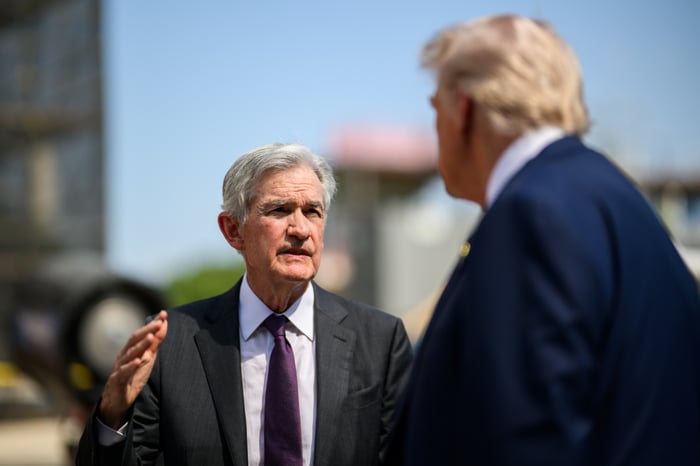
Jerome Powell's term as Fed chair ends on May 15, 2026. Image source: Official White House Photo by Daniel Torok.
President Donald Trump has been a vocal proponent of reducing interest rates, while Wall Street has practically made lower borrowing costs a foregone conclusion. However, Trump's nominee to succeed Jerome Powell as Fed chair may not share this same game plan.
Trump's nomination of Kevin Warsh may backfire on Wall Street
The Federal Open Market Committee (FOMC) is a 12-person body, including Fed Chair Jerome Powell, that's responsible for setting our nation's monetary policy. It does this by adjusting the federal funds rate and/or undertaking open-market operations, such as buying or selling U.S. Treasuries or mortgage-backed securities.
Although Donald Trump appointed Jerome Powell to serve as Fed chair during his first, non-consecutive term in the White House, the president and Powell have publicly feuded over the velocity of interest rate reductions since Trump's second term began. Powell's time as Fed chair will come to a close exactly three months from today, on May 15, 2026.
On Jan. 30, Trump announced his long-awaited nominee to take Powell's place and guide the FOMC, Kevin Warsh.
Warsh previously served on the Board of Governors of the Federal Reserve from Feb. 24, 2006, to March 31, 2011. You'll note this timeline coincides with, arguably, the most challenging period for the nation's central bank since the Great Depression -- or at the very least, the hyperinflation period of the early 1980s. Warsh has experience, and we, as investors, have statistical evidence of how he might approach future challenges from a leadership position.
"If Trump wants someone easy on inflation, he got the wrong guy in Kevin Warsh."@AnnaEconomist pic.twitter.com/FGMfeSqHpU
-- Daily Chartbook (@dailychartbook) January 31, 2026
Perhaps the defining characteristic of the final few years of Warsh's tenure on the Board of Governors was his focus on inflation over unemployment.
The Fed's primary goals are to maximize employment and stabilize prices. Whereas most members of the FOMC were paying closer attention to rising unemployment during the Great Recession, Warsh homed in on inflationary concerns and was reluctant to keep interest rates at/near historic lows. Warsh's historic propensity to focus on inflation is a potential worry for Wall Street.
Although the trailing 12-month inflation rate has fallen off considerably since peaking at over 9% in June 2022, it's still above the Fed's long-term target of 2%. Shelter inflation -- the largest weighted component of the Consumer Price Index for All Urban Consumers -- has been particularly stubborn. An inflation rate that's unwilling to bend or declining at a snail's pace is unlikely to encourage a dovish rate-cutting approach from Trump's Fed chair nominee.
Image source: Getty Images.
Warsh's stance on balance sheet deleveraging marks potential trouble for stocks
However, Warsh's response during the financial crisis isn't the only reason for investors to be skeptical of additional rate cuts.
The Fed Chair nominee has previously been critical of the role the Federal Reserve has played in stabilizing markets. Specifically, Warsh holds the opinion that the Fed should be a passive observer rather than an active participant. On paper, this makes sense -- but it's easier said than done when the nation's central bank has a $6.6 trillion balance sheet.
The Fed's balance sheet is primarily comprised of U.S. Treasury bonds and mortgage-backed securities (MBS). Since bond prices and yields are inversely related, buying bonds can raise prices and lower long-term yields (and, by extension, interest rates).
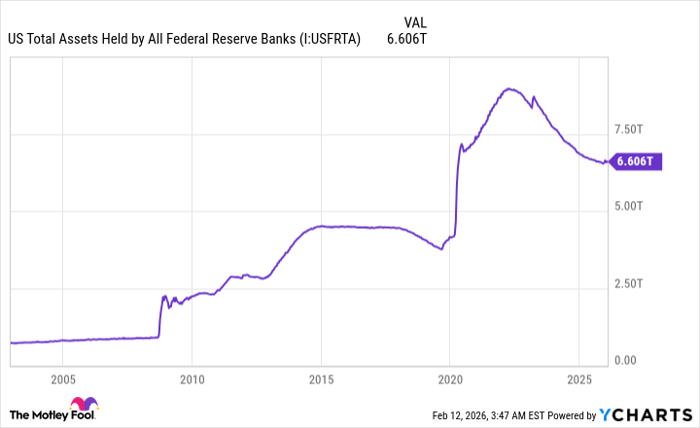
US Total Assets Held by All Federal Reserve Banks data by YCharts.
Hypothetically, if Kevin Warsh got his wish and the Fed were to actively deleverage its balance sheet, we'd see Treasury bonds and MBSs being sold. As U.S. Treasuries and MBSs hit the market, borrowing costs, including mortgages, would climb. In other words, Warsh's balance sheet deleveraging would likely reduce housing affordability and disincentivize consumer/corporate lending -- i.e., the opposite of what President Trump and Wall Street would prefer to see.
To be fair, there are a lot of hurdles to clear before any of these potential fears would be realized for investors. Warsh first needs to receive a majority of votes in the Senate Banking Committee to proceed to a full Senate vote. It's unclear if the former Fed Governor has the necessary votes in the Senate Banking Committee right now.
Additionally, Warsh represents a single vote among 12 within the FOMC. While his commentary may draw more media attention than that of other voting members, it would take a strategic shift within the FOMC to pare down the central bank's balance sheet.
Nevertheless, historic division within the FOMC at the tail-end of Powell's term, coupled with clear question marks about Kevin Warsh's monetary policy approach, has the potential to send a historically expensive stock market over the edge.
Should you buy stock in S&P 500 Index right now?
Before you buy stock in S&P 500 Index, consider this:
The Motley Fool Stock Advisor analyst team just identified what they believe are the 10 best stocks for investors to buy now… and S&P 500 Index wasn’t one of them. The 10 stocks that made the cut could produce monster returns in the coming years.
Consider when Netflix made this list on December 17, 2004... if you invested $1,000 at the time of our recommendation, you’d have $414,554!* Or when Nvidia made this list on April 15, 2005... if you invested $1,000 at the time of our recommendation, you’d have $1,120,663!*
Now, it’s worth noting Stock Advisor’s total average return is 884% — a market-crushing outperformance compared to 193% for the S&P 500. Don't miss the latest top 10 list, available with Stock Advisor, and join an investing community built by individual investors for individual investors.
See the 10 stocks »
*Stock Advisor returns as of February 15, 2026.
Sean Williams has no position in any of the stocks mentioned. The Motley Fool has no position in any of the stocks mentioned. The Motley Fool has a disclosure policy.
Recommended Articles


