




Palantir: Stock to Avoid or Once-in-a-Decade Buying Opportunity?
Key Points
Palantir has been one of the most successful growth stories of the AI boom so far.
Commercial and government customers have rushed to the software company, driving revenue higher.
- 10 stocks we like better than Palantir Technologies ›
Palantir Technologies (NASDAQ: PLTR) has roared higher in recent years as investors identified it as one of the companies winning in this artificial intelligence (AI) revolution. The company sells software platforms, including one leveraging the power of AI, that help customers make better use of their data. And demand for this software has skyrocketed, resulting in tremendous earnings growth for the company.
Though this earnings strength has continued, the stock has faltered in recent times. Investors have worried about Palantir's high valuation -- and the possibility that, if an AI bubble forms, Palantir may be among the first to suffer as investors flee the most expensive stocks. Palantir stock has soared 1,700% over the past three years, but so far this year, the stock has lost about 20%.
Will AI create the world's first trillionaire? Our team just released a report on the one little-known company, called an "Indispensable Monopoly" providing the critical technology Nvidia and Intel both need. Continue »
Is Palantir a stock to avoid right now -- or is it a once-in-a-decade buying opportunity? Let's find out.

Image source: Getty Images.
From under-the-radar to center stage
First, let's talk about the Palantir story so far. It's important to note that Palantir isn't a young start-up that recently jumped into the spotlight. Instead, it's a company that launched more than 20 years ago, so it's had plenty of time to work on its software platforms and develop expertise. In Palantir's early days, contracts with the government drove revenue, and Palantir, as a private company, wasn't necessarily on investors' radar screens.
The company's long history provided solid foundations for growth, but its major growth story actually started taking shape just a few years ago. Palantir launched an initial public offering in 2020, which got the ball rolling, and then in 2023, it made a major move that truly marked a turning point. The tech company released its Artificial Intelligence Platform (AIP), an AI-driven system that helps customers gather, analyze, and make use of their data. This may sound banal, but it actually isn't. AIP can reorganize a company's workflow to gain in efficiency, predict outcomes on the battlefield to save lives, or help a company use its data to innovate -- and those are just a few examples.
Considering this versatility, it's not surprising that AIP has been in high demand. It's also important to remember that, these days, as companies seek ways to incorporate AI into their businesses, AIP allows them to do so instantly. So they don't have to build out AI infrastructure or an AI platform.
A new growth driver
Quarter after quarter, Palantir has announced earnings growth -- and the company no longer relies heavily on government contracts. While the government business remains strong, another business has joined it as a growth driver. I'm talking about the U.S. commercial business. The company has grown its number of U.S. commercial customers from 14 just a few years ago to 571 in the latest quarter. Revenue in this business climbed in the triple digits during the quarter, and contract value soared, too.
All of this sounds fantastic, and these trends have powered Palantir stock higher over time, but in recent months, some investors have hesitated to get in on the Palantir story. And in many cases, this is because of the stock's valuation.
Though it's come down significantly, it still remains high in relation to forward earnings estimates.
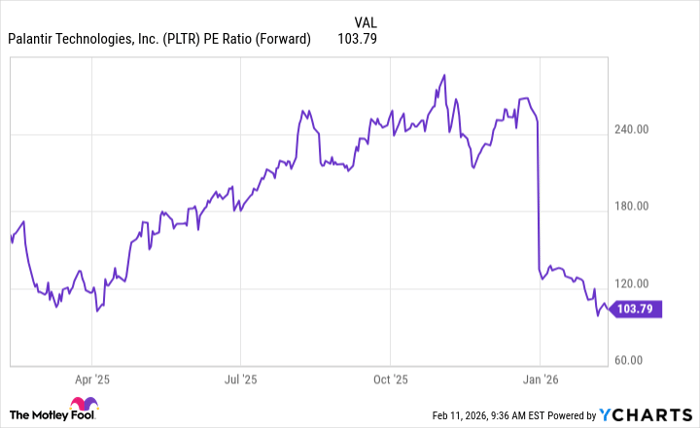
PLTR PE Ratio (Forward) data by YCharts
Is Palantir a buy?
Now, let's consider our question: Is Palantir a stock to avoid at these levels, or are we looking at a once-in-a-decade buying opportunity right now?
I'll start by saying that any new technology -- such as AI -- involves some risk. It's always possible that interest will wane and that technology won't become as big as everyone initially expected. So far, though, all signals point to AI playing a key role in many areas of our lives in the future, so there's reason to be at least cautiously optimistic about this field.
Next, it's key to consider two things about Palantir. First, the company built successful software platforms before the AI boom and generated growth, so it has a long-established track record. This suggests it can manage any potential ups and downs along the AI path.
And my second point is about valuation. These measures consider past earnings or earnings a year from now -- but they don't reflect the company's earnings potential down the road. So, while they are useful, I wouldn't let a high valuation stop me from buying shares of a company like Palantir that may be in the early stages of an explosive AI growth story.
All of this means, if you're a growth investor looking for an exciting potential AI winner, it's not the time to avoid this stock. Palantir may be offering you a once-in-a-decade buying opportunity right now.
Should you buy stock in Palantir Technologies right now?
Before you buy stock in Palantir Technologies, consider this:
The Motley Fool Stock Advisor analyst team just identified what they believe are the 10 best stocks for investors to buy now… and Palantir Technologies wasn’t one of them. The 10 stocks that made the cut could produce monster returns in the coming years.
Consider when Netflix made this list on December 17, 2004... if you invested $1,000 at the time of our recommendation, you’d have $409,108!* Or when Nvidia made this list on April 15, 2005... if you invested $1,000 at the time of our recommendation, you’d have $1,145,980!*
Now, it’s worth noting Stock Advisor’s total average return is 886% — a market-crushing outperformance compared to 193% for the S&P 500. Don't miss the latest top 10 list, available with Stock Advisor, and join an investing community built by individual investors for individual investors.
See the 10 stocks »
*Stock Advisor returns as of February 14, 2026.
Adria Cimino has no position in any of the stocks mentioned. The Motley Fool has positions in and recommends Palantir Technologies. The Motley Fool has a disclosure policy.
Recommended Articles


