




The Best Homebuilding Stocks for 2026
Key Points
Three to four more million homes are needed to solve the U.S.'s housing shortage.
The housing shortage represents a powerful secular trend that is likely to continue.
There is plenty of room for the nation’s leading homebuilders to keep building homes.
- 10 stocks we like better than D.R. Horton ›
Popular opinion suggests there is a shortage of homes for people to live in in the United States. Not all widely held beliefs are true, but in this case, there is quite a bit of evidence supporting the claims that homebuilders haven't been able to keep up with housing demand.
This powerful secular trend is likely to continue, and with the Federal Reserve biased toward lowering interest rates, mortgage rates could continue to fall and add further impetus to a bull run in housing stocks. Here are three names that could boost your portfolio going forward.
Where to invest $1,000 right now? Our analyst team just revealed what they believe are the 10 best stocks to buy right now, when you join Stock Advisor. See the stocks »
The Secular Homebuilding Trend
Last fall, Goldman Sachs issued an update and outlook on the U.S. housing industry. Its analysis echoed the overall sentiment that the U.S. suffers from a chronic housing shortage. The report estimates that an additional 3 to 4 million homes are needed to address our housing shortage. And that's in addition to the normal annual construction of roughly 1.5 million homes.
The laws of supply and demand are in full effect in U.S. housing. Because there are too few homes, too many buyers are chasing them, driving up prices. That leaves plenty of room for the nation's leading homebuilders to keep building homes and better match demand with supply.
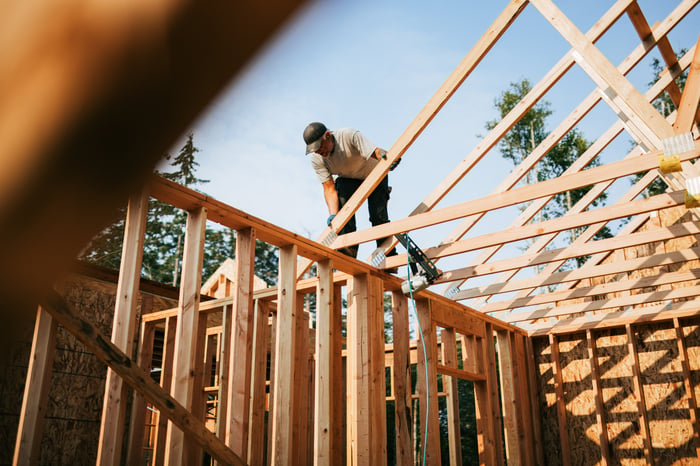
Image source: Getty Images
The Growth Play
LGI Homes Inc. (LGIH) is a regional, but growing homebuilder based in Houston, Texas. It focuses on first-time homebuyers and now sells homes in 21 states.
Most of the large, publicly traded homebuilders, including the likes of KB Home (KBH), PulteGroup Inc. (PHM), Meritage Homes Corporation (MTH), Toll Brothers Inc. (TOL), and Lennar Corporation (LEN) are projected to grow sales in the mid single digits. LGI stands out from this crowd -- analysts project 11% sales growth this year. It expects 6% growth next year, with total sales reaching $2 billion by the end of 2027. That is a much lower level than the larger players. To me, that should make it easier to keep sales growth elevated and above the industry average for at least a few years to come.
The Value Play
Speaking of the industry incumbents, D.R. Horton Inc. (DHI) builds homes in 36 states across the United States. Last year, it reported $34.3 billion in sales, outpacing LGI Homes by more than 17 times. In fact, D.R. Horton is the largest homebuilder in the country.
Still, according to analysts, D.R. Horton should be able to grow sales in the mid-single-digit percent over the next couple of years. That should lead to sales of almost $40 billion by the end of 2028.
In terms of profits, analysts project $16 in earnings per share a couple of years out. That puts the forward P/E ratio at a very reasonable 10x, or less than half of the market multiple of the overall stock market. That seems a great value for a dominant, profitable homebuilder.
DR Horton reported earnings on January 20th that largely exceeded analyst expectations. Here is a deeper dive for Fools looking for more insight into this leading builder.
The Income Play
Instead of building and selling homes to consumers, Invitation Homes Inc. (INVH) buys them, keeps them, and rents them out. Its growth trajectory is impressive and it now owns or manages more than 100,000 homes.
Management believes it is "in the early stages of our third phase of growth" and continues to focus on sunbelt states in the Southeast and Southwest for the bulk of its expansion ambitions. The stock is officially a REIT, or real estate investment trust, to suggest it is more of an income, as opposed to a growth play. This should appeal to more income-minded investors, such as retirees.
The income bias is evident in the projections. Sales growth is pegged at only about 3% over the next couple of years. And earnings per share should hover around $0.75 per share, for a rather lofty forward P/E of 37. However, the dividend yield is 4.34%, which is more than triple the 1.19% yield for the market overall.
The Foolish Bottom Line
It's almost hard to go wrong by investing in America's leading homebuilders. But LGI Homes stands out for its smaller size and higher growth potential. D.R. Horton should continue to plug along as the largest homebuilder in the country, and renting out homes, which is Invitation Homes' forte, is also quite appealing.
Should you buy stock in D.R. Horton right now?
Before you buy stock in D.R. Horton, consider this:
The Motley Fool Stock Advisor analyst team just identified what they believe are the 10 best stocks for investors to buy now… and D.R. Horton wasn’t one of them. The 10 stocks that made the cut could produce monster returns in the coming years.
Consider when Netflix made this list on December 17, 2004... if you invested $1,000 at the time of our recommendation, you’d have $443,353!* Or when Nvidia made this list on April 15, 2005... if you invested $1,000 at the time of our recommendation, you’d have $1,155,789!*
Now, it’s worth noting Stock Advisor’s total average return is 920% — a market-crushing outperformance compared to 196% for the S&P 500. Don't miss the latest top 10 list, available with Stock Advisor, and join an investing community built by individual investors for individual investors.
See the 10 stocks »
*Stock Advisor returns as of February 11, 2026.
At the time of Writing, Ryan Fuhrmann, CFA holds no position in any of the stocks mentioned.
The Motley Fool has positions in and recommends D.R. Horton, Invitation Homes, LGI Homes, and Lennar. The Motley Fool recommends KB Home and Meritage Homes and recommends the following options: short April 2026 $65 calls on KB Home. The Motley Fool has a disclosure policy.
Recommended Articles


