




In 2026, Should You Invest in Stagnant Tesla or Continuously Soaring Gold and Silver?
TradingKey - Since the start of 2025, precious metals have continued to skyrocket, while the performance of the top 10 US stocks by market capitalization has been highly polarized. Driven by sentiment from the "Year One of AI," some companies have seen their share prices and market caps continue to climb, with just Google (GOOGL) and TSMC (TSM) surging by over 70%. In contrast, Tesla (TSLA), seen as the ultimate embodiment of AI concepts, has delivered underwhelming performance. As of January 29, ET, Tesla's gain for the period stood at less than 10%.
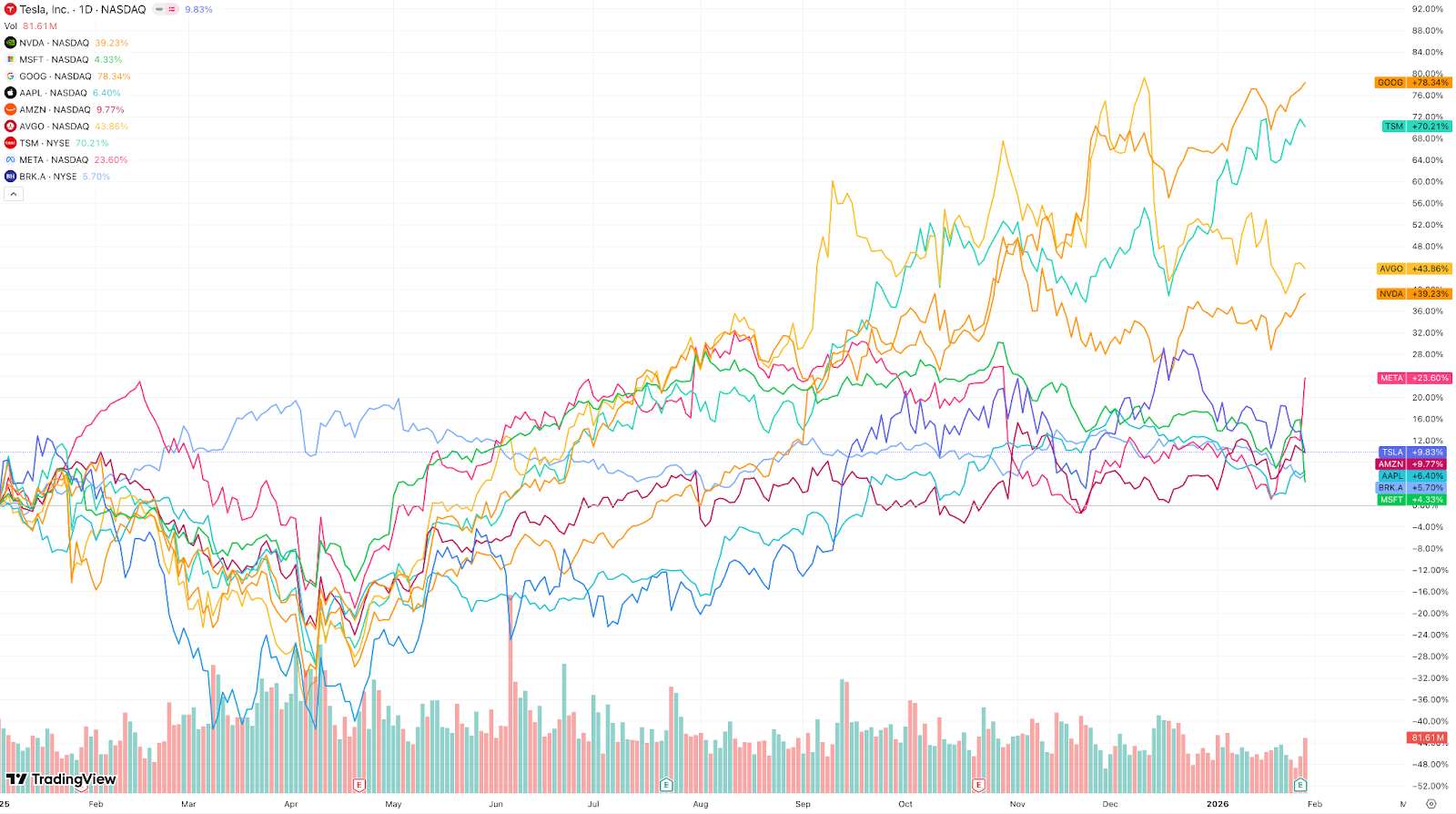
[Year-to-Date Gains of the Top 10 US Stocks, Source: TradingView]
The most prominent performers in the second half of 2025 were gold (XAUUSD) and silver (XAGUSD). Since the beginning of 2025, gold prices have risen by over 100% at their peak, while silver has surged by more than 290%. Amid a consensus bullish outlook from major institutions, the rally in gold and silver appears to have no end in sight.
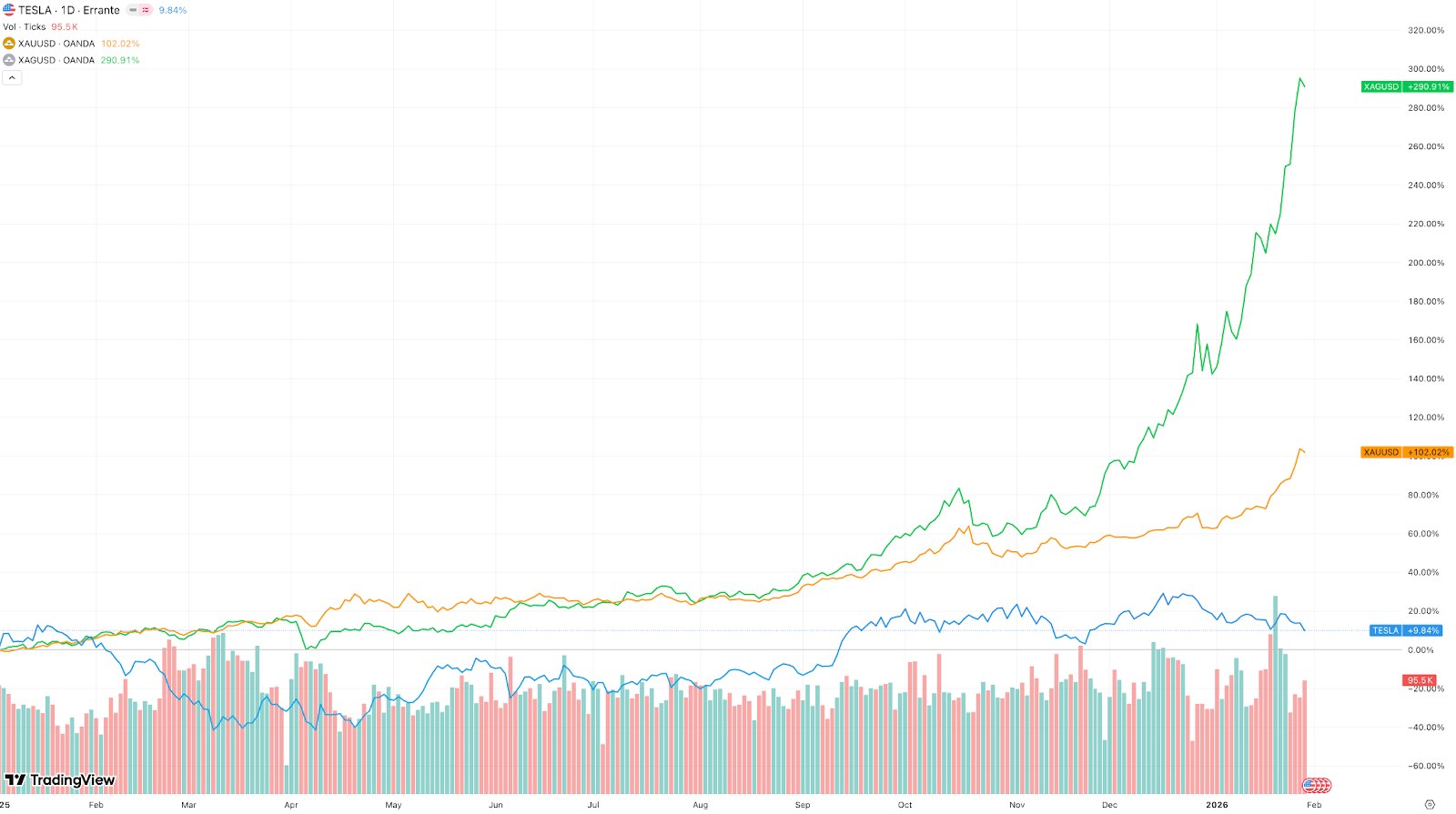
[Gains of Gold, Silver, and Tesla since 2025, Source: TradingView]
However, this raises a critical question: after the massive rally in gold and silver, does the investment logic still hold?
From the perspective of capital structure, the rally in precious metals during the second half of 2025 is no longer just a simple safe-haven trade. Instead, it is driven by a combination of continuous central bank buying, a downward shift in real interest rates, and concerns over long-term currency credibility. This has shifted the pricing logic for gold and silver from "hedging tools" to "trend assets."
However, investors should be wary that as prices soar, the volatility of precious metals has also expanded significantly. For silver, its industrial properties make it more susceptible to shifts in macro expectations and risk appetite. Meanwhile, as gold trades at elevated levels, the risk of a short-term correction cannot be ignored. In other words, while precious metals remain strong, they are no longer low-risk assets.
Against this backdrop, the market has begun to re-examine another class of assets: tech stocks with stagnant short-term performance but enduring long-term narratives. Tesla has thus become a focal point of market discussion.
Should investors choose to invest in Tesla in 2026?
Despite the lack of significant growth in Tesla's share price, we still do not recommend buying Tesla for investors with low risk tolerance for the following reasons:
First, according to Tesla's recently released Q4 2025 earnings report, sales in its core EV business continue to weaken. Tesla's automotive revenue fell sharply by 11% year-over-year to $17.69 billion. Full-year automotive revenue was $69.5 billion, representing a 10% acceleration in decline following the 6.5% year-over-year drop last year, marking two consecutive years of contraction.
Delivery figures released by Tesla show that deliveries for the quarter were 418,000 units, a 16% year-over-year decrease. Full-year deliveries reached 1.636 million units, down 9% year-over-year, also marking a second consecutive year of decline.
Fundamentals suggest that Tesla's stock no longer possesses strong appeal. Furthermore, due to pressure on overall profitability, Tesla still maintains a P/E ratio exceeding 380x, even after its stock price fell 3.4% following the earnings report.
In the short term, a return to the pre-earnings average P/E of 220x (the average P/E over the past week) would require a price correction of over 45% to $226 per share, which would be devastating for Tesla investors. What keeps investors engaged, however, is Elon Musk's renewed pitch for the future during the post-earnings call.
A $2 billion investment in Musk's AI startup xAI, massive spending to build "TeraFab" chip factories, and an annual production target of 1 million Optimus robots have reignited hope among investors. Meanwhile, a Bloomberg report claiming that "SpaceX is considering a merger with Tesla or xAI" has caused fresh market excitement. If successful, Tesla's post-merger valuation might become more attractive, potentially further boosting its sustained premium capability.
If SpaceX and Tesla successfully merge, their combined market capitalization could potentially reach $3 trillion through a high premium, propelling Tesla into the ranks of the top 4 most valuable public companies globally.
In 2026, based on Tesla's current fundamentals, we believe its short-term high valuation remains difficult to justify. Uncertain growth drivers and long-term macro narrative ambiguities may force some long-term capital to exit early. Meanwhile, we believe gold and silver no longer possess "safe-haven" characteristics.
Although some fundamental demand for precious metals has driven the recent rally, it alone does not justify such a massive surge. Maximilian Tomei, CEO of Galena Asset Management, stated that silver's performance has been exaggerated, noting that fundamentals cannot explain a 200% rise in a commodity. He also believes that the gold and silver markets have become disconnected from reality.
For investors with risk tolerance, we suggest waiting for significant pullbacks in assets like Tesla, gold, and silver—which have strayed far from their fundamentals—until they align more closely with their fundamental base before buying, which could reduce the risk of major losses. For aggressive investors, it is still necessary to avoid significant losses caused by short-term volatility.
Recommended Articles


