




Tesla's 2025 Was a Turning Point. Here Are 3 Things Investors Should Know.
Key Points
Investors no longer view Tesla as just an EV company.
Robotaxi moved from concept to early reality, but scaling remains the real test.
Optimus represents asymmetric upside, not near-term earnings.
- These 10 stocks could mint the next wave of millionaires ›
Tesla's (NASDAQ: TSLA) 2025 wasn't defined by a breakout quarter, a surprise earnings beat, or a dramatic surge in vehicle deliveries. Instead, it was a year of strategic clarification. By the end of the year, it became increasingly clear what Tesla wants to be and, just as importantly, how investors should think about it.
The company didn't abandon electric vehicles (EVs), but it quietly repositioned them as the foundation rather than the future. The real debate around Tesla now centers on autonomy and robotics. For long-term investors, 2025 helped sharpen that picture in three important ways.
Where to invest $1,000 right now? Our analyst team just revealed what they believe are the 10 best stocks to buy right now. Continue »
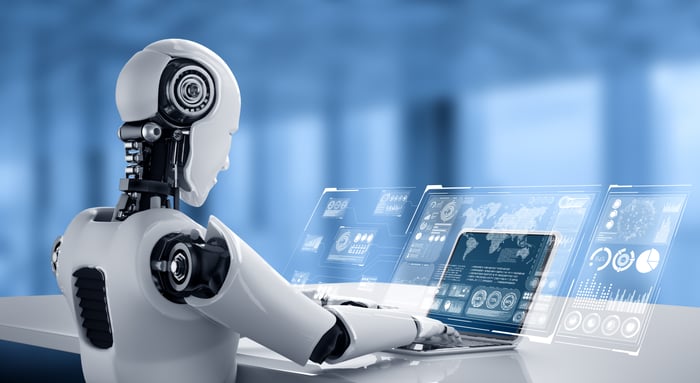
Image source: Getty Images.
Tesla's future lies in autonomy and robotics, not EV sales
For most of the past decade, Tesla's valuation rested on its ability to grow vehicle deliveries faster than the broader auto industry. In 2025, that framework began to break down.
EV demand remained healthy, but growth slowed, competition intensified, and pricing pressure weighed on margins. None of that was catastrophic, but it reinforced a reality investors have been circling for years: EVs are becoming a more competitive, capital-intensive business.
Tesla's response was telling. Management increasingly emphasized long-term opportunities in robotaxis and humanoid robots, reframing the company less as an automaker and more as an AI-driven platform company with physical products.
That shift mattered. Throughout 2025, Tesla's stock reacted less to delivery numbers and more to updates around Full Self-Driving, autonomy milestones, and Optimus demonstrations. The market was no longer asking how many cars Tesla could sell next year. It was asking what Tesla could become over the next decade.
For investors, this reframing raises both the upside and the risk. Tesla is no longer valued purely on automotive metrics. It's multiple now reflects expectations around technology breakthroughs that are harder to model but potentially far more valuable.
Robotaxi crossed a credibility threshold but remains far from scale
For years, Tesla's robotaxi ambitions lived mostly in presentations and earnings calls. In 2025, that changed.
The company launched a limited, geofenced robotaxi pilot in Austin, operating with safety monitors and strict constraints. From a revenue standpoint, the impact was negligible. From a credibility standpoint, it was significant.
Tesla finally demonstrated that its autonomy stack could operate in a controlled, real-world environment. That reduced the existential risk that robotaxi would remain purely theoretical. The conversation shifted from "Is this possible?" to "How fast can this scale?" For instance, Tesla CEO Elon Musk claims driverless Robotaxis will be available by the end of the year. That distinction matters for investors.
At the same time, 2025 also highlighted the obstacles ahead. Regulatory approval remains fragmented. Safety scrutiny is intense. Public trust will take time to earn. Competitors like Waymo continue to make steady progress.
In other words, robotaxi is no longer a binary bet, but it is still a long-dated one. The technology appears directionally viable, yet the timeline to meaningful revenue remains uncertain.
For investors, the key takeaway from 2025 is somewhat balanced. Tesla made tangible progress, but robotaxi should still be viewed as a multiyear build-out, not a near-term earnings driver.
Optimus is a massive option, but its value lies well beyond the near term
If robotaxi became more tangible in 2025, Optimus remained firmly in the realm of long-term optionality.
Tesla continued to show improvements in its humanoid robot, including better movement, balance, and task execution. The vision is bold: general-purpose robots capable of performing repetitive or dangerous work across factories, warehouses, and eventually homes.
However, 2025 also clarified what Optimus is not, at least for now. It is not close to mass production. It is not contributing revenue. And it is not immune to technical bottlenecks or leadership changes.
That doesn't make Optimus unimportant. In fact, it may be Tesla's most asymmetric bet. If humanoid robots become economically viable at scale, the addressable market could extend far beyond mobility, touching labor, logistics, healthcare, and services.
But investors should anchor expectations appropriately. Optimus is best thought of as a 2030s opportunity, not a catalyst for the next few quarters. Its value today lies in option-like upside rather than cash flow.
What does it mean for investors?
Taken together, these three themes explain why Tesla's 2025 felt unsettled.
The company moved away from a clean, linear EV growth story toward a more complex portfolio of long-term bets. That transition increases uncertainty, but it also expands the range of possible outcomes.
For investors with a short time horizon, that ambiguity can be uncomfortable. For long-term investors, it's the core of the new thesis. Tesla's future returns now hinge less on selling more cars and more on whether autonomy and robotics mature into scalable, high-margin businesses.
2025 didn't provide definitive answers. But it clarified the questions, and that alone made it a pivotal year.
Don’t miss this second chance at a potentially lucrative opportunity
Ever feel like you missed the boat in buying the most successful stocks? Then you’ll want to hear this.
On rare occasions, our expert team of analysts issues a “Double Down” stock recommendation for companies that they think are about to pop. If you’re worried you’ve already missed your chance to invest, now is the best time to buy before it’s too late. And the numbers speak for themselves:
- Nvidia: if you invested $1,000 when we doubled down in 2009, you’d have $457,248!*
- Apple: if you invested $1,000 when we doubled down in 2008, you’d have $52,147!*
- Netflix: if you invested $1,000 when we doubled down in 2004, you’d have $505,695!*
Right now, we’re issuing “Double Down” alerts for three incredible companies, available when you join Stock Advisor, and there may not be another chance like this anytime soon.
See the 3 stocks »
*Stock Advisor returns as of December 17, 2025.
Lawrence Nga has no position in any of the stocks mentioned. The Motley Fool has positions in and recommends Tesla. The Motley Fool has a disclosure policy.
Recommended Articles


