




Here Are 2 Major Social Security Changes Retirees Need to Know Heading Into 2026
Key Points
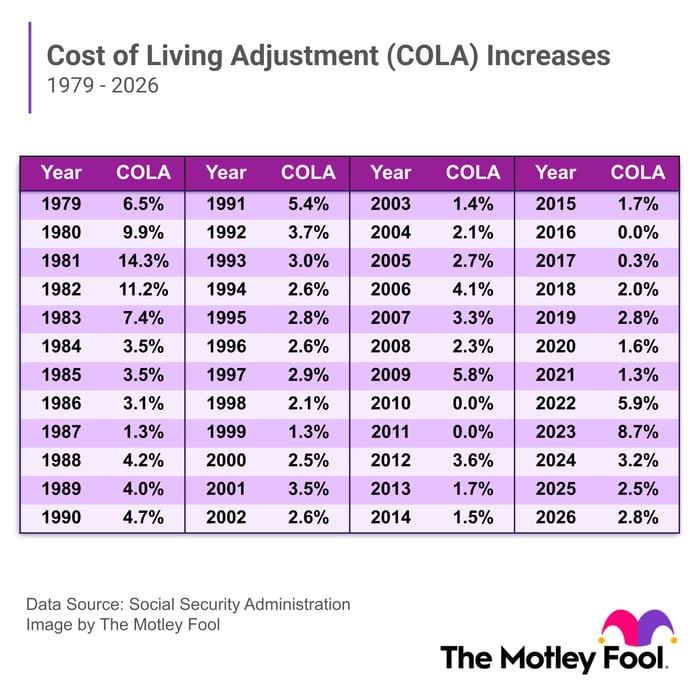
Social Security recipients are going to see an annual cost-of-living adjustment (COLA) of 2.8% for 2026.
They'll also see a boost in the wage base limit -- the max income subject to Social Security payroll taxes.
- The $23,760 Social Security bonus most retirees completely overlook ›
There's a strong argument to be made that Social Security is one of America's most important social programs. A little over 53.4 million people receive Social Security retirement benefits, and for many of them, Social Security will account for the bulk or all of their retirement income.
Unfortunately for most recipients, it can be tough to keep up with all the happenings surrounding the Social Security program. As I like to say, the only constant is change. And as we approach 2026, there are two key Social Security changes that all recipients and those approaching claiming age (62 is the earliest you can claim) should know.
Where to invest $1,000 right now? Our analyst team just revealed what they believe are the 10 best stocks to buy right now, when you join Stock Advisor. See the stocks »

Image source: Getty Images.
Current Social Security recipients will receive a benefit boost in 2026
The most anticipated change each year is the annual cost-of-living adjustment (COLA). To help combat inflation, the annual COLA helps retirees maintain some of their purchasing power. To determine how much to increase benefits by, the Social Security Administration (SSA) looks at changes in the Consumer Price Index for Urban Wage Earners and Clerical Workers (CPI-W).
First, it takes the average CPI-W from the third quarter (Q3) of the previous year. Next, it looks at the Q3 average of the current year. Then it sets the COLA to whatever the CPI-W average increased by, rounded up to the nearest tenth of a percentage point. If the average declined, there is no COLA, but benefits will not be reduced.
The 2025 Q3 CPI-W average was 2.76% higher than the 2024 average, which is how we end up with the 2026 COLA of 2.8%. This means if someone is currently receiving $2,000 in benefits, they'd begin receiving $2,056 in January.
Not everyone will be happy with the 2026 COLA, but it definitely falls in the "it could be better, but it could also be worse" bucket. Here is how 2026's 2.8% COLA stacks up against past COLAs:
The wage base limit is increasing
Each year, the SSA sets a "wage base limit," which is the maximum amount of your income that's subject to Social Security's payroll tax. For most workers, the 12.4% tax is split evenly between you and your employer. For self-employed people, the 12.4% is their responsibility.
Beginning in 2026, the wage base limit will increase to $184,500, up from $176,100 in 2025. This means anyone earning between $176,100 and $184,500 can expect to pay more in Social Security payroll taxes next year. For example, if you earned $180,000 in 2025, $3,900 would be exempt from the tax. If you earn the same amount in 2026, all of it would be subject to the tax. That's an extra $223.20 owed (6.2% of $3,600).
While the annual COLA is based on changes in CPI-W numbers, the wage base limit is based on changes in the national average wage index (NAWI). The NAWI is a metric collected by the SSA that looks at the average wage of U.S. workers. It's like an inflation measure, but only for wages, not prices. Here are the past 10 wage base limits.
| Year | Wage Base Limit |
|---|---|
| 2025 | $176,100 |
| 2024 | $168,600 |
| 2023 | $160,200 |
| 2022 | $147,000 |
| 2021 | $142,800 |
| 2020 | $137,700 |
| 2019 | $132,900 |
| 2018 | $128,400 |
| 2017 | $127,200 |
| 2016 | $118,500 |
Data source: SSA. Table by author.
Knowing past wage base limits is important for those approaching retirement because it can affect whether you're eligible for the maximum monthly benefit. To be eligible for the maximum benefit, someone must earn at least the wage base limit in the 35 years that the SSA uses to calculate benefits.
If that's something you're aiming for, you would need to have earned at least the above amounts in those respective years.
The $23,760 Social Security bonus most retirees completely overlook
If you're like most Americans, you're a few years (or more) behind on your retirement savings. But a handful of little-known "Social Security secrets" could help ensure a boost in your retirement income.
One easy trick could pay you as much as $23,760 more... each year! Once you learn how to maximize your Social Security benefits, we think you could retire confidently with the peace of mind we're all after. Join Stock Advisor to learn more about these strategies.
View the "Social Security secrets" »
The Motley Fool has a disclosure policy.
Recommended Articles


