




Dow Jones Industrial Average softens on final trading day of 2025
- The Dow Jones softened alongside other indexes on the final trading day of 2025.
- Equities are closing out a strong December in a long run of strong months.
- US economic data continues to twist in a concerning direction.
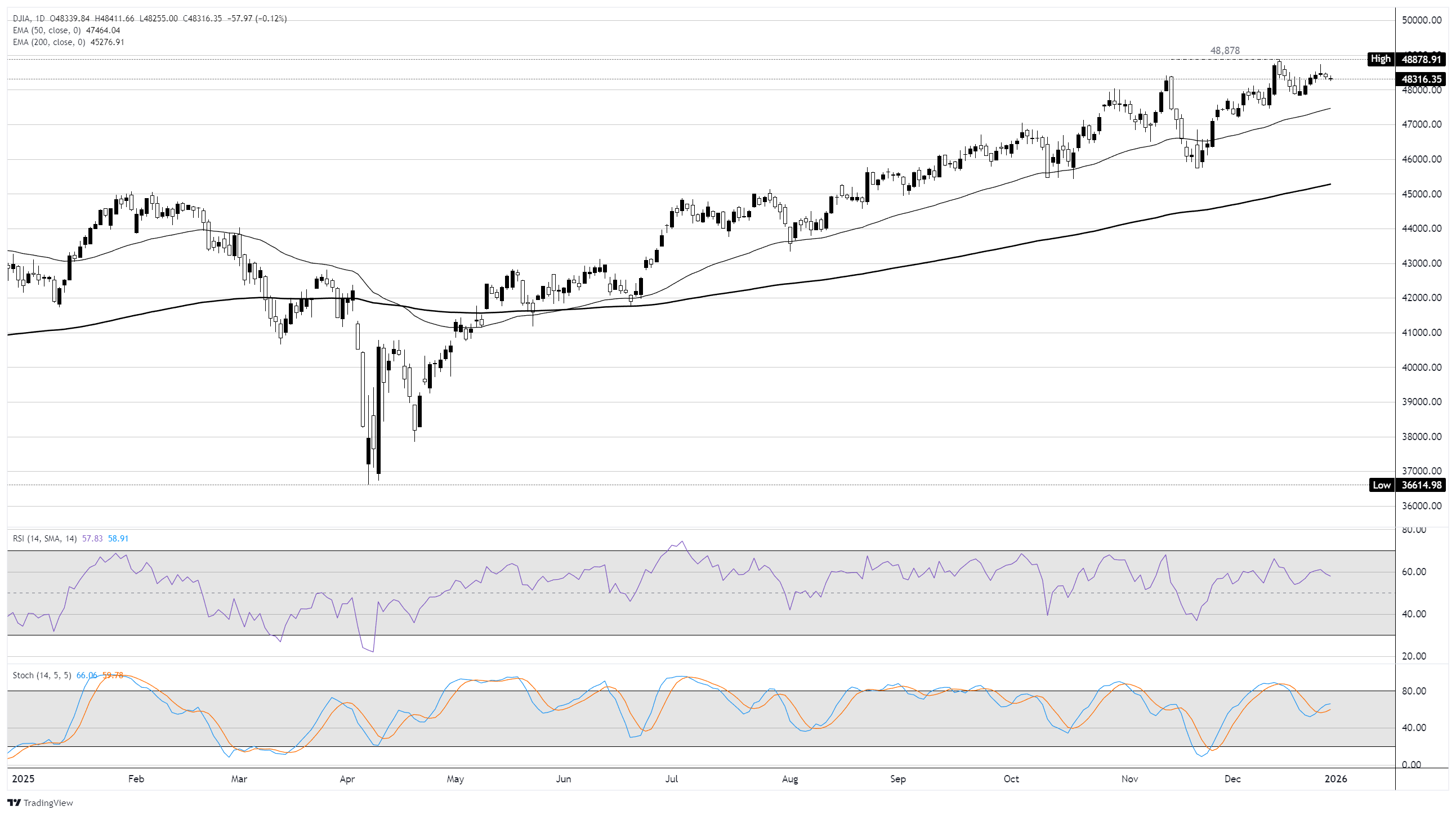
US equities pulled back modestly midweek, but the broader picture for investors remains one of a strong year nearing its conclusion. The S&P 500 slipped about 0.2% on Wednesday, matching declines in the Nasdaq Composite, while the Dow Jones Industrial Average fell roughly 0.5%. The market is on a mild three-session losing streak, yet the losses have done little to dent what has been an impressive annual performance. The S&P 500 is on track for a gain of roughly 17% in 2025, its third consecutive double-digit advance, while the Nasdaq has climbed about 21% on the back of sustained enthusiasm around artificial intelligence. The Dow has lagged somewhat with a 13% gain, reflecting its lower exposure to technology stocks.
From a seasonal perspective, December has remained a buster month for equities. Both the Dow and the S&P 500 are on pace to finish the month higher, each notching what would be an eighth consecutive winning month, a streak not seen since 2018. The Nasdaq, however, has been roughly flat for the month, underscoring the more selective nature of recent gains.
Corporate and economic updates offered a mixed but generally stable backdrop. Nike (NKE) shares rose after multiple insiders, including board members and the CEO, increased their stakes following a difficult year in which the stock fell more than 17%. On the macro front, labor market data pointed to continued resilience. Initial jobless claims fell to 199K in the latest week, well below expectations, while continuing claims also declined, reinforcing the picture of a low-hire, low-fire environment as the year comes to a close.
Stocks had a rough start despite a strong finish
This strength marks a sharp recovery from the turmoil seen in early April, when sweeping tariff announcements triggered a near bear market drawdown that pushed the S&P 500 close to a 19% decline from its February high. Since then, investors have grown more confident that trade policy lessons were absorbed and that companies can adjust supply chains and pricing to protect margins. Even so, the recent softness has raised some concern, as the final trading days of the year and the first sessions of January are typically associated with the so-called Santa Claus rally. The current bout of profit taking may also be an early signal of choppier conditions ahead. While many strategists expect another positive year for stocks in 2026, there is growing debate over whether returns will be more range-bound as earnings growth works to justify elevated valuations.
Artificial intelligence continues to shape market narratives, though its influence has become more nuanced. After blockbuster gains in 2023 and 2024 tied to the emergence of generative AI, leadership broadened in 2025 and performance within the largest technology stocks diverged. Alphabet stood out with gains exceeding 65% as investors positioned it as a key AI beneficiary, while Amazon lagged with a much more modest advance. At the same time, returns outside the megacaps improved notably, with commodities delivering exceptional performance. Gold rose more than 64% this year and silver surged over 140%, putting both metals on track for their strongest annual gains since the late 1970s. This shift in market internals has fueled expectations that future returns may depend more on traditional fundamentals than on monetary policy or massive AI infrastructure spending.
Dow Jones daily chart
Dow Jones FAQs
The Dow Jones Industrial Average, one of the oldest stock market indices in the world, is compiled of the 30 most traded stocks in the US. The index is price-weighted rather than weighted by capitalization. It is calculated by summing the prices of the constituent stocks and dividing them by a factor, currently 0.152. The index was founded by Charles Dow, who also founded the Wall Street Journal. In later years it has been criticized for not being broadly representative enough because it only tracks 30 conglomerates, unlike broader indices such as the S&P 500.
Many different factors drive the Dow Jones Industrial Average (DJIA). The aggregate performance of the component companies revealed in quarterly company earnings reports is the main one. US and global macroeconomic data also contributes as it impacts on investor sentiment. The level of interest rates, set by the Federal Reserve (Fed), also influences the DJIA as it affects the cost of credit, on which many corporations are heavily reliant. Therefore, inflation can be a major driver as well as other metrics which impact the Fed decisions.
Dow Theory is a method for identifying the primary trend of the stock market developed by Charles Dow. A key step is to compare the direction of the Dow Jones Industrial Average (DJIA) and the Dow Jones Transportation Average (DJTA) and only follow trends where both are moving in the same direction. Volume is a confirmatory criteria. The theory uses elements of peak and trough analysis. Dow’s theory posits three trend phases: accumulation, when smart money starts buying or selling; public participation, when the wider public joins in; and distribution, when the smart money exits.
There are a number of ways to trade the DJIA. One is to use ETFs which allow investors to trade the DJIA as a single security, rather than having to buy shares in all 30 constituent companies. A leading example is the SPDR Dow Jones Industrial Average ETF (DIA). DJIA futures contracts enable traders to speculate on the future value of the index and Options provide the right, but not the obligation, to buy or sell the index at a predetermined price in the future. Mutual funds enable investors to buy a share of a diversified portfolio of DJIA stocks thus providing exposure to the overall index.
Recommended Articles


