




Malone Lam pleads guilty in $245M theft that hacked people, not wallets
The online wallets were not hacked. The individuals owning them were the ones hacked.
Twenty-two-year-old Malone Lam, who is a citizen of Singapore as well as a recent resident of Miami, on Tuesday, pleaded guilty to one count of RICO conspiracy for leading a gang that used social engineering to steal and launder an amount of over $245 million in cryptocurrency.
The prosecutors indicated that Lam and his group used the technique of social engineering, targeted wealthy holders of cryptocurrency, pretended to be trustworthy companies/organizations, and made the victims give away their personal data or access.
How a fake security warning drained $245 million
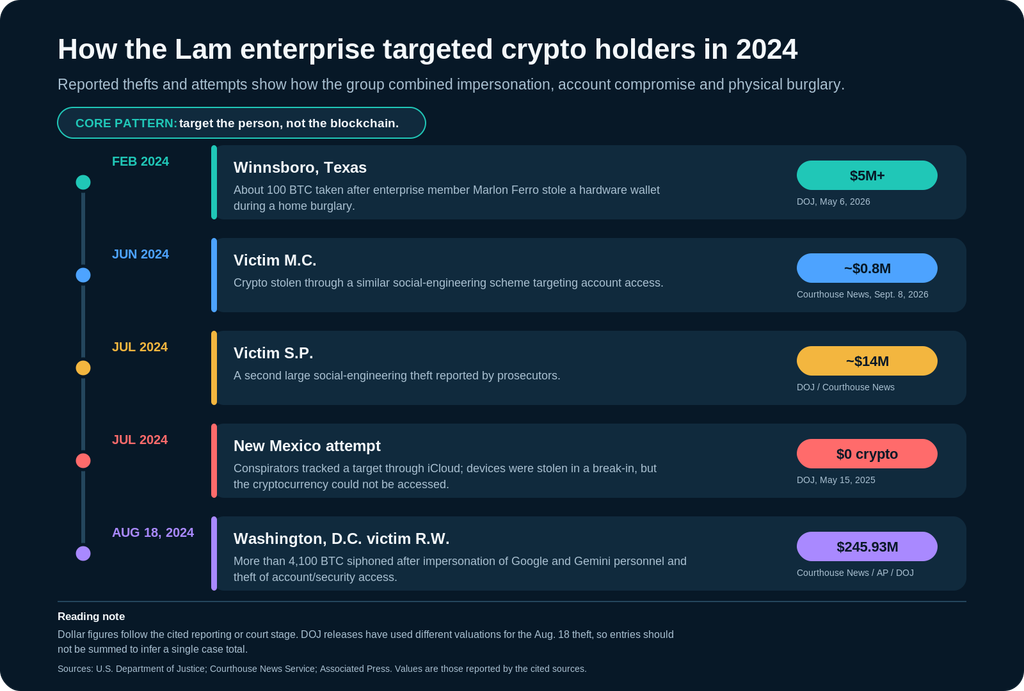
The largest theft happened on August 18, 2024. According to prosecutors, the offenders pretended they were representatives of Google and Gemini and convinced a victim in Washington, D.C., to let them into Google Drive and give them security codes. They drained more than 4,100 Bitcoin, equivalent to over $245 million, from the victim’s wallet.
Assistant U.S. Attorney Christopher Howland referred to the organization in court as a “social engineering enterprise,” as reported by Courthouse News.
The group was said to have used the phone to trick the victims into giving that information before moving any stolen cryptocurrency. There were also reports of the theft of around $800,000 from victim M.C. in June 2024 and about $14 million from S.P. Another burglary operation in New Mexico that had tried to get access to a hardware wallet did not result in the acquisition of cryptocurrency.
Nightclubs, Ferraris, and a Miami arrest
According to the Justice Department, the enterprise originated from relationships developed on online gaming platforms. Members participated in different activities, including database hacking and target identification, fraudulent calls, and laundering, as well as breaking and entering, if the remote fraud failed.
The money earned from their criminal activities was spent in luxury. Reportedly, members spent as much as $500,000 during one night at a nightclub, rented luxury villas, chartered private jets, and purchased fancy cars valued at $3.8 million. Lam has agreed to give away Ferraris, Rolls-Royces, Lamborghinis, and Mercedes-Benzes as victim compensation.
Lam was arrested on September 18, 2024, in Miami. One of the accomplices of Lam, by the name of Evan Tangeman, was sentenced in April for laundering money from the scam operation.
Why custodians are building for the human failure
Lam faces up to 20 years in prison, with a status hearing set for December 8. U.S. Attorney Jeanine Ferris Pirro said:
“If you build a cybercrime empire, we will find you, dismantle your operation, and hold you accountable.”
The broader market lesson is less about Bitcoin’s code than about access control. Hong Kong’s securities regulator has warned that weak approval controls and signers authorizing fraudulent transactions can undermine custody systems regardless of whether they use HSMs, MPC or multisignature technology. A 2026 institutional survey found 66% of investors cited security and key-signing protocols as a key factor when choosing custodians.
The threat is also scaling. Chainalysis estimates scams received at least $14 billion on-chain in 2025 and could exceed $17 billion as more addresses are identified, while impersonation scams grew more than 1,400% year over year. TRM Labs rated scams the only “Mature” category in its 2026 AI-in-Crime Adoption Index, while the FBI recorded 181,565 cryptocurrency-related complaints and more than $11 billion in losses.
The smartest crypto minds already read our newsletter. Want in? Join them.
Recommended Articles


