




US in support of OpenAI’s fair-use claim and warns of AI licensing oligopoly
The US Justice Department told a Manhattan federal court Tuesday that OpenAI’s use of copyrighted writing at the training stage should be protected by fair use, a position that could reshape the economics of the global AI industry as worldwide investment is set to exceed $1 trillion this year.
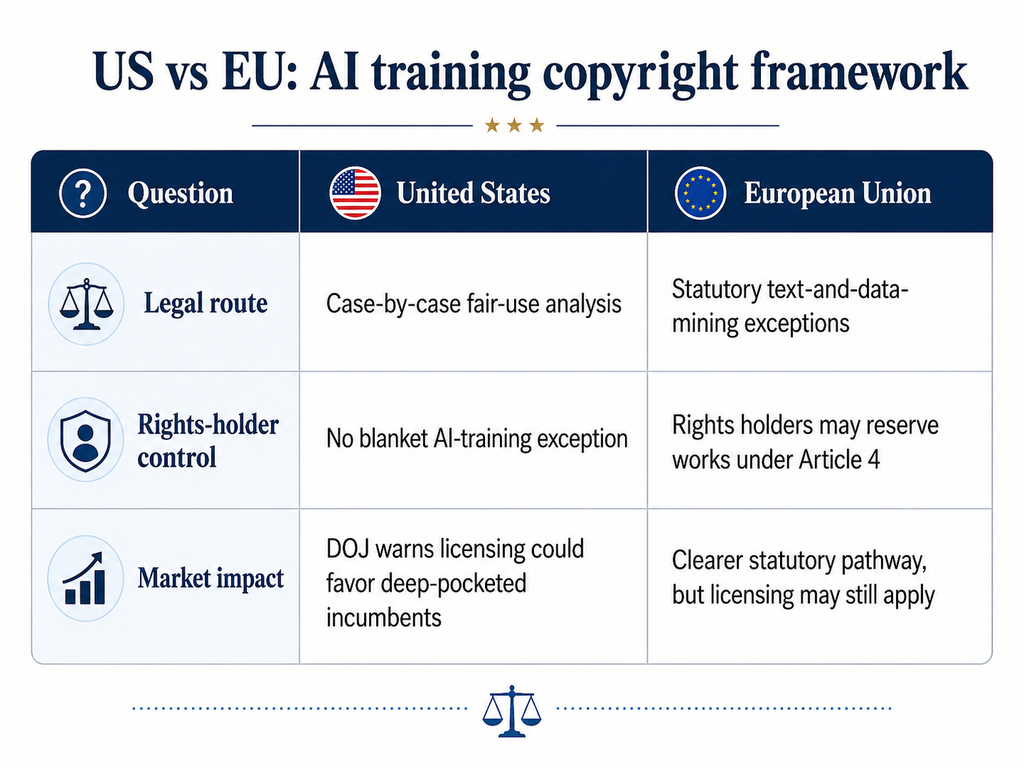
In the statement of interest it filed in the consolidated copyright lawsuit against OpenAI, the government warned that if developers were made to license training text, only wealthy corporations would be able to continue making cutting-edge AI technologies.
The government argues that its argument has both legal and economic implications: mandatory licensing could create huge hurdles to entry, bolster incumbent tech firms, and transfer much of the resulting profits to existing publishers with the largest archives.
Why Washington calls a licensing regime an entry barrier
According to the Justice Department, imposing a cost on the information used to train AI may cause smaller developers to be marginalized by bigger players.
This is in line with the OECD report that says that current AI market access to computing power, data, and expertise is already consolidated and will continue to benefit companies that are already well-established in the field.
Washington argued that smaller creators can take advantage of inexpensive AI tools. Authors, in particular, can use models to generate images that they cannot afford otherwise or find sources and perspectives that they would otherwise miss out on.
However, the US Copyright Office took a more nuanced stance in stating that some uses for training AI can be covered by fair use, while others may not, depending on the source of the material being used, the purpose of its usage, and the market impact.
The transformative-use argument at the center
The Justice Department leaned heavily on the first fair-use factor, describing AI training as “extraordinarily transformative.” It argued that training copies serve a different purpose from the original articles and that AI’s benefits “far outweigh any competitive harm.”
Nonetheless, the filing does not provide total protection to AI creators. It differentiates between model training and its outcome that refers to copyrighted material, as well as issues regarding the process of obtaining the training data.
The distinction can be seen in the California cases. A Copyright Alliance analysis of Bartz v. Anthropic and Kadrey v. Meta states that, on one hand, both courts ruled training was transformative, while, on the other hand, reached different conclusions regarding piracy and the damage done to the market.
According to Associate Attorney General Stanley Woodward Jr., this filing represents a “historic statement of interest,” which links the administration’s stance on copyright law with the overall objective of keeping US position in the area of AI.
National security and the race against foreign rivals
The filing also casts copyright rules as an industrial-policy and national-security issue, arguing that higher development costs could put US companies at a disadvantage against foreign competitors.
The stakes are substantial. Goldman Sachs Research projects more than $1 trillion in global AI-related investment in 2026, including $581 billion in the United States.
The European Union has taken a different route. Its Digital Single Market Directive provides explicit text-and-data-mining exceptions, although rights holders can reserve their works from some forms of mining.
What the publishers and the court say next
The New York Times, which sued OpenAI and Microsoft in 2023, rejected Washington’s position.
Authors Guild CEO Mary Rasenberger was equally critical, telling WIRED:
“Extremely disappointed” and “replete with faulty arguments and a gross misunderstanding of the fair use doctrine and copyright law.” — Mary Rasenberger, Authors Guild CEO, via WIRED
Berkeley copyright scholar Pamela Samuelson described the government’s intervention more cautiously:
“A significant development.” — Pamela Samuelson, Berkeley Center for Law & Technology, via WIRED
Judge Sidney H. Stein is not required to follow the Justice Department’s position.
A ruling in favor of OpenAI may still leave an important issue unresolved: the way that training data is procured. As noted by Cryptopolitan, Anthropic’s settlement with authors in the amount of $1.5 billion was based on the pirated copies of the training material and not the training itself.
This difference may matter a great deal. Even if the training is considered to fall within fair use, AI creators still run into a major risk by illegally procuring the material used in their models.
TLDR
, and
The smartest crypto minds already read our newsletter. Want in? Join them.
Recommended Articles


