




Morgan Stanley Filed a Bitcoin ETF During the Worst Week of the War: A $5.5 Trillion Signal That Crypto Is Permanent
Slug: morgan-stanley-bitcoin-etf-msbt
The past week has been the most volatile one for markets as hostilities in the Iran war escalated rapidly. Brent crude pushed close to the $120 mark, Gold dropped over 12% in a week marking its worst correction since 1983 and the S&P 500 saw its fourth consecutive week in red. On March 20, however, in the middle of this chaos and as Trump issued a 48 hour ultimatum (which has now been pushed back to five days) that threatened strikes on Iran’s power plants, Morgan Stanley filed for a Bitcoin ETF.
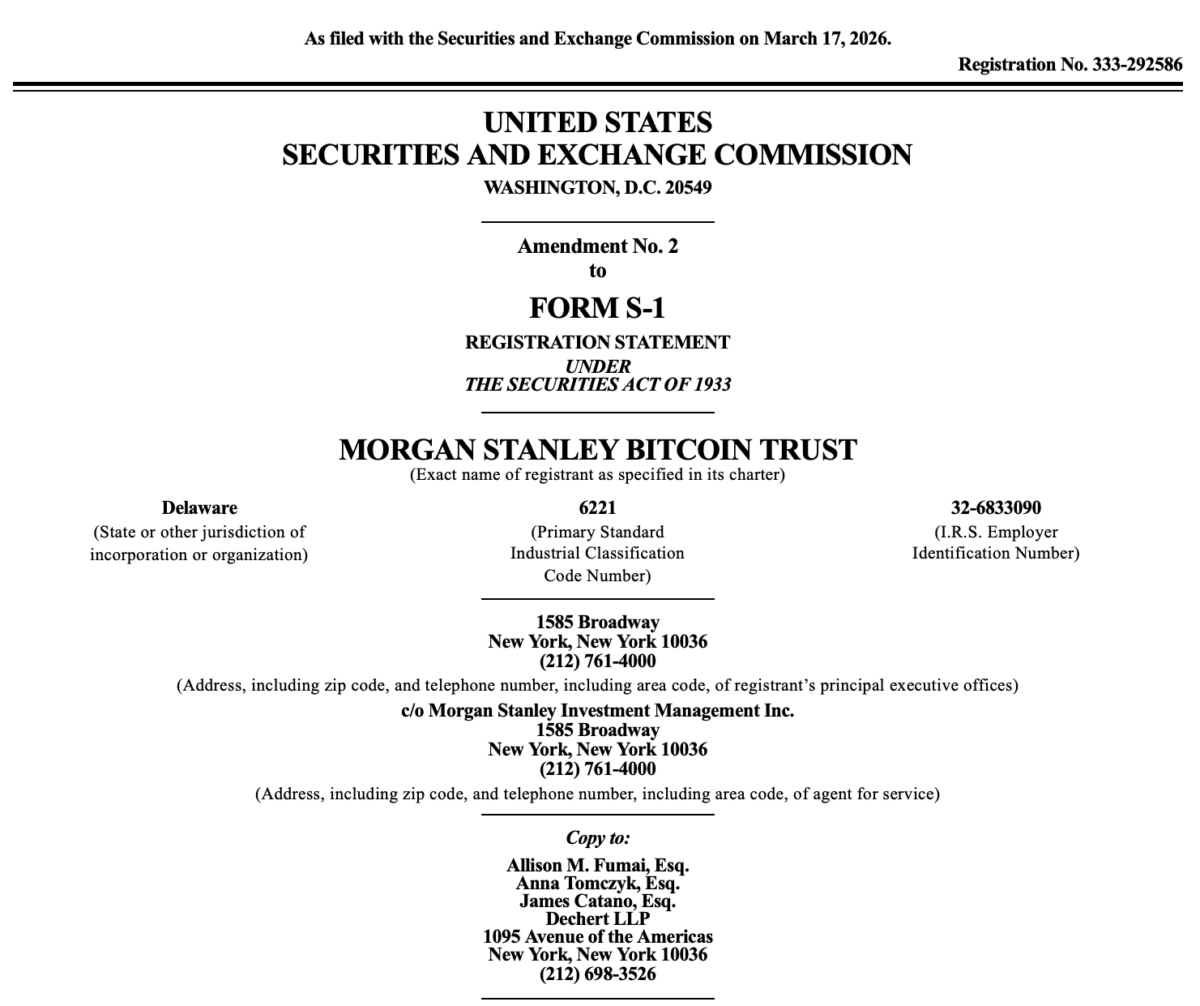
One of the oldest and largest investment banks in the world that manages $5.5 trillion in client assets and employs over 15,000 financial advisors. The timing is what makes this particularly striking. MSBT is not just another name added to the list of existing Bitcoin ETFs. It represents something far larger. The fact is that Morgan Stanley has a massive distribution network that includes direct relationships with pension funds, sovereign wealth funds and corporate treasuries. When a bank as large as Morgan Stanley provides access to BTC into portfolios it already manages, this completely changes the game from who buys BTC to how much they buy and when.
Why Morgan Stanley Is Different From Every Other ETF Issuer
On paper, Morgan Stanley’s MSBT filing with the SEC looks very similar to existing ETFs like BlackRock’s IBIT. The firm filed an S-1 for listing on NYSE Arca, with Coinbase handling Bitcoin custody and BNY Mellon managing administration. That said, the structural similarities to IBIT is where the comparison ends. Morgan Stanley is not an asset manager but an investment bank that holds $5.5 trillion in client assets and has over 15,000 financial advisors who sit across from pension funds, endowments, family offices and corporate treasuries every single day.
This massive distribution angle is what makes this filing very different from the rest of the Bitcoin ETFs on the market. BlackRock’s IBIT crossed $70 billion in assets largely because their institutional sales team put it in front of the right allocators. What Morgan Stanley has going for it is completely different in that their advisory network sits directly between capital and allocation decisions. Adding to this is that their 15,000 advisors have direct access to high net worth individuals and mid tier institutions that traditional ETFs don’t touch. That’s why Strategy CEO Phong Le calling it a “monster Bitcoin Bet,” as reported in Bitcoin Magazine, is so apt.
Even though the SEC is yet to approve the filing, this marks the first bank-issued spot Bitcoin ETF in the U.S. and as Yahoo Finance puts it “a move no major US Bank has done before”. FinTech Weekly went further, reporting that Morgan Stanley is “not just filing an ETF, it’s building everything around it”. Even as we wait for the approval from the SEC, the filing alone tells you that Morgan Stanley’s internal risk and compliance teams have cleared Bitcoin and that sign off, in itself, is significant.
74% of Institutions Are Bullish: The Survey Explains the Timing
When you begin to look at institutional sentiment toward Bitcoin, the timing of Morgan Stanley’s filing starts to make a lot more sense. In January this year, Coinbase and EY-Parthenon conducted an in depth survey across 351 institutional investors that provided a comprehensive look into overall crypto sentiment. The key takeaway from the survey was that, despite the volatile start to the year, sentiment among institutions has actually strengthened.
Around 74% of respondents expect crypto prices to rise in the next 12 months and 73% plan to increase their exposure to digital assets before the end of the year. 83% also stated that they have used or plan to use stablecoin payments and that same 83% indicated that clearer regulations like the GENIUS Act would increase their willingness to engage with the space. Tokenization moving from pilot to priority was another theme with 63% expressing interest in tokenized assets and 61% expecting tokenization to have a massive impact on market structure in the coming years.
The bullish sentiment toward crypto is, however, only one side of the story. The bigger picture that this survey highlighted was how institutional investors want exposure. 49% of the respondents said that the recent volatility has forced them to tighten risk and liquidity management while wanting Bitcoin exposure through regulated instruments, one that has a familiar structure like an ETF. With 73% looking to allocate capital, the demand is clearly there. Coupled with this is the fact that their preferred access route is via an ETF during a time when regulation is moving in the right direction. The timing of Morgan Stanley’s filing in this context becomes very clear.
The War Didn’t Stop Institutional Crypto, It Accelerated It
The news of the filing dropped at a time of peak macro uncertainty. The same week, we saw Oil rise toward the $120 per barrel mark, Gold saw its worst weekly performance in decades and traditional equity markets like the S&P 500 saw their weekly losing streak extend. Bitcoin, on the other hand, remains resilient since the conflict began. Just over three weeks into the war, BTC has rallied all the way from $65.8K on February 28 to now trading close to $71K, a roughly +7.5% move up. This move is happening at a time when global equities and even traditional safe havens like Gold are in the negative since the start of the month.
Despite Bitcoin retracing to around $68K after the FOMC meeting, President Trump’s decision to postpone the 48 hour ultimatum to five days, citing “very good and productive conversations” with Iran, as reported by NBC, led to a relief rally, with Bitcoin bouncing back to $71K. The situation remains precarious as Iranian media were quick to deny any negotiations taking place.
The crisis thus far has shown how resolute Bitcoin is as an asset class and yesterday’s potential de-escalation news show how sensitive it is to any macro resolution signals. Morgan Stanley has recognized that the crisis itself has demonstrated Bitcoin’s resilience and that earns a place in serious portfolios.
What to Watch: From Filing to Approval to $5.5 Trillion in Distribution
On the regulatory front, SEC review typically runs three to six months from an amended S-1, which puts a potential MSBT launch somewhere in the Q3 to Q4 2026 window, a timeline that could coincide with a post-war recovery environment if the current diplomatic window holds. For context on what approval could mean in practice, BlackRock’s IBIT attracted $37 billion in its first year, making it the fastest-growing ETP in history. MSBT won’t be competing for the same capital, it targets a different client base entirely, which means it expands the total addressable market rather than splitting it. Morgan Stanley’s 15,000 advisors reaching high-net-worth individuals and mid-tier institutions represents a distribution layer that no existing Bitcoin ETF has systematically accessed. And if Morgan Stanley has filed, it is a reasonable assumption that Goldman Sachs and JPMorgan’s asset management arms are running similar internal evaluations right now. The bank-issued Bitcoin ETF could quickly go from a novelty to a category.
On the price side, the next few days are going to be very important to monitor. Trump’s five-day negotiation window with Iran runs through approximately March 28. If talks show genuine progress and oil pulls back, the risk-on environment that follows likely pushes Bitcoin back toward a retest of the $75K level. If the window collapses and the ultimatum is reinstated, $67K becomes the key support level to watch. The current pivot sits around $70K, a sustained move above $72K signals the post-FOMC pullback is over, while a break below $67K would put the war outperformance thesis under real pressure. That said, Morgan Stanley’s filing reframes where the institutional floor actually sits. A bank with $5.5 trillion in client assets does not build Bitcoin distribution infrastructure for a trade, it builds it because the long-term allocation decision has already been made internally and the market may not be fully pricing that in yet.
Get seen where it counts. Advertise in Cryptopolitan Research and reach crypto’s sharpest investors and builders.
Recommended Articles


