




RTX Corp Stock (RTX) Moved Down by 3.62% on Mar 30: Drivers Behind the Movement
RTX Corp (RTX) moved down by 3.62%. The Industrial Goods sector is down by 1.31%. The company underperformed the industry. Top 3 stocks by turnover in the sector: General Electric Co (GE) down 4.02%; Vertiv Holdings Co (VRT) down 7.22%; Bloom Energy Corp (BE) down 12.26%.
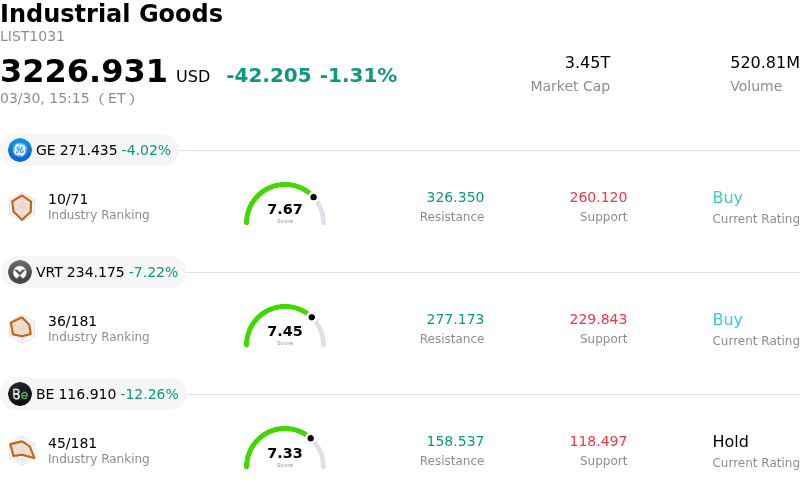
What is driving RTX Corp (RTX)’s stock price down today?
The decline in RTX's stock performance on this trading day appears to be influenced by a combination of factors related to market sentiment, company risks, and institutional adjustments, despite generally positive financial outlooks and strong backlogs.
A key contributing factor to the downward movement could be recent insider selling activity. Over the last three months, company insiders have sold a notable amount of shares, with specific executive vice presidents and vice presidents conducting sales in February and March 2026. For instance, a VP sold shares on February 13th, and an executive vice president's transaction on March 30th resulted in a significant decrease in their holdings. This volume of insider selling, totaling over shares valued at millions of dollars in the past three months, can sometimes signal a lack of confidence from those closest to the company, potentially impacting broader market sentiment negatively. Additionally, institutional investors have shown mixed activity, with some significantly adding shares while others removed substantial positions in the fourth quarter of 2025. Notably, Arlington Partners LLC recently exited its position in RTX.
Furthermore, company-specific risks, despite a largely positive outlook, may be playing a role in investor caution. While RTX has a robust backlog of orders and strong demand in both commercial aerospace and defense sectors, concerns persist regarding the Pratt & Whitney GTF engine crisis. Approximately 800 aircraft are still grounded globally as of early 2026, and any further delays in maintenance turnaround times could lead to additional compensation claims from airlines, impacting the Pratt & Whitney segment. Supply chain fragility, including shortages in castings, forgings, and skilled labor, continues to limit the company's ability to convert its record backlog into revenue. There are also concerns about potential margin dilution in the Raytheon segment due to an increase in fixed-price production contracts. A deteriorating liquidity profile, indicated by a current ratio barely covering short-term liabilities, and potential restrictions on capital return initiatives through 2026, also represent ongoing risks.
It is worth noting that the broader analyst consensus on RTX remains generally positive, with a "Moderate Buy" rating from multiple brokerages and numerous price targets issued recently, with a median target suggesting upside. The company also reported strong financial results for 2025, exceeding analyst estimates for earnings per share and revenue, and provided an optimistic outlook for 2026, with anticipated sales growth and strong free cash flow. These positive fundamental indicators, however, appear to be currently overshadowed by the aforementioned concerns and selling pressure.
Technical Analysis of RTX Corp (RTX)
Technically, RTX Corp (RTX) shows a MACD (12,26,9) value of [-0.36], indicating a sell signal. The RSI at 34.89 suggests neutral condition and the Williams %R at -98.75 suggests oversold condition. Please monitor closely.
Fundamental Analysis of RTX Corp (RTX)
RTX Corp (RTX) is in the Industrial Goods industry. Its latest annual revenue is $88.60B, ranking 2 in the industry. The net profit is $6.73B, ranking 2 in the industry. Company Profile
Over the past month, multiple analysts have rated the company as Buy, with an average price target of $208.65, a high of $240.00, and a low of $115.00.
More details about RTX Corp (RTX)
Company Specific Risks:
- Airbus is pursuing financial damages and potential arbitration against RTX's Pratt & Whitney unit due to chronic GTF engine delivery failures, which have caused Airbus to reduce its 2026 aircraft delivery guidance and will result in significant financial charges for airline compensation and expedited maintenance for RTX.
- The Raytheon segment faces operating margin compression due to increasing fixed-price production contracts, which may lead to negative earnings per share revisions as lower-margin work displaces higher-margin programs, a risk highlighted in RTX's 10-K filing as cost overruns.
- RTX exhibits a weakening liquidity profile, with a current ratio of 1.03 in Annual 2025 indicating that current assets barely cover short-term liabilities, coupled with a deceleration in projected free cash flow growth for 2026, which could constrain capital return initiatives and increase debt reliance.
- Recent insider trading activity within the last six months shows a significant number of share sales by key executives, including the Chairman, CFO, and President of Pratt & Whitney, with no corresponding purchases, which could signal a lack of confidence from leadership.
Recommended Articles


