


VOO vs. SPY: Which ETF Is the Best Way to Buy the S&P 500?
Key Points
The Vanguard S&P 500 ETF (VOO) has more than $1 trillion of assets and is larger than the State Street SPDR S&P 500 ETF Trust (SPY).
Both funds are top-rated ways to buy America’s 500 largest public companies.
The Vanguard fund offers lower fees, with an ultra-low expense ratio of 0.03%.
- 10 stocks we like better than SPDR S&P 500 ETF Trust ›
The Vanguard S&P 500 ETF (NYSEMKT: VOO) made headlines on June 3 when, according to Bloomberg, the fund surpassed $1 trillion of net assets. That means Vanguard investors are now holding a total of more than $1 trillion of their money in this one exchange-traded fund (ETF). It's an impressive milestone.
The Vanguard S&P 500 ETF has become the most popular way for ETF investors to buy the S&P 500 index of the 500 largest publicly traded U.S. stocks. In February 2025, the Vanguard S&P 500 ETF became the largest ETF in the world, outgrowing the State Street SPDR S&P 500 ETF Trust (NYSEMKT: SPY), another popular S&P 500 tracker fund that currently has over $781 million in assets under management.
Will AI create the world's first trillionaire? Our team just released a report on the one little-known company, called an "Indispensable Monopoly" providing the critical technology Nvidia and Intel both need. Continue »
Both funds are well-regarded in the investing world as easy, low-cost ways to buy a diversified mix of the biggest companies in America. Both have become shorthand nicknames for the best S&P 500 ETFs. The two ETFs hold almost exactly the same stocks and deliver almost identical returns. In the past five years, the Vanguard fund's shares have gained 79.17%, while the State Street fund's share price is up 79.15%.
Despite these minor differences, one fund might be a better fit for most investors' portfolios. Let's look at a few reasons why -- and how to decide.

Image source: Getty Images.
Vanguard S&P 500 ETF (VOO): Rock-bottom expense ratio (0.03%)
The Vanguard S&P 500 ETF is a great example of Vanguard's low-cost index approach to investing. For an ultra-low expense ratio of 0.03%, this fund lets everyday investors own the entire S&P 500 index -- the fund holds 505 stocks as of April 30, encompassing a few companies that have issued multiple classes of shares.
Ever since this fund's inception in September 2010, it has delivered annualized returns of about 15.2%. The top five sector holdings in the S&P 500 index (and by extension, in this Vanguard ETF as of April 30) are information technology (35%), financials (12%), communication services (11%), consumer discretionary (10%), and industrials (8.8%).
The top five stocks (as of April 30) in the Vanguard S&P 500 ETF are all major tech names: Nvidia (7.85% of the fund), Alphabet (6.52% including Class A and Class C shares), Apple (6.45%), Microsoft (4.9%), and Amazon (4.2%).
These percentages change over time as different stocks gain or lose market capitalization. With this fund, or any S&P 500 ETF, you don't have to choose which stocks to buy. The fund does it for you -- by passively tracking and replicating the everyday shifts and reshufflings of the stock market.
State Street SPDR S&P 500 ETF Trust (SPY): 0.0945% expense ratio, some upside for traders
The State Street SPDR S&P 500 ETF Trust was launched in January 1993, and for the past 33 years (and counting) it's delivered annualized returns of 10.75%. This fund charges an expense ratio of 0.0945%, which is higher than the Vanguard fund.
When is it worth paying a higher fee for the same stocks? The State Street fund has a few features that might be useful for professional stock traders and institutional investors. It has a much higher daily trading volume: 45.2 million shares as of June 4, compared to only 6.1 million shares for the Vanguard fund. Higher volume can help traders execute transactions more easily and at lower cost. The State Street fund also offers options trading.
But those features are probably not relevant for most people who are investing for retirement or other long-term goals. Unless you're a professional stock trader or money manager, the State Street SPDR S&P 500 ETF Trust probably isn't worth paying the extra few basis points of fees. Lower fees have helped the Vanguard fund deliver a slightly higher total return: 324.6% instead of 322.5%. It's a small difference, but it adds up over time.
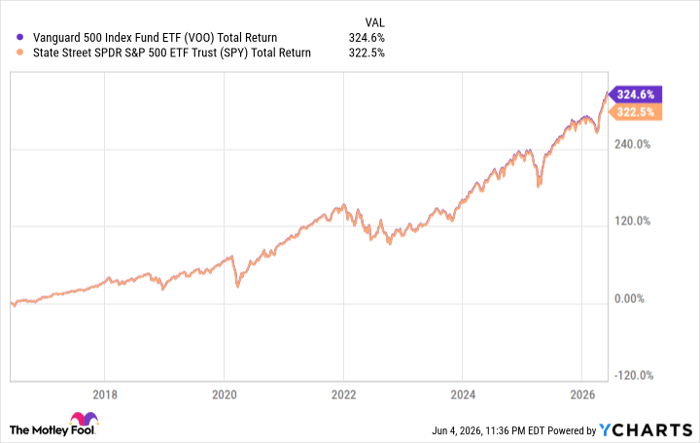
VOO Total Return Level data by YCharts
Why buy VOO instead of SPY
Keep in mind that just because one ETF has more assets under management doesn't mean that the fund will perform better. Both of these S&P 500 ETFs hold the same stocks and should deliver approximately the same returns over time -- and both are great choices for investors who want to own the S&P 500.
Buying one over the other might depend on which fund is available in your retirement account or brokerage platform. But if I had to choose one, I would go with the Vanguard S&P 500 ETF. It has lower fees (0.03% instead of 0.0945%). Low fees and simple access to the S&P 500 helped this fund make the list of the best Vanguard ETFs.
Should you buy stock in SPDR S&P 500 ETF Trust right now?
Before you buy stock in SPDR S&P 500 ETF Trust, consider this:
The Motley Fool Stock Advisor analyst team just identified what they believe are the 10 best stocks for investors to buy now… and SPDR S&P 500 ETF Trust wasn’t one of them. The 10 stocks that made the cut could produce monster returns in the coming years.
Consider when Netflix made this list on December 17, 2004... if you invested $1,000 at the time of our recommendation, you’d have $443,191!* Or when Nvidia made this list on April 15, 2005... if you invested $1,000 at the time of our recommendation, you’d have $1,258,838!*
Now, it’s worth noting Stock Advisor’s total average return is 941% — a market-crushing outperformance compared to 206% for the S&P 500. Don't miss the latest top 10 list, available with Stock Advisor, and join an investing community built by individual investors for individual investors.
See the 10 stocks »
*Stock Advisor returns as of June 8, 2026.
Ben Gran has no position in any of the stocks mentioned. The Motley Fool has positions in and recommends Alphabet, Amazon, Apple, Microsoft, Nvidia, and Vanguard S&P 500 ETF. The Motley Fool has a disclosure policy.
Recommended Articles


