


Why Oil Prices Retreated After Surging? Volatile Iran-Israel Situation, WTI Crude Eyes $97 Resistance
TradingKey - Oil prices spiked earlier today (June 8) following renewed clashes between Iran and Israel, before paring some gains after Iran announced an end to its military operations against Israel and market risk sentiment cooled slightly. This indicates that volatility in the crude oil market remains primarily driven by the geopolitical situation in the Middle East.
Middle East Tensions Dominate Oil Price Trends
Latest reports indicate that Iran and Israel have once again exchanged attacks, breaking the fragile ceasefire in place since April and reigniting market concerns over energy supply security in the Middle East. Particularly after Israel struck Iranian petrochemical facilities and Iran subsequently launched missile attacks on Israeli targets, the market quickly priced in supply disruption risks, driving international oil prices sharply higher during the session. Brent crude rose to an intraday high of $98.08, while WTI crude ( USOIL) hit a high of $95.47.
However, the situation in the Middle East shifted before the U.S. market open. Iran's announcement of a suspension of attacks against Israel eased market fears of further escalation. As a result, both WTI and Brent crude surrendered intraday gains of over 4%, with WTI retreating to near $91.60 and Brent falling back to around $94.60; global equity markets and risk assets also experienced some recovery.
But this does not mean that risks to oil prices have been fully resolved. First, Iran's announced suspension does not equate to a formal ceasefire agreement. Uncertainty remains regarding whether Israel will halt subsequent retaliation, whether Iran will respond again if hit by new strikes, and whether the U.S. will continue to intervene. Second, as the conflict has already involved Iranian petrochemical facilities and regional transport corridors, the market remains concerned that energy infrastructure or tanker routes could be targeted again. As long as shipping risks in the Strait of Hormuz and the Red Sea are not substantively eliminated, oil prices will remain supported on the downside.
Furthermore, Houthi militants announced a blockade of Israel-linked shipping in the Red Sea, threatening to treat Israeli vessels as military targets. This has raised concerns that risks are not only concentrated in the Strait of Hormuz but could also spread to key transit points such as the Red Sea and the Bab el-Mandeb Strait. The Red Sea is a vital route for global oil and commodity transport; if shipping risks escalate, it could further drive up maritime costs and provide support for oil prices.
WTI Crude Oil Technical Analysis: Short-Term Bullish Bias, Focus on 97 Resistance Level
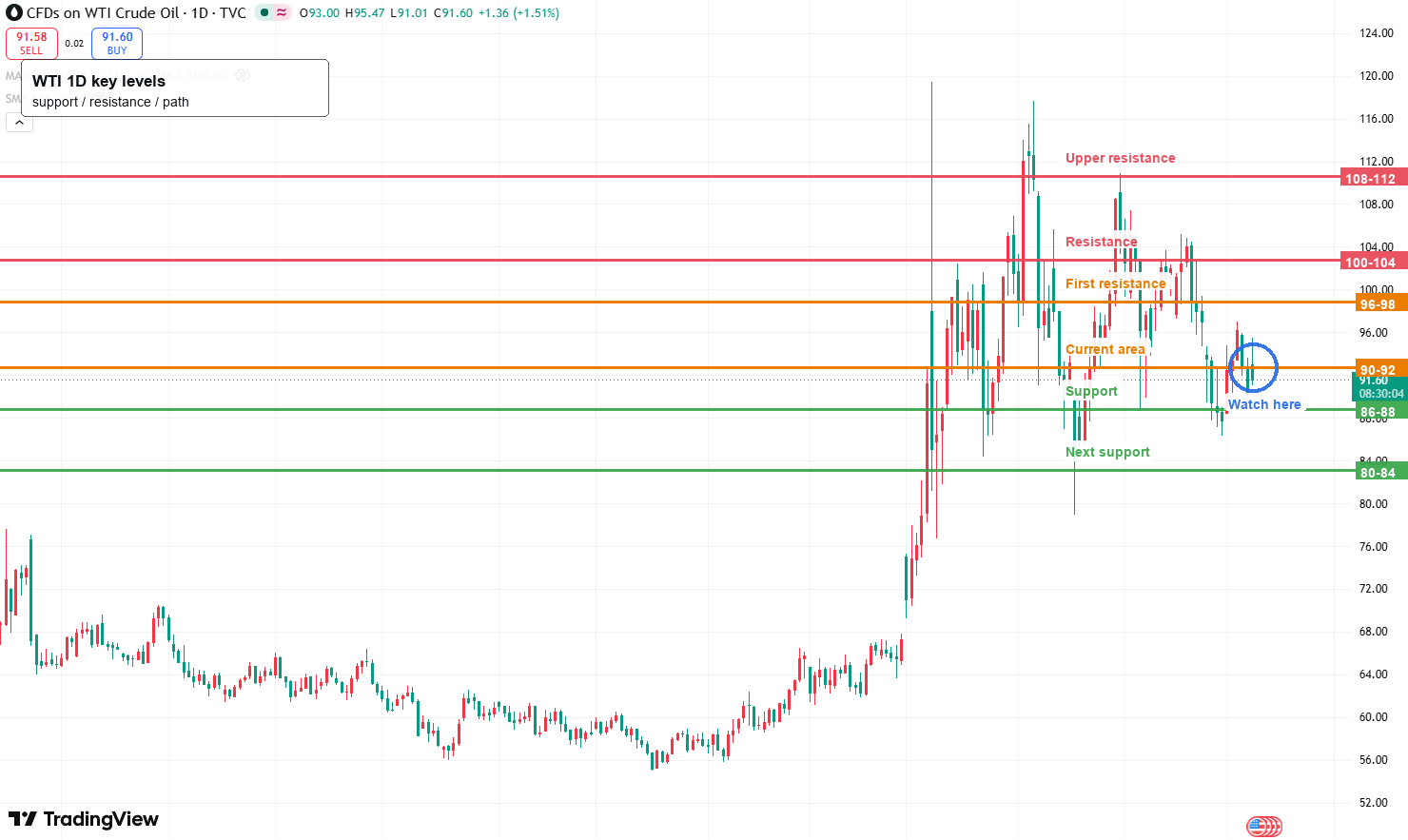
WTI Daily Price Chart, Source: TradingView
WTI crude oil is currently trading within a wide high-level range on the daily chart, primarily oscillating between 88 and 104. The current price is near 91.50, acting as a short-term turning point in the lower half of the range.
To the upside, focus first on short-term resistance at 97. If the price effectively breaks and holds above this level, it will have the opportunity to test the previous high-volume resistance zone at 100-104; stronger resistance levels further up are at 108-112. On the downside, the 86-88 support zone is key; if this area is breached, the price may further decline to test 80-84. Overall, there is currently no one-sided trend, and the market appears to be seeking direction within a consolidation range.
Recommended Articles


