


BoC expected to raise interest rates to 2.50%
- The Bank of Canada is expected to raise interest rates by 25 basis points to 2.50% on Wednesday.
- Canadian employment fell sharply in September, complicating the case for tighter monetary policy.
- Investors will scrutinize the central bank's guidance for clues about further rate increases.
The Bank of Canada (BoC) is expected to raise its benchmark interest rate by 25 basis points to 2.50% on Wednesday, as persistent inflation concerns put pressure on policymakers to tighten monetary policy despite growing signs of economic weakness.
According to a Reuters poll, 19 of 34 economists anticipate a rate hike, which would mark the central bank's first increase since July 2023. However, the decision remains uncertain as recent economic data highlight the challenges facing the Canadian economy.
Canada's Consumer Price Index (CPI) rose 3.1% YoY in September, compared with 3% in August, mainly driven by higher energy prices. Underlying inflation measures, however, eased, suggesting that broader price pressures remain relatively contained. BoC Governor Tiff Macklem has warned that prolonged increases in Oil prices could eventually spread to other goods and services.
Meanwhile, the Canadian labor market deteriorated sharply in September. Employment declined by 68.3K jobs, far below expectations of a 7K increase, following a loss of 41.7K jobs in August. The Unemployment Rate rose to 6.5% from 6.4%, reinforcing concerns about weakening domestic demand.
These conflicting signals have divided economists. BBH and Scotiabank expect a quarter-point rate hike, while TD Securities anticipates that the BoC will wait until December. Standard Chartered also favors keeping rates unchanged, citing subdued underlying inflation and economic weakness.
Beyond Wednesday's decision, investors will closely examine the BoC's updated economic projections and Governor Macklem's comments to assess whether policymakers are preparing for additional tightening or a more cautious approach.
When will the BoC release its monetary policy decision, and how could it affect USD/CAD?
The BoC will announce its monetary policy decision on Wednesday at 13:45 GMT, alongside its updated Monetary Policy Report. Governor Tiff Macklem's subsequent press conference at 14:30 GMT will offer further insights into the central bank's policy outlook.
A 25-basis-point rate hike accompanied by hawkish guidance could support the Canadian Dollar (CAD) and weigh on USD/CAD. Conversely, a hold rates decision or cautious guidance highlighting labor market weakness could undermine the Canadian Dollar and push USD/CAD higher.
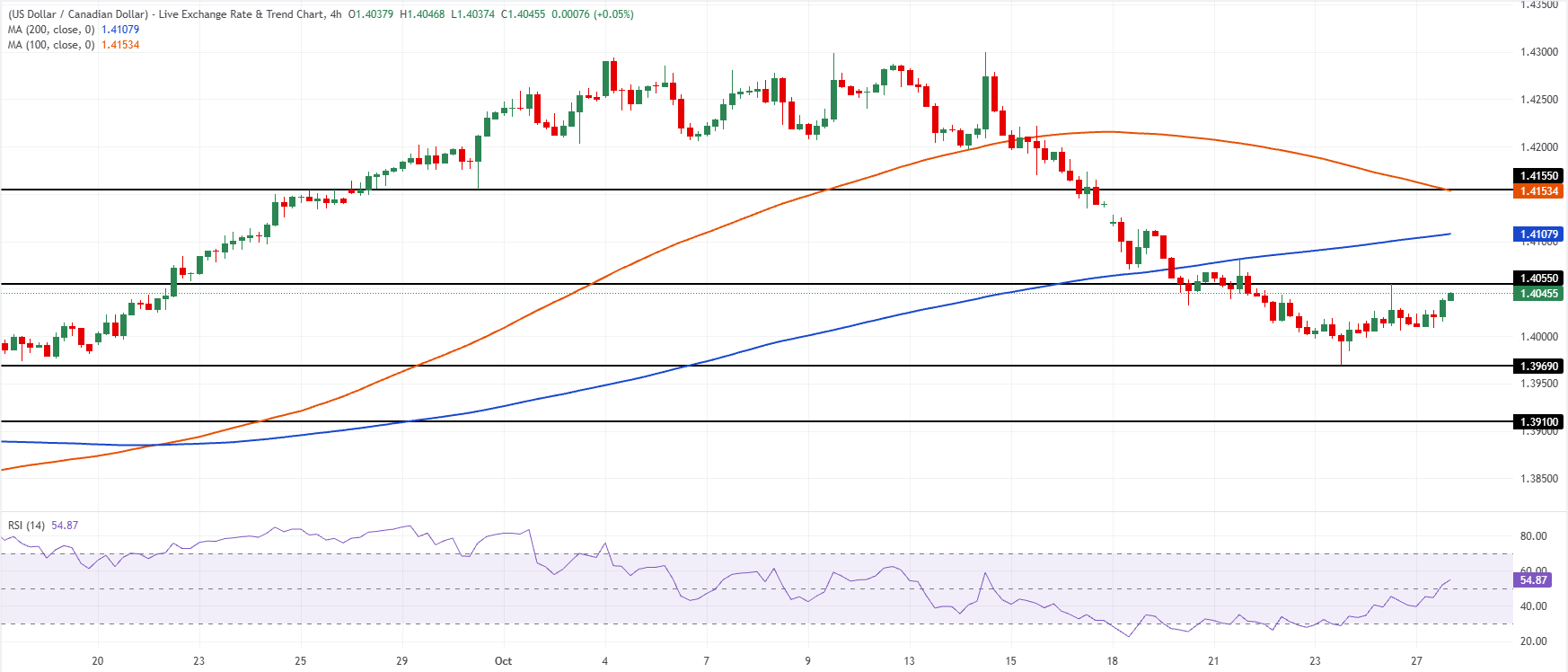
In the four-hour chart, USD/CAD keeps a capped near-term tone as it holds just under the horizontal barrier at 1.4055 while remaining below the 200-period simple moving average (SMA) at 1.4108 and the 100-period SMA at 1.4153. The Relative Strength Index (14) at 54.9 has recovered into mildly positive territory, suggesting improving momentum, but price action is still constrained by these overhead averages, limiting upside follow-through for now.
On the topside, initial resistance is located at 1.4055, ahead of the 200-period SMA at 1.4108, with the 100-period SMA at 1.4153 and the nearby horizontal level at 1.4155 forming a broader supply zone higher up. On the downside, immediate support appears at 1.3969, with a deeper floor seen at 1.3910, and a break below this latter level would likely expose further bearish pressure in the short term.
(The technical analysis of this story was written with the help of an AI tool. Know more.)
Economic Indicator
BoC Interest Rate Decision
The Bank of Canada (BoC) announces its interest rate decision at the end of its eight scheduled meetings per year. If the BoC believes inflation will be above target (hawkish), it will raise interest rates in order to bring it down. This is bullish for the CAD since higher interest rates attract greater inflows of foreign capital. Likewise, if the BoC sees inflation falling below target (dovish) it will lower interest rates in order to give the Canadian economy a boost in the hope inflation will rise back up. This is bearish for CAD since it detracts from foreign capital flowing into the country.
Read more.Next release: Wed Oct 28, 2026 13:45
Frequency: Irregular
Consensus: 2.5%
Previous: 2.25%
Source: Bank of Canada
Bank of Canada FAQs
The Bank of Canada (BoC), based in Ottawa, is the institution that sets interest rates and manages monetary policy for Canada. It does so at eight scheduled meetings a year and ad hoc emergency meetings that are held as required. The BoC primary mandate is to maintain price stability, which means keeping inflation at between 1-3%. Its main tool for achieving this is by raising or lowering interest rates. Relatively high interest rates will usually result in a stronger Canadian Dollar (CAD) and vice versa. Other tools used include quantitative easing and tightening.
In extreme situations, the Bank of Canada can enact a policy tool called Quantitative Easing. QE is the process by which the BoC prints Canadian Dollars for the purpose of buying assets – usually government or corporate bonds – from financial institutions. QE usually results in a weaker CAD. QE is a last resort when simply lowering interest rates is unlikely to achieve the objective of price stability. The Bank of Canada used the measure during the Great Financial Crisis of 2009-11 when credit froze after banks lost faith in each other’s ability to repay debts.
Quantitative tightening (QT) is the reverse of QE. It is undertaken after QE when an economic recovery is underway and inflation starts rising. Whilst in QE the Bank of Canada purchases government and corporate bonds from financial institutions to provide them with liquidity, in QT the BoC stops buying more assets, and stops reinvesting the principal maturing on the bonds it already holds. It is usually positive (or bullish) for the Canadian Dollar.
Artigos Recomendados


