


Kevin Warsh offers no policy clues: Why markets still got their answer
Financial markets came to Sintra looking for clues about the Federal Reserve's (Fed) next move. They largely left with confirmation that Fed Chair Kevin Warsh intends to make those clues much harder to find.
Making his first public appearance outside the United States (US) since becoming Fed Chair, Warsh largely resisted giving markets what they wanted. Instead of offering hints on the timing of future interest rate decisions, he doubled down on the communication strategy unveiled at his first Federal Open Market Committee (FOMC) meeting in June: no forward guidance, a stronger focus on price stability and a broader review of how the Fed conducts monetary policy.
That message may have lacked immediate policy signals, but it reinforced the framework investors will have to navigate going forward.
No forward guidance means no forward guidance
Ahead of the European Central Bank (ECB) Forum in Sintra, investors wondered whether Warsh would soften his communication style during his first appearance alongside fellow central bankers ECB President Christine Lagarde, Bank of England (BoE) Governor Andrew Bailey and Bank of Canada (BoC) Governor Tiff Macklem.
Instead, he did the opposite. Warsh once again refused to discuss the future path of interest rates and openly defended the Fed's decision to abandon forward guidance. Echoing comments made after the June FOMC meeting, he argued that the central bank should not steer markets toward predetermined policy outcomes.
For investors hoping Sintra would offer fresh guidance ahead of the July FOMC meeting, the message was straightforward: the Fed will continue to let incoming data, rather than central bank communication, shape market expectations.
Inflation remains the Fed's priority
Although Warsh avoided discussing future rate decisions, he left little doubt about the Fed's inflation objective. "We're in the price stability business," he said, while stressing that US prices remain "too high."
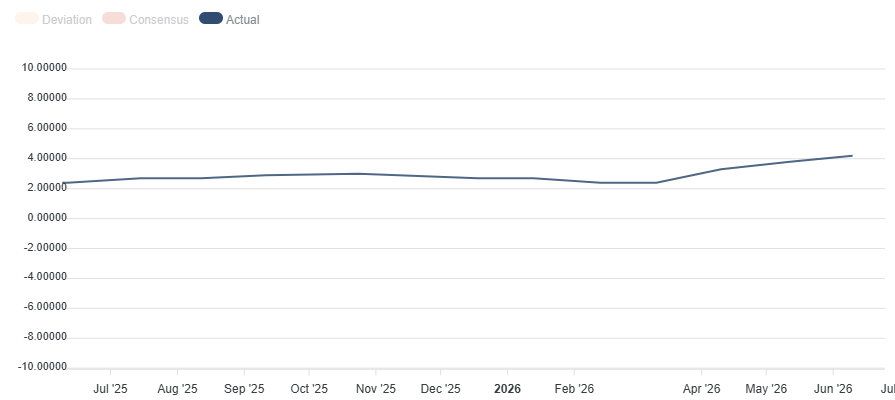
Warsh acknowledged that inflation expectations and inflation risks have moderated over recent weeks, but made clear that this does not change the central bank's objective. "If anyone thought we would be happy with inflation above 2%, they will be disappointed," added the Fed Chair.
The remarks largely reinforced the hawkish tone established during his first FOMC press conference. While acknowledging some improvement in inflation dynamics, Warsh offered no indication that the Federal Reserve is becoming more comfortable with inflation remaining above target.
Instead, he reiterated that restoring price stability remains the central bank's overriding objective.
AI moves closer to the center of the policy debate
One area where investors did receive additional insight was artificial intelligence. Warsh argued that the United States is likely to emerge as one of the biggest beneficiaries of the AI revolution, describing the current stage as only "the first or second inning." At the same time, he stressed that it is the central bank's responsibility to determine whether AI ultimately proves inflationary.
Those comments fit neatly with the task forces announced after the June meeting, including the group dedicated to studying productivity and employment. Rather than treating AI as a purely technological story, Warsh appears increasingly willing to integrate it into the Fed's longer-term assessment of growth, productivity and inflation.
While those issues are unlikely to affect policy in the near term, they may eventually influence estimates of potential growth and the neutral interest rate.
Structural reform remains part of Warsh's agenda
Beyond monetary policy, Warsh also reaffirmed that institutional reform remains a priority. He said the Fed would "chart a new course" to improve policymaking and announced that the leaders of the newly created policy task forces could be unveiled as early as next week.
On the balance sheet, however, Warsh suggested continuity rather than change. He said his views had not changed during his first month as Chair and emphasized that any future adjustment would be carefully considered and clearly communicated. He also reiterated that balance sheet policy should remain secondary to interest rates, arguing that the balance sheet "borders on fiscal policy" and that interest rates should continue to serve as the Fed's primary policy instrument.
Markets receive confirmation rather than surprises
Before Sintra, investors viewed Warsh's first international appearance as a potential opportunity to better understand the new Fed Chair's reaction function. Instead, they received confirmation of what had already emerged in June.
Warsh remains committed to limiting forward guidance. He continues to prioritize price stability above all else. He sees the labor market as stable, the supply side as resilient and the United States as well positioned to benefit from the AI revolution. At the same time, he insisted that the Fed's independence remains unchanged despite continued political pressure.
The speech did not materially alter the broader policy outlook. FXStreet's Fed Sentiment Index remained virtually unchanged following his remarks, while the FXS SpeechTracker assigned the speech a moderately hawkish score of 5.6 out of 10, reflecting continuity rather than a meaningful shift in the Fed's policy stance.
Ironically, that may have been the biggest takeaway from Sintra. Markets listened closely because they expected every word to matter. In the end, Warsh's most important message was that the Federal Reserve's new communication strategy is exactly what he promised: fewer signals, greater uncertainty around future policy decisions and an even stronger emphasis on letting economic data, rather than central bank guidance, drive market expectations.
Fed FAQs
Monetary policy in the US is shaped by the Federal Reserve (Fed). The Fed has two mandates: to achieve price stability and foster full employment. Its primary tool to achieve these goals is by adjusting interest rates. When prices are rising too quickly and inflation is above the Fed’s 2% target, it raises interest rates, increasing borrowing costs throughout the economy. This results in a stronger US Dollar (USD) as it makes the US a more attractive place for international investors to park their money. When inflation falls below 2% or the Unemployment Rate is too high, the Fed may lower interest rates to encourage borrowing, which weighs on the Greenback.
The Federal Reserve (Fed) holds eight policy meetings a year, where the Federal Open Market Committee (FOMC) assesses economic conditions and makes monetary policy decisions. The FOMC is attended by twelve Fed officials – the seven members of the Board of Governors, the president of the Federal Reserve Bank of New York, and four of the remaining eleven regional Reserve Bank presidents, who serve one-year terms on a rotating basis.
In extreme situations, the Federal Reserve may resort to a policy named Quantitative Easing (QE). QE is the process by which the Fed substantially increases the flow of credit in a stuck financial system. It is a non-standard policy measure used during crises or when inflation is extremely low. It was the Fed’s weapon of choice during the Great Financial Crisis in 2008. It involves the Fed printing more Dollars and using them to buy high grade bonds from financial institutions. QE usually weakens the US Dollar.
Quantitative tightening (QT) is the reverse process of QE, whereby the Federal Reserve stops buying bonds from financial institutions and does not reinvest the principal from the bonds it holds maturing, to purchase new bonds. It is usually positive for the value of the US Dollar.
Artigos Recomendados


