


EUR/USD rebounds as Trump delays Iran strike, Waller backs July rate cut
- EUR/USD up 0.36%, set to end week flat after Trump delays military action against Iran.
- Waller’s call for a July cut contrasts with Fed report and Barkin’s cautious stance.
- EU–US trade deal in jeopardy as July 9 deadline nears, capping upside potential.
The Euro recovers some ground against the US Dollar on Friday and is set to finish the week virtually flat as risk appetite deteriorates. This is taking place despite US President Donald Trump delaying a military intervention in the Israel–Iran conflict. At the time of writing, the EUR/USD trades at 1.1534, up 0.36%.
Market appetite has turned negative due to US trade policies restricting chipmakers with production interests in China as a top US official seeking to revoke waivers sent major US indices tumbling. In the meantime, Trump’s decision to support diplomacy over fighting, delaying a possible attack for two weeks, underpinned the shared currency. Nevertheless, Iran said it would not negotiate while Israel continued hostilities.
Another event that boosted the Euro was Federal Reserve (Fed) Governor Christopher Waller announcing that he supports a rate cut in July. Contrarily, the Fed monetary policy report suggested that current policy is well-positioned amid uncertainty of external shocks, while Richmond Fed President Thomas Barkin favored further patience before reducing rates.
Despite this, the EUR/USD could be pressured due to the failure to reach a trade agreement between the European Union (EU) and the United States. The chances of a deal are diminishing as the clock ticks to the July 9 deadline.
On the data front, the EU revealed that the EU Consumer Confidence index disappointed investors, though traders shrugged off the bad reading and drove the EUR/USD higher.
Daily digest market movers: EUR/USD shrugs off Fed hawkishness and rallies
- Geopolitics will continue to drive price action, which so far has benefited further US Dollar appreciation. Hence, a risk-off environment is most likely to push the EUR/USD downward, even though the “Sell America” trade remains intact.
- Fresh data from the United States signaled a cooling economy, with the Philadelphia Fed Manufacturing Index holding at -4 in June, unchanged from May but falling short of expectations for a more minor contraction of -1.
- Fed Chair Jerome Powell said the bank is in wait-and-see mode, adding that policy is modestly restrictive. He added that as long as the labor market remains solid and inflation cools down, holding rates is the “right thing to do.”
- During the week, the Fed held rates unchanged at 4.25%-4.50%. Fed officials updated their economic projections, downgrading the 2025 GDP growth outlook to 1.4% from 1.7% in March. The Unemployment Rate forecast was revised up to 4.5% from 4.4%, while the core PCE inflation projection rose to 3.1% from 2.8%.
- EU Consumer Confidence in June fell to -15.3, worse than the expected -14.5 improvement.
- Financial market players do not expect that the ECB will reduce its Deposit Facility Rate by 25 basis points (bps) at the July monetary policy meeting.
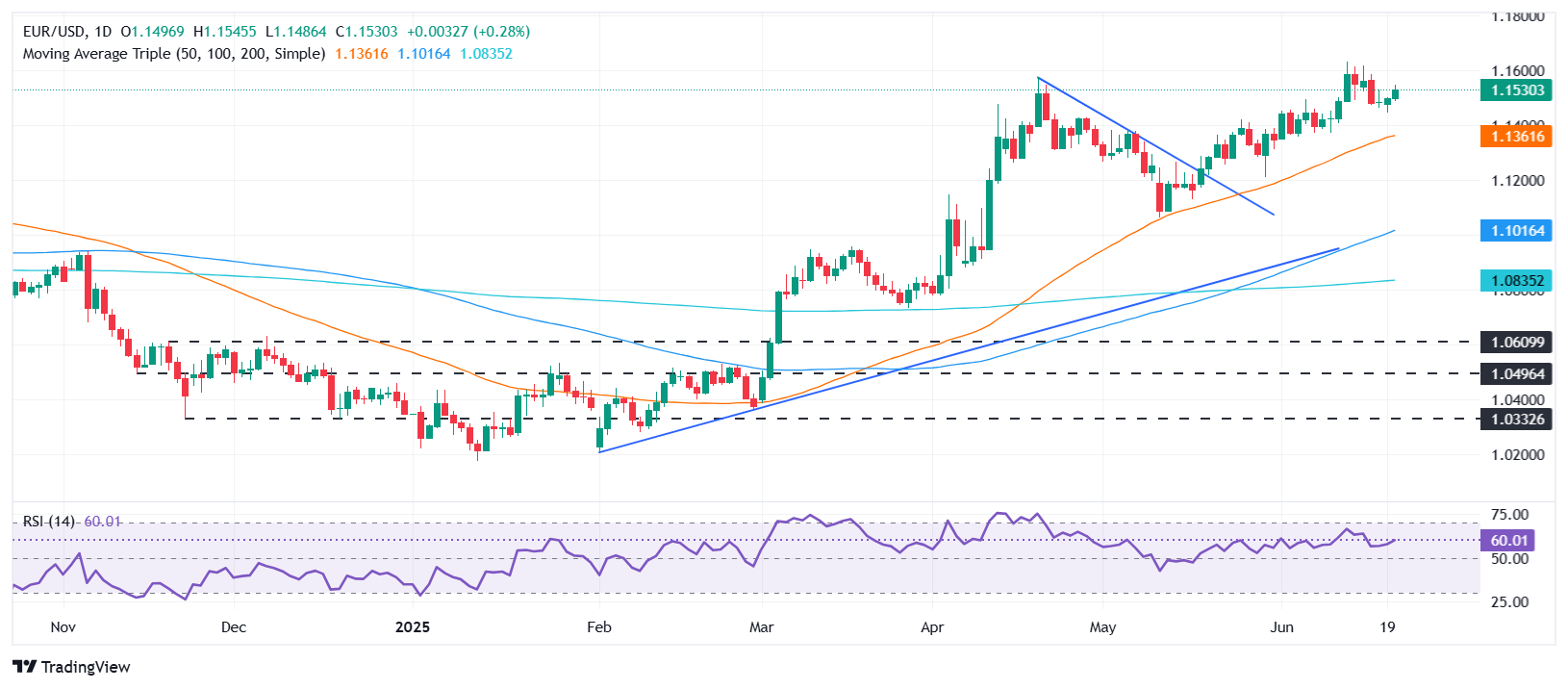
Euro technical outlook: EUR/USD climbs above 1.1500, bulls target 1.1550
From a technical standpoint, the EUR/USD uptrend is resuming. Price action suggests that a “morning star” three-candle chart pattern implies that buyers are accumulating, poised to drive the exchange rate higher. Further confirmation is provided by the Relative Strength Index (RSI), which is aiming upwards after stalling for two days.
Hence, the EUR/USD first resistance would be 1.1550. A breach of the latter will expose 1.1600, followed by the YTD high of 1.1631. Conversely, a daily close below 1.1500 paves the way to test 1.1450. The next key support would be the 20-day Simple Moving Average (SMA) at 1.1438, followed by 1.1400.
Euro FAQs
The Euro is the currency for the 19 European Union countries that belong to the Eurozone. It is the second most heavily traded currency in the world behind the US Dollar. In 2022, it accounted for 31% of all foreign exchange transactions, with an average daily turnover of over $2.2 trillion a day. EUR/USD is the most heavily traded currency pair in the world, accounting for an estimated 30% off all transactions, followed by EUR/JPY (4%), EUR/GBP (3%) and EUR/AUD (2%).
The European Central Bank (ECB) in Frankfurt, Germany, is the reserve bank for the Eurozone. The ECB sets interest rates and manages monetary policy. The ECB’s primary mandate is to maintain price stability, which means either controlling inflation or stimulating growth. Its primary tool is the raising or lowering of interest rates. Relatively high interest rates – or the expectation of higher rates – will usually benefit the Euro and vice versa. The ECB Governing Council makes monetary policy decisions at meetings held eight times a year. Decisions are made by heads of the Eurozone national banks and six permanent members, including the President of the ECB, Christine Lagarde.
Eurozone inflation data, measured by the Harmonized Index of Consumer Prices (HICP), is an important econometric for the Euro. If inflation rises more than expected, especially if above the ECB’s 2% target, it obliges the ECB to raise interest rates to bring it back under control. Relatively high interest rates compared to its counterparts will usually benefit the Euro, as it makes the region more attractive as a place for global investors to park their money.
Data releases gauge the health of the economy and can impact on the Euro. Indicators such as GDP, Manufacturing and Services PMIs, employment, and consumer sentiment surveys can all influence the direction of the single currency. A strong economy is good for the Euro. Not only does it attract more foreign investment but it may encourage the ECB to put up interest rates, which will directly strengthen the Euro. Otherwise, if economic data is weak, the Euro is likely to fall. Economic data for the four largest economies in the euro area (Germany, France, Italy and Spain) are especially significant, as they account for 75% of the Eurozone’s economy.
Another significant data release for the Euro is the Trade Balance. This indicator measures the difference between what a country earns from its exports and what it spends on imports over a given period. If a country produces highly sought after exports then its currency will gain in value purely from the extra demand created from foreign buyers seeking to purchase these goods. Therefore, a positive net Trade Balance strengthens a currency and vice versa for a negative balance.
Artigos Recomendados


