


Bitcoin Price Forecast: BTC slips below $84,500 amid rising liquidation pressure
- Bitcoin slipped below $84,500 on Wednesday, down more than 2.5% so far this week.
- Mixed flows in institutional demand signal caution among investors.
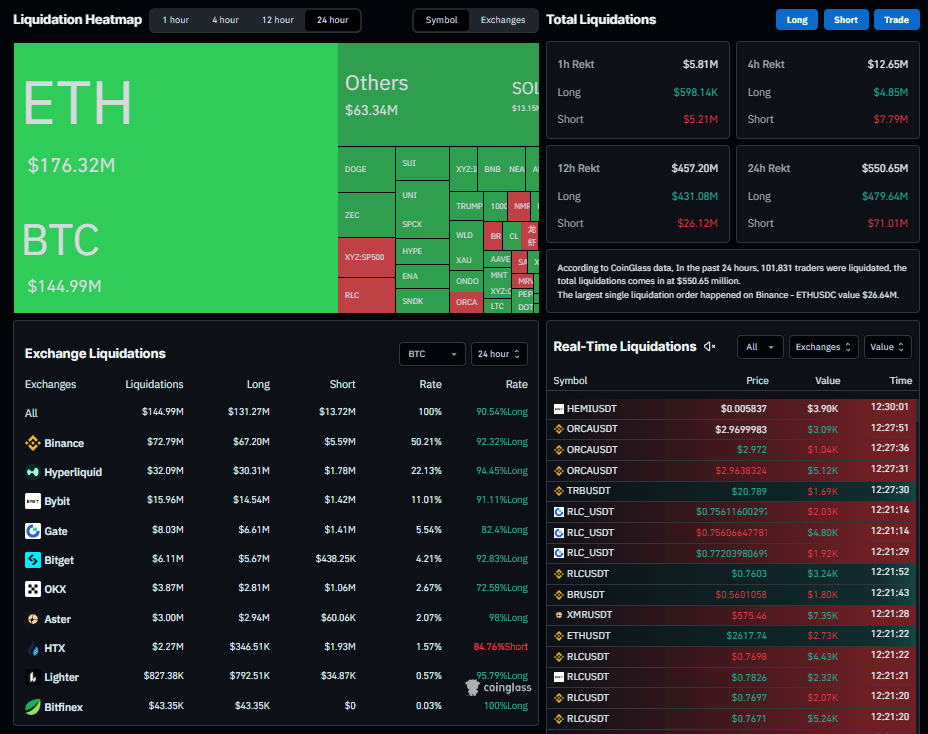
- CoinGlass data shows that 101,831 traders were liquidated over the past 24 hours, totaling $550.65 million, adding to selling pressure.
Bitcoin (BTC) slips below $84,500 at the time of writing on Wednesday, down over 2.5% so far this week. Mixed spot Bitcoin Exchange Traded Funds (ETFs) flows point to cautious institutional demand so far this week. Meanwhile, a wave of liquidations across the crypto market is adding to the downside risks, raising doubts about whether BTC’s bullish momentum can sustain.
Mixed institutional demand
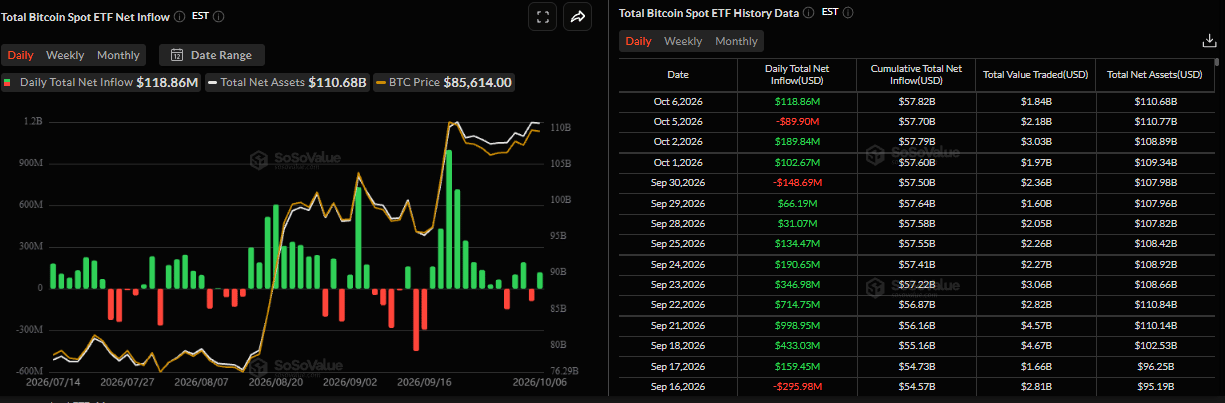
Institutional demand shows mixed sentiment so far this week. SoSoValue data showed that after weeks of heavy inflows since mid-September, BTC ETFs recorded an inflow of $118.86 million on Tuesday after a mild outflow of $89.90 million the previous day. These mixed flows so far this week reflect cautious institutional positioning amid rising US Treasury yields and a stronger US Dollar (USD). Moreover, if the outflow trend resumes and intensifies, BTC could see further correction.
Rising liquidations threaten BTC’s recovery
The cryptocurrency market faced a sharp pullback mid-week, with BTC falling nearly -$2,000 in 20 minutes as $400 million in levered longs were liquidated in under one hour, according to The Kobeissi Letter X post.
CoinGlass Liquidation Map chart below shows that 101,831 traders were liquidated over the past 24 hours, totaling $550.65 million. Notably, 90.54% of BTC positions were long, indicating overly bullish positioning and leaving leveraged traders vulnerable to further downside.
As noted in the previous report, the broader decline in crypto prices may also be attributed to elevated profit-taking, which reached on Monday its highest level since November 23, 2025.
Bitcoin technical outlook: Bulls fail to close above recent highs
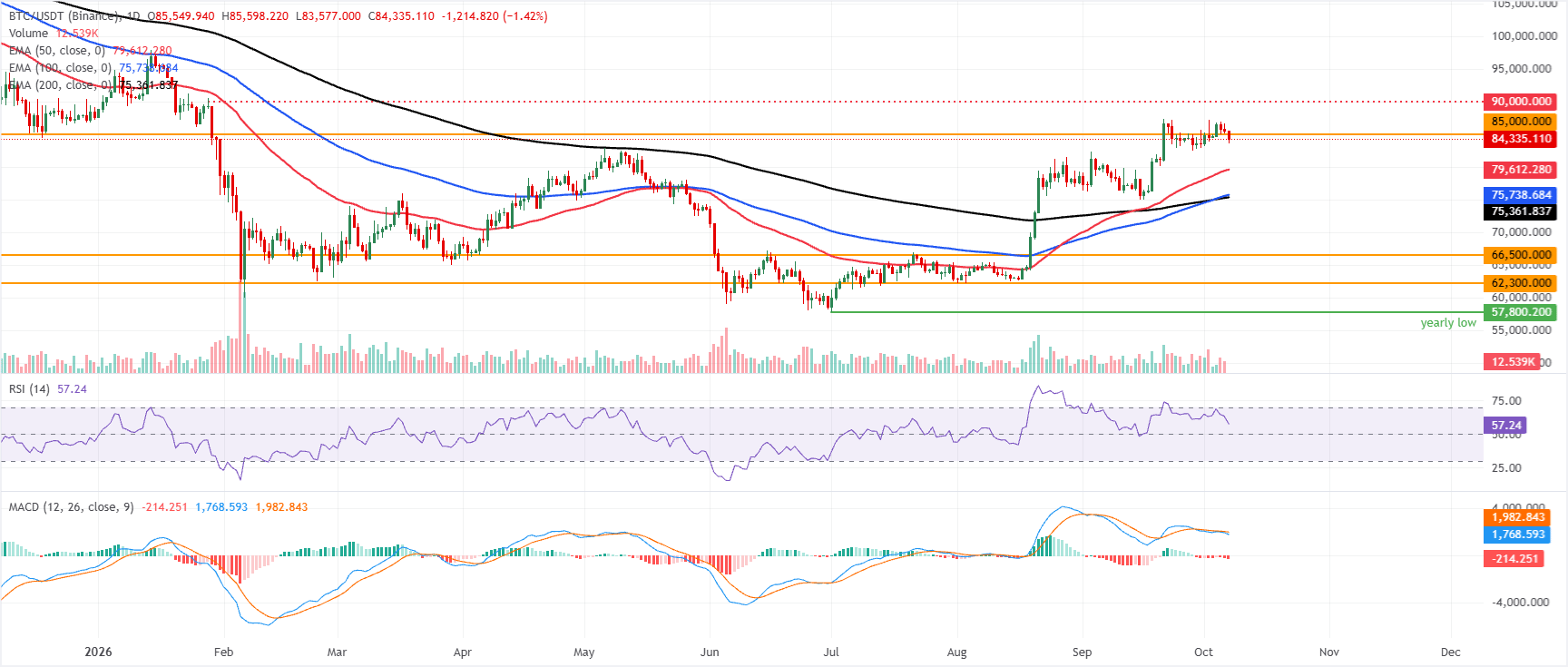
Bitcoin price trades at $84,335 on Wednesday, three consecutive days of correction so far this week. BTC failed to surpass the recent highs around $87,000 and slipped below the key $85,000 support.
Despite the pullback, BTC remains broadly bullish, holding well above the 50-day, 100-day, and 200-day Exponential Moving Averages (EMAs) clustered between roughly $79,600 and $75,300.
The Relative Strength Index (14) has cooled to 57, hinting at a normalization from prior overbought readings rather than outright weakness. At the same time, the Moving Average Convergence Divergence (MACD) has slipped back below zero, suggesting waning upside momentum as price consolidates just under the nearby ceiling.
On the topside, immediate resistance is located at the horizontal barrier at $85,000, where a clear daily close above would reopen the path toward the recent highs around $87,000.
On the downside, initial demand is seen at the 50-day EMA near $79,612, followed by the 100-day EMA at $75,738 and the 200-day EMA at $75,361, which together define a broad structural support band; deeper pullbacks would expose the previous horizontal floors at $66,500 and $62,300.
(The technical analysis of this story was written with the help of an AI tool. Know more.)
Bitcoin, altcoins, stablecoins FAQs
Bitcoin is the largest cryptocurrency by market capitalization, a virtual currency designed to serve as money. This form of payment cannot be controlled by any one person, group, or entity, which eliminates the need for third-party participation during financial transactions.
Altcoins are any cryptocurrency apart from Bitcoin, but some also regard Ethereum as a non-altcoin because it is from these two cryptocurrencies that forking happens. If this is true, then Litecoin is the first altcoin, forked from the Bitcoin protocol and, therefore, an “improved” version of it.
Stablecoins are cryptocurrencies designed to have a stable price, with their value backed by a reserve of the asset it represents. To achieve this, the value of any one stablecoin is pegged to a commodity or financial instrument, such as the US Dollar (USD), with its supply regulated by an algorithm or demand. The main goal of stablecoins is to provide an on/off-ramp for investors willing to trade and invest in cryptocurrencies. Stablecoins also allow investors to store value since cryptocurrencies, in general, are subject to volatility.
Bitcoin dominance is the ratio of Bitcoin's market capitalization to the total market capitalization of all cryptocurrencies combined. It provides a clear picture of Bitcoin’s interest among investors. A high BTC dominance typically happens before and during a bull run, in which investors resort to investing in relatively stable and high market capitalization cryptocurrency like Bitcoin. A drop in BTC dominance usually means that investors are moving their capital and/or profits to altcoins in a quest for higher returns, which usually triggers an explosion of altcoin rallies.
Artigos Recomendados


