


Gold rebounds above $4,130 as Oil retreats, Fed decision looms
- Gold gains 0.15% to $4,132 after bouncing from $4,106.
- Oil prices retreat as the US authorizes the offloading of blocked cargoes.
- October Fed hike odds remain at 14%, compared with 89% for December.
Gold price (XAU/USD) registers modest gains on Wednesday as Oil prices edge lower after the US authorized the offloading of cargo from some blocked vessels, triggering a downside reaction in Oil markets. At the time of writing, XAU/USD trades at $4,133, up 0.25%, after bouncing off daily lows of $4,106.
XAU/USD recovers as falling Oil prices and steady Treasury yields support bullion
Bullion’s advance remains contained by an improvement in market mood, despite ongoing developments in the US-Iran war. Newswires reported that the Pakistani Army chief Asim Munir met with Iranian officials in Tehran, where he presented a “compromise proposal,” while N12 news reported that Munir delivered the US “final warning” to Tehran, meaning that if Iran does not agree to a peace deal, attacks could resume.
Al Hadath reported that Iran's Secretary of the Supreme National Security Council, Mohsen Rezaei, informed Munir of Iran's explicit rejection of the American demands.
Meanwhile, good news emerged about the Russia-Ukraine war, as the Kremlin agreed that a new round of trilateral talks among the United States, Russia, and Ukraine may take place in Abu Dhabi.
In the US, the economic docket remained scarce, but market participants are getting a nod from US equities, which continued to extend their gains amid a surge in technology stocks driven by AI hype.
Steady US Treasury yields are supporting Gold's advance. The US 10-year benchmark note is yielding 5.111%, flat, while the Greenback registers minimal losses.
The US Dollar Index (DXY), which measures the buck’s performance against a basket of six currencies, is down 0.05% at 101.67.
Gold’s advance also lies on what the Federal Reserve (Fed) might do in the foreseeable future. Markets are pricing in a 14% chance of a 25-basis-point hike in October, but the odds for December remain high at near 89%, according to Prime Terminal.
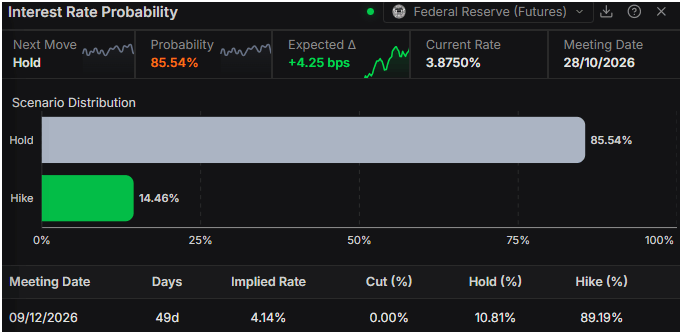
Traders' eyes are shifting to next week's Fed meeting, along with the release of the US central bank's favorite inflation gauge, the Core Personal Consumption Expenditures (PCE) Price Index.
This week, traders are eyeing the release of US Initial Jobless Claims and the University of Michigan Consumer Sentiment for October.
XAU/USD technical analysis: Gold consolidates at around $4,100-$4,200
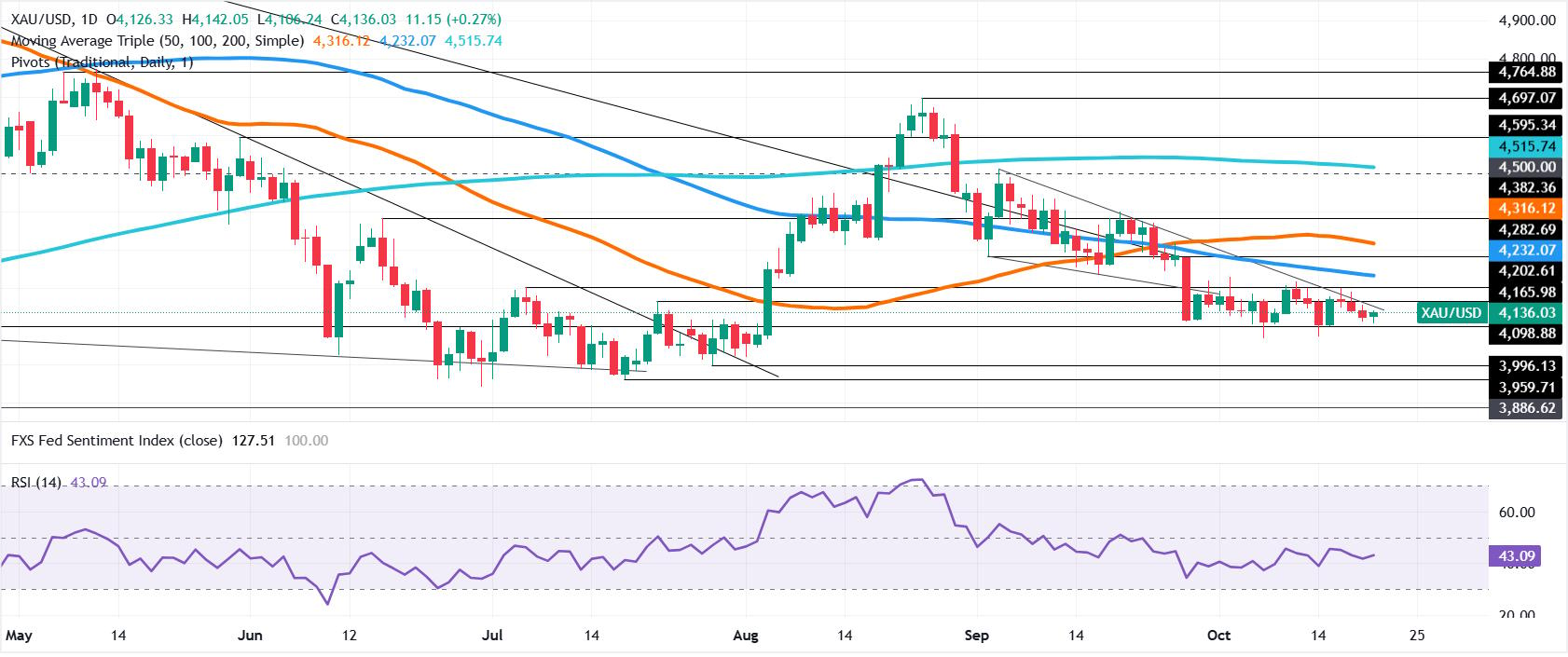
Gold price continues to trade sideways within the $4,100-$4,200 range for the sixteenth straight day. There is no clear bias, but the yellow metal has fallen nearly 26% from its record high near $5,600, indicating a mid-term downward trend.
Momentum, as measured by the Relative Strength Index (RSI), is bearish, but the index points modestly up, a mixed reading that suggests that further consolidation lies ahead.
Hence, XAU/USD’s path of least resistance is downwards. The first support is $4,100. A breach of the latter will expose the October 14 low of $4,073, followed immediately by the July 29 cycle low of $3,996. Below lies the July 17 low at $3,959 and the year-to-date (YTD) low at $3,941.
For a bullish reversal, XAU/USD faces resistance at $4,200, at the 100-day Simple Moving Average (SMA) at $4,235, at the 50-day SMA at $4,316 and at $4,500.
Gold FAQs
Gold has played a key role in human’s history as it has been widely used as a store of value and medium of exchange. Currently, apart from its shine and usage for jewelry, the precious metal is widely seen as a safe-haven asset, meaning that it is considered a good investment during turbulent times. Gold is also widely seen as a hedge against inflation and against depreciating currencies as it doesn’t rely on any specific issuer or government.
Central banks are the biggest Gold holders. In their aim to support their currencies in turbulent times, central banks tend to diversify their reserves and buy Gold to improve the perceived strength of the economy and the currency. High Gold reserves can be a source of trust for a country’s solvency. Central banks added 1,136 tonnes of Gold worth around $70 billion to their reserves in 2022, according to data from the World Gold Council. This is the highest yearly purchase since records began. Central banks from emerging economies such as China, India and Turkey are quickly increasing their Gold reserves.
Gold has an inverse correlation with the US Dollar and US Treasuries, which are both major reserve and safe-haven assets. When the Dollar depreciates, Gold tends to rise, enabling investors and central banks to diversify their assets in turbulent times. Gold is also inversely correlated with risk assets. A rally in the stock market tends to weaken Gold price, while sell-offs in riskier markets tend to favor the precious metal.
The price can move due to a wide range of factors. Geopolitical instability or fears of a deep recession can quickly make Gold price escalate due to its safe-haven status. As a yield-less asset, Gold tends to rise with lower interest rates, while higher cost of money usually weighs down on the yellow metal. Still, most moves depend on how the US Dollar (USD) behaves as the asset is priced in dollars (XAU/USD). A strong Dollar tends to keep the price of Gold controlled, whereas a weaker Dollar is likely to push Gold prices up.
Artigos Recomendados


