


Mexican Peso gains as Banxico surprises with rate cut amid rising inflation
- Mexican Peso’s demand increases despite Banxico’s surprising decision.
- Banxico lowers rates by 25 bps in a 3-2 split decision.
- Central bank signals further easing ahead despite inflation risks and growth concerns.
- Core inflation continues to decline, projected to dip below 4% by Q4 2024.
The Mexican Peso advanced for the third straight day following a surprising monetary policy decision by the Bank of Mexico (Banxico). The bank decided to lower borrowing costs despite earlier revelations that inflation had topped 5.50%. The USD/MXN, instead of rallying sharply, retreated and traded at 18.79, down 0.38%.
On Thursday, Banxico decided to lower borrowing costs in a 3-2 split decision among the Governing Council. Governor Victoria Rodriguez Ceja and Deputy Governors Galia Borja and Omar Mejia favored a 25-basis-point (bps) rate cut, while Irene Espinosa and Jonathan Heath voted for keeping rates unchanged.
The statement barely changed compared to the previous two meetings, yet they reiterated, “Looking ahead, the Board foresees that [the] inflationary environment may allow for discussing reference rate adjustments,” meaning that further easing lies ahead.
The central bank acknowledged that inflationary risks remain tilted to the upside, while growth is biased to the downside.
Banxico’s board updated its inflation forecasts, indicating that headline inflation is expected to rise in the short term but remain unchanged in the longer term. Core inflation is projected to edge lower and dip below 4% in the fourth quarter of 2024.
In its monetary policy statement, Banxico officials commented that despite July’s inflation rising to 5.57%, core figures “which better reflects the inflation trend, accumulated eighteen consecutive months of reductions, registering 4.05%.”
Across the board, the US economic docket is scarce. Yet Boston Fed President Susan Collins expressed that it’s appropriate to begin easing soon if the data comes as expected. Collins considers the timing of data as crucial to making Fed policy decisions.
Daily digest market movers: Mexican Peso rises as traders shrugged off Banxico's cut
- Banxico’s board revealed that the Consumer Price Index (CPI) is expected to rise to 5.2% in Q3 and to edge lower to 4.4% in Q4, both readings for the remainder of 2024. They expect it will reach the 3% plus or minus 1% goal by Q4 2025.
- Core CPI is projected to hit 3.9% in Q4 2024 and reach 3% by the end of next year.
- Mexico’s inflation rate rose by 1.05% MoM, exceeding estimates of 1.02% and significantly higher than June’s 0.38%. Over the 12 months to July, inflation increased from 4.98% to 5.57%, in line with expectations.
- Core prices ticked up from 0.22% to 0.32% MoM, surpassing economists' projections of 0.29%. On an annual basis, however, inflation missed the 4.02% consensus but dipped slightly to 4.05%, showing improvement compared to June's 4.13%.
- Mexico’s Industrial Production dipped from 0.7% to 0.4% MoM but exceeded estimates of 0.3%. On an annual basis, it plunged more than the -0.1% YoY projected and came at -0.7%, further confirming that the economy is stagnating.
- The CME FedWatch Tool shows the odds of a 50-basis-point interest rate cut by the Fed at the September meeting at 52.5%, down from 57.5% a day ago.
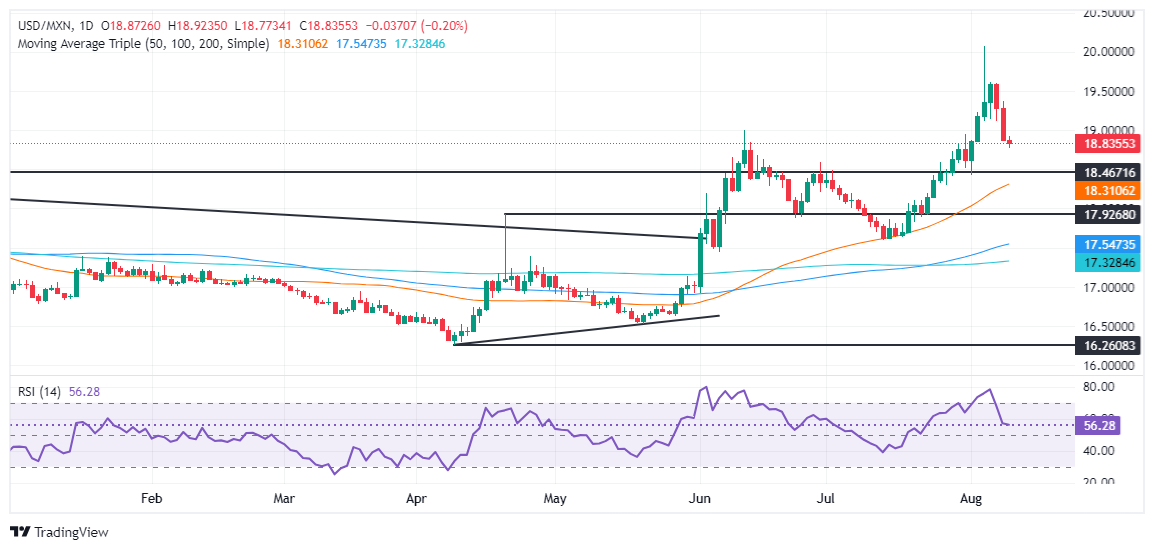
Technical analysis: Mexican Peso appreciates further as USD/MXN drops further below 19.00
The USD/MXN extended its losses to a six-day low of 18.76, yet the pair remains upwardly biased. Although momentum supports the Peso’s recovery, surpassing the next support at 18.59, the June 28 peak would be difficult as it lies above the psychological 18.50 mark.
On the other hand, if buyers cap the USD/MXN downside and lift the exchange rate above 19.00, this will pave the way for a recovery. The exotic pair’s next resistance would be 19.50, followed by the key 20.00 mark. A decisive break will expose the YTD high at 20.22, followed by the 20.50 mark.
Mexican Peso FAQs
The Mexican Peso (MXN) is the most traded currency among its Latin American peers. Its value is broadly determined by the performance of the Mexican economy, the country’s central bank’s policy, the amount of foreign investment in the country and even the levels of remittances sent by Mexicans who live abroad, particularly in the United States. Geopolitical trends can also move MXN: for example, the process of nearshoring – or the decision by some firms to relocate manufacturing capacity and supply chains closer to their home countries – is also seen as a catalyst for the Mexican currency as the country is considered a key manufacturing hub in the American continent. Another catalyst for MXN is Oil prices as Mexico is a key exporter of the commodity.
The main objective of Mexico’s central bank, also known as Banxico, is to maintain inflation at low and stable levels (at or close to its target of 3%, the midpoint in a tolerance band of between 2% and 4%). To this end, the bank sets an appropriate level of interest rates. When inflation is too high, Banxico will attempt to tame it by raising interest rates, making it more expensive for households and businesses to borrow money, thus cooling demand and the overall economy. Higher interest rates are generally positive for the Mexican Peso (MXN) as they lead to higher yields, making the country a more attractive place for investors. On the contrary, lower interest rates tend to weaken MXN.
Macroeconomic data releases are key to assess the state of the economy and can have an impact on the Mexican Peso (MXN) valuation. A strong Mexican economy, based on high economic growth, low unemployment and high confidence is good for MXN. Not only does it attract more foreign investment but it may encourage the Bank of Mexico (Banxico) to increase interest rates, particularly if this strength comes together with elevated inflation. However, if economic data is weak, MXN is likely to depreciate.
As an emerging-market currency, the Mexican Peso (MXN) tends to strive during risk-on periods, or when investors perceive that broader market risks are low and thus are eager to engage with investments that carry a higher risk. Conversely, MXN tends to weaken at times of market turbulence or economic uncertainty as investors tend to sell higher-risk assets and flee to the more-stable safe havens.
Artigos Recomendados


