


New Zealand consumer confidence tops 100 as the Kiwi's slide pauses
- NZD/USD slips inside Wednesday's range after a ten-session losing run ended.
- The RBNZ rate is 2.75% and the Fed's is 3.75%-4.00%, a gap of over a point.
- US markets trade a half-day Friday, and the Fed's quiet period starts Saturday.
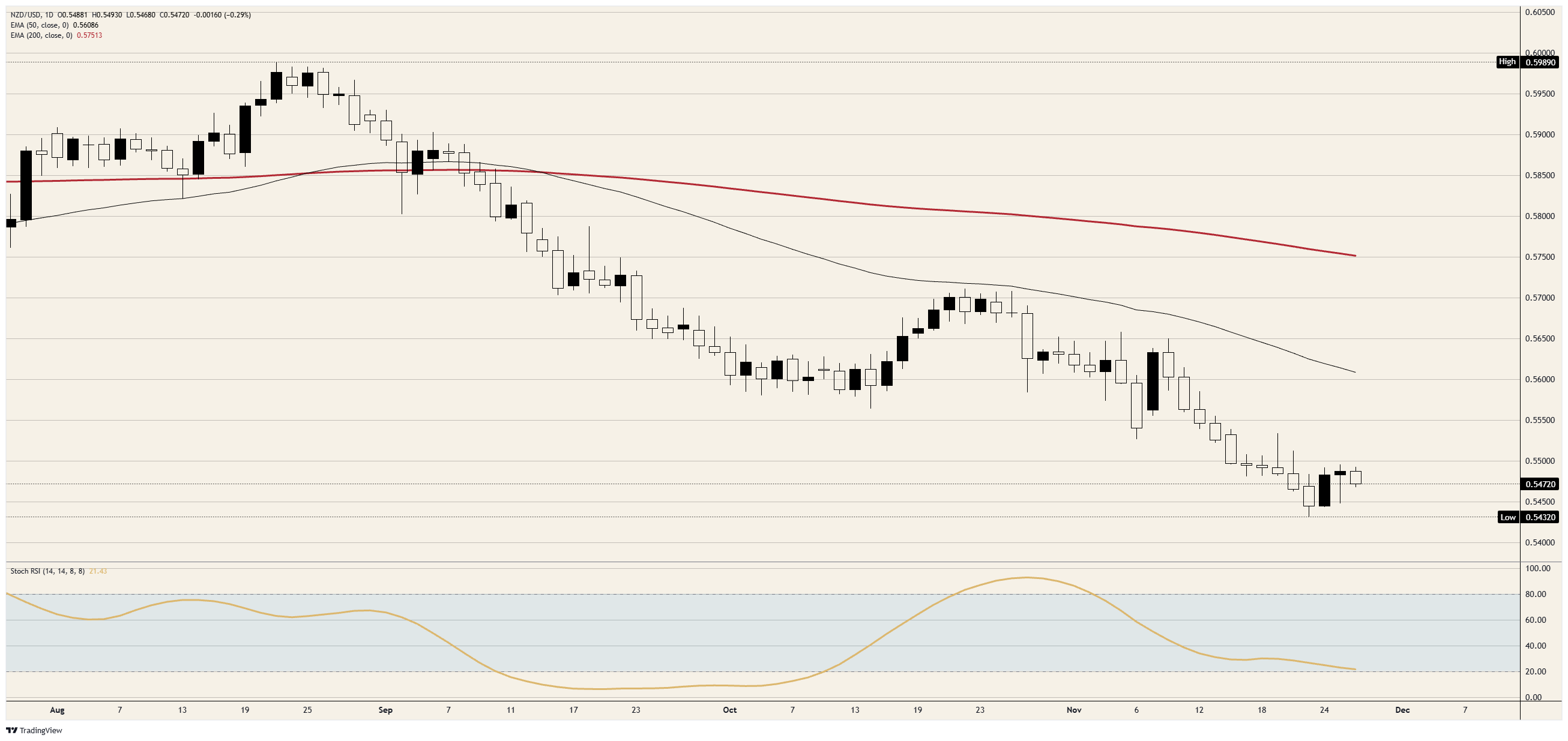
New Zealand consumers turned more confident in November and the Kiwi is lower anyway, because the number it trades on is the gap between US and New Zealand interest rates. NZD/USD is trading between 0.5450 and 0.5500, inside Wednesday's range. A ten-session losing run ended on Monday at a low just under 0.5450, its lowest since at least August.
The Reserve Bank of New Zealand (RBNZ) held its rate at 2.75% on October 28 in a 4-3 vote, when traders had almost fully priced a rise to 3%. The Fed's rate is 3.75%-4.00% and is expected to rise on December 9, so the gap against the Kiwi is just over a point and likely to widen. RBNZ Governor Breman has said further increases are likely at coming meetings, and the slide ran for ten sessions regardless.
ANZ-Roy Morgan consumer confidence rose to 100.2 in November from 96.2, about 20 points above April's low. ANZ's October report listed the weak currency among the things weighing on households, and November's rise arrived in the same month as the ten-session slide. The survey doesn't change the RBNZ's rate, and the Kiwi is lower on the session.
On the calendar
New Zealand has nothing else scheduled before the weekend. The RBNZ's next decision comes at its December meeting, with a full set of forecasts and a new projected path for the rate, the New Zealand side of the gap.
US traders return on Friday for a half session with no data due. The Fed's blackout on public comment starts on Saturday, and traders see better than nine chances in ten of a quarter-point rise on December 9.
On the charts
The rebound that began on Tuesday has recovered under a fifth of the fall from the November 5 high, now just above 0.5650. NZD/USD trades beneath its 50-day Exponential Moving Average (EMA), just above 0.5600, and its 200-day, near 0.5750, and the decline began at the late-August high just under 0.6000. Daily momentum is near oversold.
NZD/USD daily chart
New Zealand Dollar FAQs
The New Zealand Dollar (NZD), also known as the Kiwi, is a well-known traded currency among investors. Its value is broadly determined by the health of the New Zealand economy and the country’s central bank policy. Still, there are some unique particularities that also can make NZD move. The performance of the Chinese economy tends to move the Kiwi because China is New Zealand’s biggest trading partner. Bad news for the Chinese economy likely means less New Zealand exports to the country, hitting the economy and thus its currency. Another factor moving NZD is dairy prices as the dairy industry is New Zealand’s main export. High dairy prices boost export income, contributing positively to the economy and thus to the NZD.
The Reserve Bank of New Zealand (RBNZ) aims to achieve and maintain an inflation rate between 1% and 3% over the medium term, with a focus to keep it near the 2% mid-point. To this end, the bank sets an appropriate level of interest rates. When inflation is too high, the RBNZ will increase interest rates to cool the economy, but the move will also make bond yields higher, increasing investors’ appeal to invest in the country and thus boosting NZD. On the contrary, lower interest rates tend to weaken NZD. The so-called rate differential, or how rates in New Zealand are or are expected to be compared to the ones set by the US Federal Reserve, can also play a key role in moving the NZD/USD pair.
Macroeconomic data releases in New Zealand are key to assess the state of the economy and can impact the New Zealand Dollar’s (NZD) valuation. A strong economy, based on high economic growth, low unemployment and high confidence is good for NZD. High economic growth attracts foreign investment and may encourage the Reserve Bank of New Zealand to increase interest rates, if this economic strength comes together with elevated inflation. Conversely, if economic data is weak, NZD is likely to depreciate.
The New Zealand Dollar (NZD) tends to strengthen during risk-on periods, or when investors perceive that broader market risks are low and are optimistic about growth. This tends to lead to a more favorable outlook for commodities and so-called ‘commodity currencies’ such as the Kiwi. Conversely, NZD tends to weaken at times of market turbulence or economic uncertainty as investors tend to sell higher-risk assets and flee to the more-stable safe havens.
Artigos Recomendados


